The Evolving Search Landscape: Why Traditional SEO Isn’t Enough for 2026
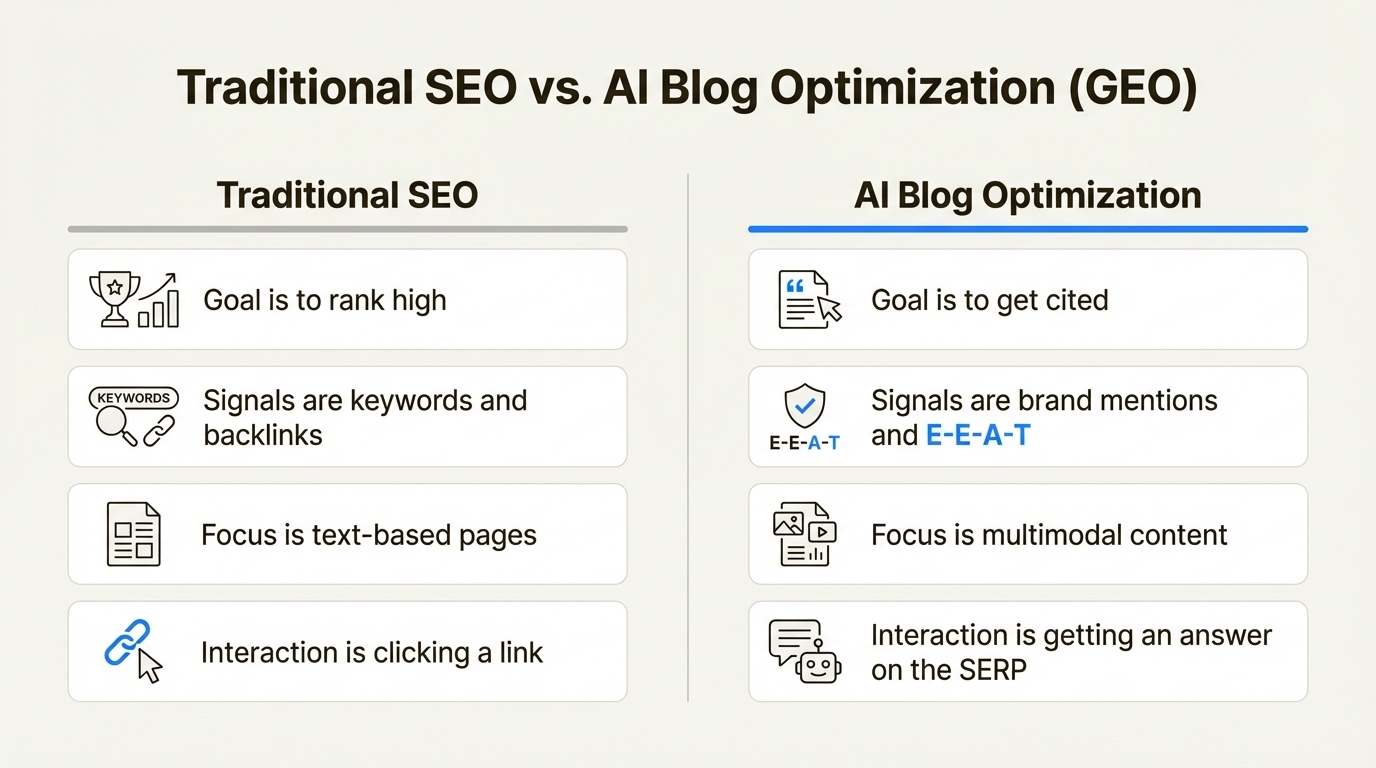
The era of relying on keyword density and backlink volume to secure search visibility is ending. We have entered the age of generative retrieval, where search is no longer a directory of links, but a synthesized experience powered by Large Language Models (LLMs). This transition represents a fundamental move from keyword-based matching to entity-based understanding.

In this new paradigm, LLMs do not “rank” a webpage; they ingest, parse, and verify entities—people, organizations, concepts, and relationships—to construct answers. Legacy content stacks, built on static page-level SEO, suffer from the “Entity Gap.” This gap exists when your digital footprint fails to clearly map its internal knowledge to the external world, leaving AI models to either ignore your brand or hallucinate incorrect associations. To thrive, brands must pivot from content-as-pages to content-as-structured-data, prioritizing knowledge graph integration to ensure their expertise is machine-readable and authoritative.
The Entity-First Tech Stack: Categorization and Tool Selection
Building an infrastructure capable of AI-driven visibility requires moving beyond CMS-based blogging. You need a dedicated technical layer that transforms content into an interconnected network of facts.
Core Infrastructure Components
- Schema Management: Moving beyond standard product markup to complex, nested schema that explicitly defines entity relationships.
- NLP/LLM Orchestration: Implementing tools that analyze your content’s semantic density and optimize it specifically for model training/retrieval patterns.
- Knowledge Graph Deployment: Creating a unified source of truth that maps your internal entities, ensuring consistency across every digital channel.
Readiness Scorecard
Before integrating new tooling, evaluate your current maturity level:
| Feature | Score (1-5) | Metric |
|---|---|---|
| Structured Data Complexity | Level of nested schema implementation | |
| Entity Consistency | Uniformity of entities across domains | |
| Semantic Optimization | Alignment with LLM training datasets |
Organizations scoring below 10 are likely experiencing significant “entity drift,” where their brand is poorly understood by LLMs, resulting in low citation frequency.
Operationalizing Entity SEO: A 90-Day Implementation Roadmap
Transitioning to an entity-first model is a surgical, iterative process.
- Days 1-30: Mapping and Auditing: Conduct a comprehensive knowledge audit. Identify your core entities and map how they are currently represented in your site’s taxonomy. Align your internal naming conventions with the standard identifiers used by major search and AI models.
- Days 31-60: Automation and Scaling: Deploy automation frameworks to inject consistent structured data at scale. This is where you move from manual meta-data updates to an automated, knowledge-graph-driven publishing pipeline.
- Days 61-90: Feedback Loops: Integrate monitoring systems that track not just traffic, but “citation attribution.” Analyze when and how your brand entities are appearing in LLM summaries and refine your entity mapping based on these outputs.
Architecting Content for Generative Visibility: The AEO/GEO Approach
The AEO/GEO platform functions as the essential operational layer that bridges the gap between raw data and generative visibility. Rather than just churning out content, our platform optimizes the underlying entity structure of your brand narrative.


By moving beyond traditional keyword metrics, we focus on Visibility Attribution. We track how effectively your content is being synthesized by AI models, providing granular data on which entity nodes are gaining authority. Companies using this architecture consistently see higher inclusion rates in long-tail generative queries, as the platform ensures their content is perfectly pre-formatted for AI retrieval.
Strategic Alignment: Integrating AI Search Success into Revenue KPIs
The ROI of this transition is measured through brand authority and assistant answer penetration. Stop treating search traffic as the only KPI. Instead, measure:
- Entity Penetration: How frequently does your brand appear in responses for category-defining queries?
- Semantic Influence Score: Are your entities being used as foundational nodes in AI summaries?
Transitioning from reactive, keyword-based tactics to proactive entity authority is the only way to safeguard your brand in a future where the search engine and the answer engine are one and the same.