Most AEO backlogs function as generic to-do lists: add keywords, refresh metadata, and chase backlinks. None of that explains why an AI engine cited one source over another. Effective AEO prioritization must align with how answer engines actually build responses, not just what users type into a search bar. That means organizing work around the six-stage retrieval pipeline: understand the query, expand it, retrieve sources, verify claims, synthesize an answer, and cite evidence. When tasks follow this sequence, your content workflow targets the specific points where your site becomes discoverable, verifiable, and worth quoting. Chasing a single keyword rarely achieves that; building a coherent, evidence-rich information environment does.

Why the 6-Stage Retrieval Pipeline Dictates AEO Prioritization
Answer engines do not read your page from top to bottom like a human reader. Instead, they use a dynamic retrieval and grounding process that breaks a single user query into multiple related searches. This “query fan-out” means the system is not just looking for your page; it is looking for specific pieces of evidence that support an accurate answer.
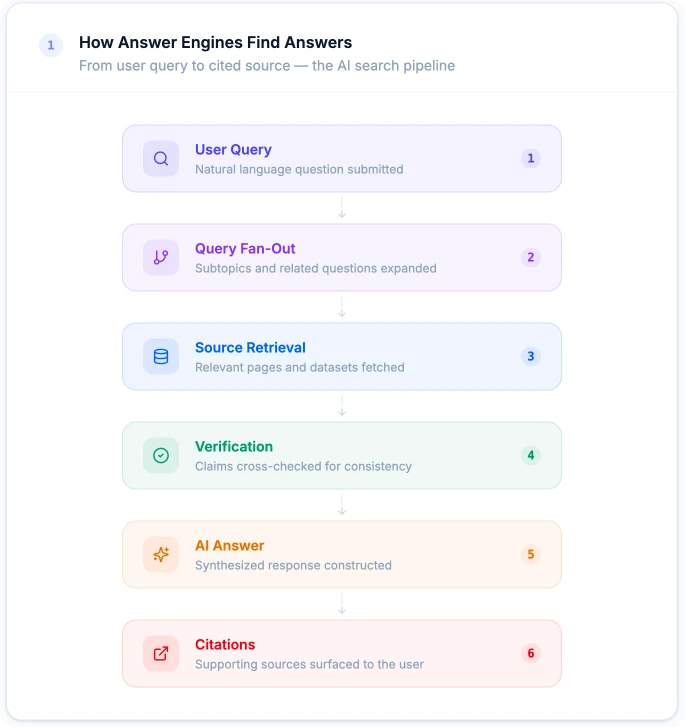
To understand why this changes your AEO prioritization, we need to look at the six distinct stages of this pipeline:
- Understand the question: The engine interprets the intent behind the user’s prompt.
- Expand the question: The system generates sub-queries to cover different angles of the topic.
- Retrieve useful sources: It gathers a broad set of potential sources from the web.
- Compare and verify: The engine cross-references these sources to check for consistency and reliability.
- Synthesize an answer: It drafts a response based on the verified data.
- Cite or recommend sources: The final output references the specific pages that grounded its answer.
Traditional search optimization strategy relies heavily on keyword density and backlinks. While these factors remain necessary for basic visibility, they are insufficient for this new environment. AEO requires a different focus: making your content discoverable, understandable, and verifiable at every stage of this pipeline.
This distinction explains why chasing a single keyword is no longer the primary goal. The true target of AEO work is building a trustworthy information environment, or “retrieval neighborhood,” where your content provides the specific, verifiable data points the engine needs to feel confident in its synthesis. When you prioritize tasks that strengthen this environment, you align your content with the way AI actually constructs truth.
Mapping AEO Tasks to the Retrieval Neighborhood
The term retrieval neighborhood describes the cluster of specific sub-questions an AI engine must answer to confidently recommend a product or service. It is not just the primary query; it includes the surrounding data points on fit, comparisons, warranty details, independent reviews, and technical specifications. When an answer engine processes a request, it does not look for a single “best” page. Instead, it maps out this neighborhood to verify if the subject is trustworthy, comparable, and well-documented across multiple dimensions. Understanding this map is central to any effective AEO task framework, as it shifts the focus from ranking for one phrase to dominating a constellation of related information needs.
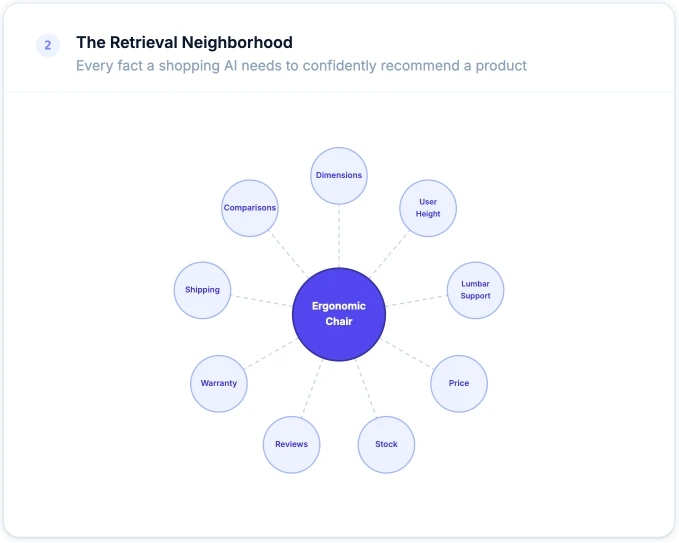
Consider a simple purchase query for an ergonomic chair. A traditional search might yield a product page. However, an answer engine performs a fan-out, asking specific questions: What are the exact dimensions? Is it in stock? What is the current price? What do independent reviewers say about its durability? The system needs these distinct data points to synthesize a recommendation. If your content only describes the chair’s aesthetic appeal without providing verifiable facts on dimensions or price, it fails the retrieval test. The AI cannot trust a source that lacks the granular details required for a comparative synthesis.
Prioritizing content creation based on this neighborhood follows a logical hierarchy. First, ensure that core facts—specifications, price, and availability—are present, accurate, and structured for easy extraction. Second, add comparative data that positions the product against alternatives, helping the engine understand where it fits in the market. Third, secure independent evidence, such as expert reviews or third-party consensus, which signals authority to the “Compare and Verify” stage of the pipeline. This sequence ensures that every piece of content serves a specific function in the retrieval process, creating a clear AI content workflow rather than a scattered collection of posts.
It is tempting to create a dedicated page for every possible fan-out query. This approach, known as content inflation, often dilutes the overall quality and confuses both users and engines. Creating dozens of thin pages targeting minor sub-questions is less effective than covering the natural decision points of the subject with high-quality, non-commodity information. A single, comprehensive resource that addresses the key dimensions of the retrieval neighborhood usually outperforms a fragmented series of narrow pages. By focusing on depth and verifiability, you build a source that an answer engine can rely on, ensuring your brand remains a trusted part of the generated answer.
Building a Verifiable Information Environment for AI Citations
Answer engines do not simply pick the most relevant page; they select sources they can verify. In the “Compare and Verify” stage of the retrieval pipeline, an AI cross-references claims against multiple data points. If your page offers only generic descriptions, the system cannot ground its answer, making you a less reliable source for the “Synthesize” and “Cite” stages.
To address this, structure content using a Citation-Ready Evidence Block. This format follows a strict logic: state the Answer, back it with Evidence, cite the specific Source/Data, provide a concrete Example, and add broader Context. This structure makes claims easier for AI systems to extract and for humans to trust, directly supporting effective AEO prioritization.
However, a well-structured page is not enough if it contains “answer debt.” This refers to stale, contradictory, or underspecified information that reduces a page’s reliability in the eyes of an answer engine. Before adding new content, audit for these gaps. Contradictions between your structured data and visible text are a common source of answer debt that confuses verification algorithms.
The difference between a commodity page and one designed for AI citation is stark. Consider the following comparison:
| Feature | Commodity Page | AEO-Ready Page |
|---|---|---|
| Data Specificity | Vague claims (“best quality”) | Specific metrics (verified durability ratings) |
| Methodology | None stated | Explicitly defined testing standards |
| Evidence | Subjective opinions | Cited studies or third-party data |
| Verification | Hard to cross-reference | Easy to verify against sources |
A Practical AEO Task Framework for Your Content Workflow
Theoretically, aligning tasks with the 6-stage pipeline is straightforward. In practice, teams often struggle to translate these abstract stages into concrete daily actions. This AEO task framework bridges that gap by breaking down your AI content workflow into four distinct, actionable stages.
Stage 1: Technical Accessibility for Retrieval
Before an AI can answer a question, it must be able to read your site. The first step in any search optimization strategy is auditing your technical crawlability. Specifically, ensure that your robots.txt file does not block key AI crawlers such as OAI-SearchBot, Claude-SearchBot, and PerplexityBot. If these bots cannot access your data, no amount of content optimization will matter. This stage is the foundation of your AEO prioritization; it determines whether your site is even eligible for consideration.
Stage 2: Mapping the Retrieval Neighborhood
Once access is granted, shift focus to content structure. Use the retrieval neighborhood concept to map out the sub-questions an AI must answer to recommend your product or service. Identify gaps where specific data points are missing. For example, if your page lists a price but lacks a shipping estimate, you have a hole in the neighborhood. Prioritize filling these gaps with clear, direct answers rather than vague marketing copy. This ensures the AI has the granular details needed to synthesize a complete response.
Stage 3: Implementing Structured Verification
Clarity is key for the Verify stage. Implement structured data, such as Product or Offer schema, to explicitly define entities and their attributes. Crucially, ensure this markup matches the visible content on the page. Discrepancies between hidden schema and visible text can reduce your site’s reliability in the eyes of an answer engine. By providing clean, consistent data, you make it easier for AI systems to verify facts and trust your source over competitors who rely on ambiguous descriptions.
Stage 4: Earning Third-Party Consensus
Finally, focus on the Cite stage. AI engines look for consensus to validate a recommendation. Rather than relying solely on self-promotion, prioritize earning independent reviews, expert mentions, and third-party citations. This external validation signals authority and trustworthiness. While you cannot control where these mentions appear, you can create the high-quality content that earns them. This stage turns your site from a mere data source into a recommended authority within the AI’s answer space.
AEO is not a magic formula; it is the discipline of becoming a source worth answering from. The most impactful task in your AI content workflow is often the simplest: verifying that your facts are accurate, current, and consistent. When your data holds up under scrutiny, answer engines can trust it. So, which retrieval neighborhood has your team left unaddressed?


