What Is Sales Technology?
Sales technology refers to the digital tools that help sales teams improve productivity and conversion. These platforms automate administrative tasks like data entry, scheduling, and research, allowing representatives to focus on actual selling. The manual era of tracking customers in spreadsheets and blindly sending email follow-ups is effectively over.
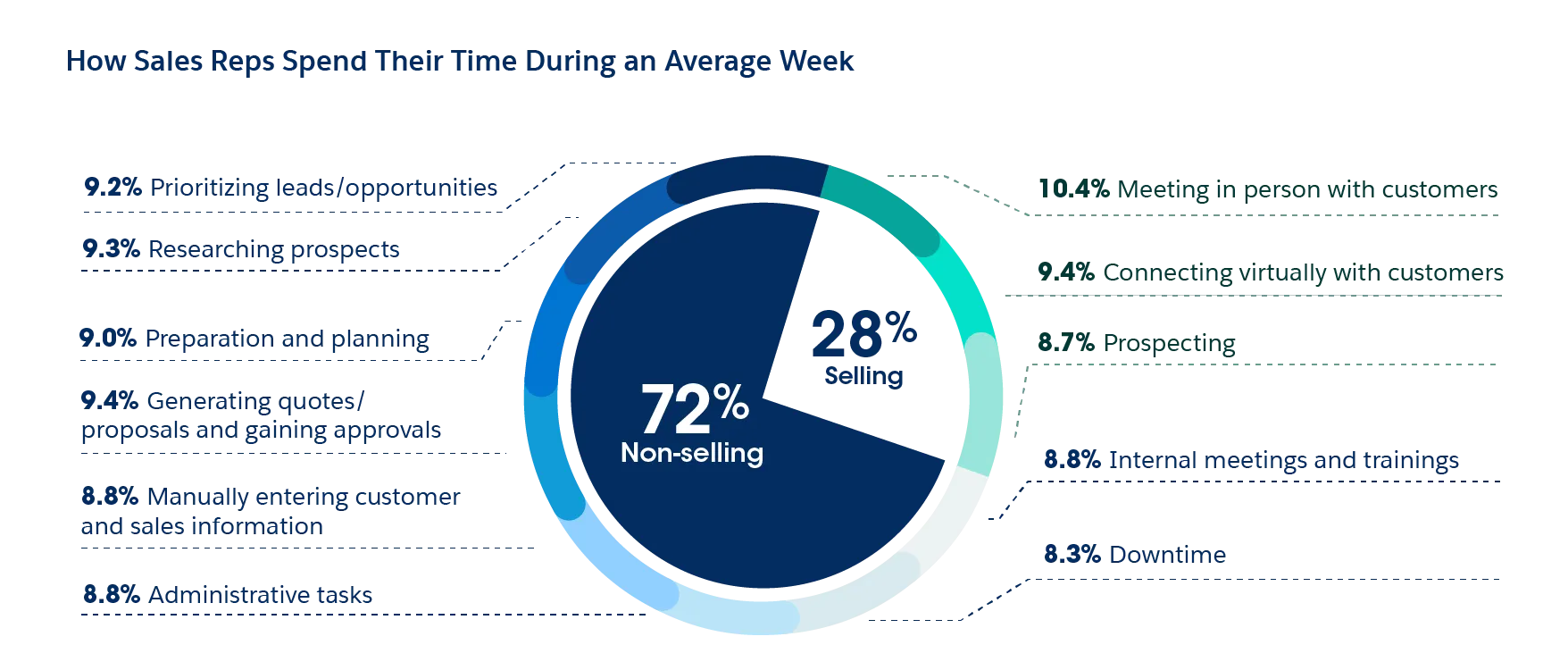
Only 34% of an average sales agent’s time is spent actually selling. The rest is consumed by data entry, prospecting, and scheduling. Sales tech aims to fix this imbalance by streamlining or even automating many of the tedious tasks that keep you from closing deals. It is not just about working harder; it is about working smarter.
Defining Sales Tech vs. Sales Enablement
You might sometimes see the term “sales tech” confused with “sales automation” or “sales enablement,” but these aren’t the same thing. Sales automation is the process of automating certain steps in your sales funnel. It is an outcome of using sales tech. Sales enablement is the process of providing your sales team with the resources, content, and information they need to increase sales. It is the goal of using sales tech.
Understanding this distinction helps you choose the right tools. You are not just buying software; you are buying a way to enable your team to perform at their best. The technology serves the strategy, not the other way around.
Building Your Sales Tech Stack
Your “sales tech stack” refers to all of the digital tools or software your sales team uses to do their job. This covers everything from time management to data tracking and reporting, right down to emailing or chatting. If your sales team uses it, it’s part of the tech stack. In the post-pandemic world, it’s not enough to have a tech stack that only works on-site.
With 63% of sales teams either fully or partially remote, according to recent HubSpot data, your sales technology must be as easy to use offsite as it is on. The average virtual selling technology stack includes 13 technologies, according to Dan Gottlieb, senior director analyst in the Gartner for Sales Leaders Practice. However, two-thirds of sales reps feel like they’re drowning in tools, according to Salesforce data.
Prioritizing Integration Over Quantity
It is a good idea to look for sales technology that condenses as much functionality as possible. It means that it’s more important now than ever to be sure that every tool in your sales tech stack integrates smoothly through native integrations or a custom API to minimize manual workarounds. A fragmented stack creates data silos and increases the cognitive load on your team.
While there is no single best tech stack, you can build the best sales tech stack for your team. This means you need to understand your team’s top priorities and what sales tools can best aid them in achieving their goals. HubSpot recently asked 516 B2B and B2C sales professionals to name their top three sales goals. Across the board, the number one goal was exceeding sales targets.
Aligning Tools with Team Goals
This isn’t particularly surprising when you consider that commission plays a significant role in compensation for the vast majority. Nearly half (48.8%) of sales organizations use a base salary plus commission model, with another 25% using a salary plus bonus model. And while B2B and B2C do have different priorities, by looking at the chart above, you can see how closely aligned they are across the board. Rounding out the top five goals are making the sales process more efficient, upselling or cross-selling your existing customers, winning more market share, and improving sales and marketing alignment.
Again, while none of this is particularly surprising, it is important to understand what your salespeople want most so you can build the sales tech stack they need. Tools should support these specific objectives, not just add features for the sake of it.
Benefits of Sales Technology
Now that you understand what sales technology is, how your tech stack can support your team, and what your team wants, let’s explore some of the biggest benefits of sales technology. Getting real-time data and actionable insights is one of the biggest advantages. Most tools are able to gather and report on the most important and commonly requested sales data right out of the box. However, because each business may need to track slightly different metrics, many can be configured for custom datasets and reports.
And the data you can access is getting even better as AI emerges as a huge power player in sales technology. Instead of downloading monthly reports and finding out what your customers needed weeks ago, AI-enabled tools get you access to real-time data so you can meet your audience where they are right now. Better yet, by automatically combing through the data, AI can do in minutes what might have taken humans weeks or months to do, generating insights you can use to make quick decisions.
Responding Quickly to Leads
A rock-solid tech stack can make sure you get to leads more quickly and effectively. Here’s why that matters. According to SuperOffice, 46% of customers expect a response within 4 hours, and 12% want one in under 15 minutes. Moreover, 78% of customers purchase from the first company to respond. And, with an overall average lead response time of 42 hours, there’s a great deal of opportunity to gain a competitive advantage and close more sales.
That makes a top-notch tech stack that allows your team to respond quickly more than “just a good idea.” It’s absolutely vital if you want to deepen your market share and start building a strong relationship with your prospects. One way you can do this is to create chatbots for your website and social channels that make it easy for customers and prospects to find the information they want and route them to real team members when they’re ready for human interaction.
Automating Busy Work
One of the drum-beats of digital transformation and technology modernization is improved efficiency across the board due to automation, which can cut out half of your work activities by reducing “busywork” types of tasks. Did you know that currently, sales reps spend less than 30% of their time actually selling? While there are many factors that go into this, one of the most significant lies in the sheer number of tasks required as part of their job. A great sales tech stack can free them up to focus more on sales, eliminating tasks like data entry, manual data transfers and manipulation, prospect research, and data insights.
What’s more, your sales tech stack can take the pressure off remembering to follow up with leads at certain intervals by automating the follow-ups themselves or simply sending reminders to your team. This reduction in administrative burden allows your team to engage more deeply with customers, rather than treating them as data points in a spreadsheet.
10 Types of Sales Tech You May Need
There are many tools available, but not all are necessary for every team. Here are ten types of sales technology that can significantly impact your results. Customer Relationship Management (CRM) is at the core. At its most basic, a CRM is software that organizes all of your interactions, communications, and data about your customers. That means tracking all purchases, payments, quotes, calls, emails, chats, and agent notes in one place. But a CRM isn’t just a database. It acts as a dynamic dashboard that lets you track leads across the entire sales lifecycle (and beyond).
Many CRMs go even further, using the data to give insights like lead scoring, segmentation, forecasting, and sales reports. A good CRM will automate the collection and organization of your customer data. A great CRM will act as a platform for your other sales tech, integrating all of your business data in one central location. Examples include HubSpot CRM and Salesforce.
Prospecting and Enrichment Tools
Sales Prospecting Tools automate the process of finding and qualifying leads. Some prospecting tools do this by gathering information about visitors to your website. Others pull demographic data from social media sites like LinkedIn or Twitter. Still, others build an internal database by scraping public and private data. You can then sort and filter these potential leads by whatever criteria are important to you — company size, geography, behavior, etc. Good prospecting tools help you build a prospect list, complete with contact info. Great prospecting tools use AI to unearth similar leads based on your ideal customer profile.
Lead Enrichment Tools find the missing pieces of your prospect lists or CRM contacts. They do that by crawling the web and building databases of job titles, email addresses, phone numbers, etc. Some enrichment tools will go even further, providing information like what technology a prospect uses, company revenue, funding history, headcount, etc. This is especially useful for those who do account-based sales, where you need to focus on specific attributes. Good enrichment tools will update their database regularly. Great enrichment tools connect to your CRM to automatically update your contact lists regularly.
Communication and Scheduling Platforms
Call Tracking and Call Analytics tools record, transcribe, and gather data about your sales calls. And we don’t just mean basic data like call length or frequency. These tools gather deeper data, like marketing sources, campaigns, and channels. They analyze the transcripts to allow you to search calls by keyword, flag comments for training, and identify sales trends. Good call-tracking tools record your calls and their associated data. Great call-tracking tools use AI to analyze the recordings and data to turn them into actionable insights.
Outreach/Email Platforms help in two ways: 1) automating the most tedious parts of emailing and 2) providing reporting so you can base your outreach on data-driven decisions. In the first case, they offer tools like email scheduling, automated follow-up, and template personalization. These let you skip the manual labor without sacrificing the human element that separates sales from spam. Second, they track important data like open rates, click-through rates, rejection rates, etc. This allows you to A/B test your email campaigns, so you can replicate your wins and learn from your losses.
Scheduling Tools make the process of setting meetings seamless. You set your availability (or integrate it with your work calendar), and your prospects can then choose a time that works for them. This way, prospects make appointments that work with their schedules, on their time, without any hassle. Meanwhile, reps can focus on other tasks and prep for their meetings with prospects. Good scheduling apps allow you to choose your availability. Great scheduling apps sync with Office 365 or Google Calendar, so your work schedule is always up to date.
Video, Chat, and Reporting Tools
Video Chat and Screen-Sharing Tools are the next best thing to in-person meetings. It’s faster than emailing and offers more connection than a phone call. Many video chat services also include screen-sharing features, which allow you to give live demos and slide presentations. You can also use it to co-browse with potential customers as they shop. Oftentimes, these tools will allow you to record video chats or screen-sharing sessions. This is great for training and performance review. Good video chat tools let you share links so your prospect can easily join. Great video chat tools allow you to seamlessly shift from email, chat, or phone to a video experience.
Live Chat tools provide a chat window on your website or app, where customers can contact a sales agent in real time. That’s a big deal when 82% of consumers consider an immediate response as important to sales questions. Many chat tools can be customized to route messages to the right team or rep. If there are no agents available, most chat tools also offer the ability to trigger automated messages or even AI chatbots. Good chat tools notify available agents of incoming messages. Great live chat tools send your messages to a universal inbox where you can also view emails, texts, and social messages.
Sales Reporting Software helps you gather, organize, interpret, and visualize that data. Different tools may pull different types of data, so consider the needs of your organization. For example, an inside sales team may need to track different KPIs than an outside sales team. At the most basic level, reporting tools will gather simple metrics like revenue, response time, cost per lead, etc. More robust reporting software can turn those numbers into deeper insights — such as weighted forecasts, pipeline tracking, deal velocity, etc. Good reporting software will cover all the necessary sales KPIs. Great reporting software will let you customize your KPIs, sales funnel, channel attribution, and reports.
Project Management Tools are the next step if you’ve outgrown a simple to-do list. These tools help you plan and assign tasks, set deadlines, and track your progress. This is especially helpful for account-based sales teams, who may need to collaborate on closing deals. These tools also give sales managers insight into productivity, time management, and project velocity. Good project management tools offer customizable task creation and to-do lists. Great project management tools automate task creation and to-do lists, so you’re always up to date.
Choosing the Right Tools
One of the best ways to discover the right sales tools for your team is by doing your homework. Keep in mind that while many sales tools have similar features, each has a unique spin. Some will work better with your brain — and your business, so don’t be afraid to experiment with different technologies to decide the right one for you. To that end, while you might discover a combination of technologies is the right solution, you may also find that a single tool is all you need. Many times, a good CRM incorporates most of the tools in this list. So, begin growing better today by determining which technology your sales team needs to support their efforts. The goal is not to have the most tools, but the most effective ones.





