Scaling Content for AI Search: A New ROI Framework
It is frustrating to watch your analytics dashboard for weeks, seeing organic impressions rise while click-through rates remain flat. Many marketers interpret this as a performance decline, but the digital landscape has fundamentally shifted. We are moving away from the era of the link-focused search results page and into the age of the zero-click search, where the answer itself is the destination.
Instead of mourning the loss of the traditional site visit, successful brands view these zero-click results as high-value trust signals. When an AI answer engine cites your expertise to provide a user with a solution, you have succeeded in the most critical step of the buyer journey: establishing authority at the point of intent.
Scaling content for AI search requires a complete reimagining of how we define success. By introducing the concept of an AI Visibility ROI score, we can bridge the gap between abstract brand influence and tangible business growth. You do not need to choose between traffic and authority. By optimizing for both, you turn modern search influence into a reliable engine for long-term discovery and conversion.
Why Traditional Metrics Fail in the AI Search Era
For years, the gold standard for marketing success has been the organic click—the moment a user leaves a search engine results page (SERP) to visit your website. However, as AI platforms like ChatGPT, Google AI Overviews, and Perplexity synthesize answers directly, that paradigm is fracturing. When a search engine provides a complete answer, the need for a user to click a link diminishes. Consequently, traditional metrics like organic sessions and click-through rates (CTR) are becoming incomplete, failing to account for the massive brand exposure happening in these non-clicking environments.
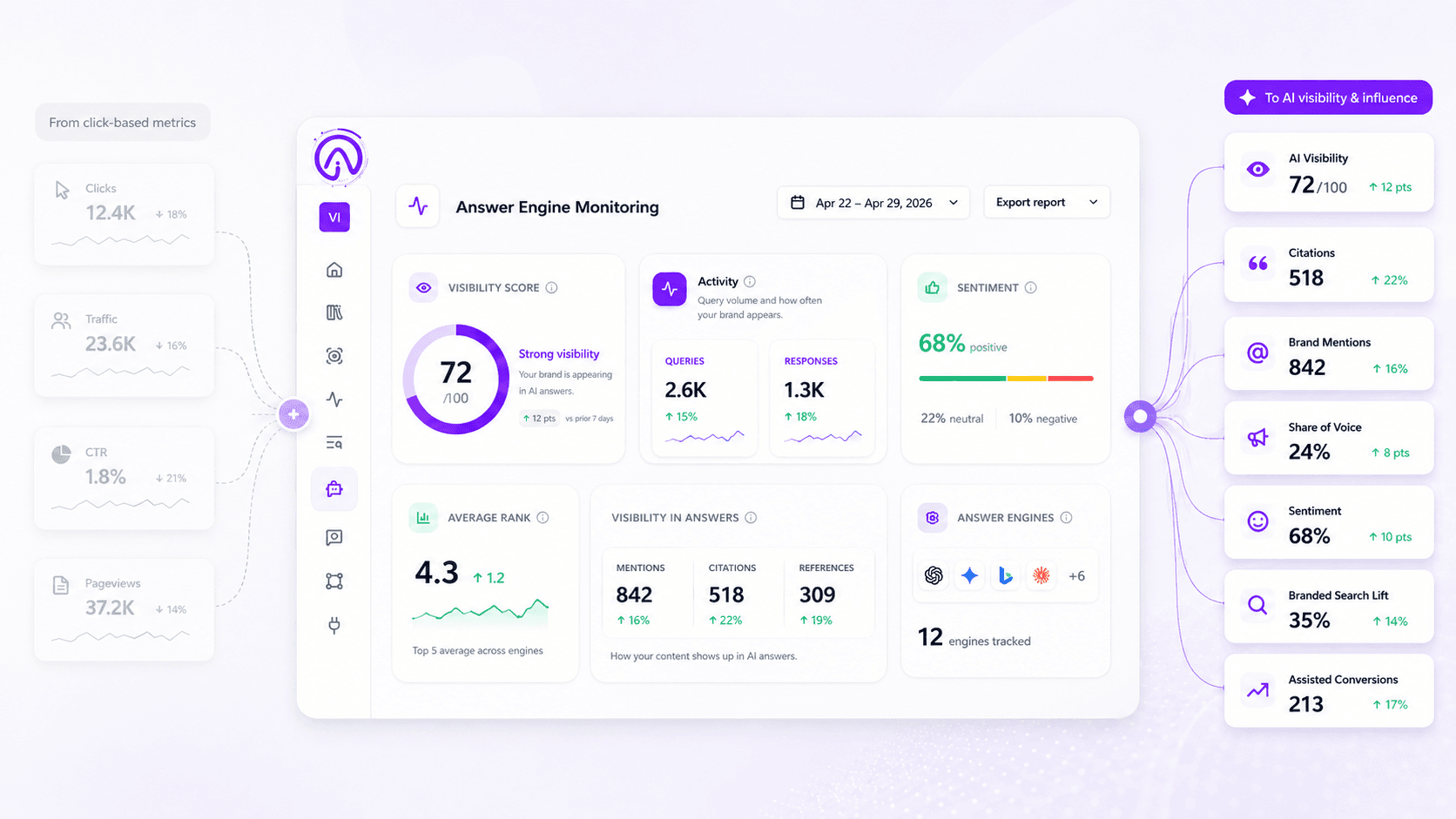
The Shift to Zero-Click Influence
When you are scaling content for AI search, you must accept that your most valuable marketing touchpoints may no longer involve a visitor landing on your URL. This is the era of the zero-click search, where the journey resolves within an AI-generated answer. While this might look like a loss of traffic in tools like Google Search Console, it is often a significant win for brand authority. When an AI engine cites your content, it endorses your business as a trusted source. This influence acts as a top-of-funnel conversion event. Even without a click, the user is introduced to your expertise, building awareness that shortens the distance to a future purchase.
Moving Beyond Clicks to Citations
To measure success in this ecosystem, you must look past simple traffic volumes. Answer Engine Optimization (AEO) prioritizes visibility within AI responses, transforming your strategy from a quest for links to a mission for relevance and trust. When cited by an LLM, you integrate into the user’s decision-making process at the moment they form an opinion. Ignoring these citations because they lack a direct click is a strategic mistake that undervalues the importance of AI-driven visibility.
| Traditional SEO Metric | AI Visibility Metric | Why It Matters |
|---|---|---|
| Organic Clicks | AI Citations / Mentions | Measures trust and source authority. |
| CTR (Click-Through Rate) | AI Visibility / Reach | Tracks potential brand awareness. |
| Keyword Rankings | Answer Synthesis Position | Indicates alignment with user intent. |
| Referral Traffic | Assisted AI Conversions | Connects AI exposure to sales. |
Building Your AI Visibility ROI Score
Traditional metrics like CTR are increasingly insufficient in a landscape where over 60% of searches end without a user ever visiting a website. When scaling content for AI search, your goal shifts from chasing raw traffic to securing high-authority citations. To measure success, you need a framework that values the trust transfer occurring during a zero-click search.
The ROI Formula for AI Citations
To quantify the value of your presence, establish a baseline for your content’s performance in LLM-driven environments. Use this formula to calculate your monthly AI Visibility ROI:
Total AI Visibility Value = (Number of Monthly Citations × Estimated Trust Value) - Total Content Production Cost
- Calculate Citations: Use monitoring or brand-tracking tools to count how often your brand is cited in answer engine responses.
- Assign Trust Value: Not all citations are equal. Assign a weight based on the audience relevance of the query. A citation in a high-intent commercial query holds more value than a mention in a broad, general informational query.
- Determine Cost-Per-Influence: Divide your total investment in content production by the number of times your content is surfaced. This reveals the actual cost paid to influence the answer.
Practical Steps for Improving Your Score
To maximize your ROI, refine how you feed information to these models. Start by auditing your content for “answer-first” formatting, ensuring every critical section opens with a 40–60 word summary that AI crawlers can easily ingest. Focus on building E-E-A-T (Experience, Expertise, Authoritativeness, and Trustworthiness) signals, as these are the primary currencies answer engines use to determine if you are a trustworthy source.
Attributing Assisted Conversions to AI Search
Proving the value of your content requires moving beyond basic session tracking. Because AI models often surface your brand as a source without driving an immediate click, you must build a framework that accounts for “assisted” conversions.
| Attribution Method | Mechanism | Goal |
|---|---|---|
| Referral Tagging | Monitor AI platform referrers | Direct click attribution |
| Branded Search Lift | Compare brand keyword volume to AI citations | Measure latent awareness |
| Conversion Surveying | Ask “How did you hear about us?” | Qualitative validation |
By adding an optional field to customer intake forms, such as “Did an AI search engine help you find us?”, you gather primary evidence of your AI visibility ROI. This qualitative data is often more convincing to stakeholders than abstract marketing metrics, providing a human narrative to your efforts. Linking these events to downstream revenue turns your content into a silent sales representative, consistently building authority until the user is ready to engage directly.
AEO/GEO
Want to learn more?
Contact us for direct consultation and support.