Scaling your digital footprint in the age of generative search requires more than just high-frequency publishing. In a landscape where AI models prioritize accuracy and intent-matching, the traditional volume-first approach is no longer a path to growth—it is a recipe for brand dilution.
The Reality of ‘AI Slop’: Why Scaling Often Backfires
The rapid expansion of AI content tools has led to a flood of low-quality, generic output—often referred to as ‘AI slop.’ When businesses prioritize sheer quantity to ‘beat the algorithm,’ they inadvertently erode their brand authority.
The threshold between helpful AI assistance and search-penalized content is razor-thin. Search engines are increasingly sophisticated at identifying content that lacks genuine insight, unique data, or editorial depth. Strategies built solely on volume fail because they ignore the core requirement of modern search: trust. If your content provides no value beyond what a basic chatbot could generate, you are essentially signaling to search engines that your brand is expendable.
The Hidden Costs of DIY AI Content Pipelines
Many teams attempt to solve the scaling problem by building custom automation stacks using APIs, webhooks, and scripts. While this DIY approach offers initial flexibility, the long-term operational burden is frequently underestimated.
- API Complexity & Maintenance: Custom pipelines are brittle. Frequent API updates from model providers necessitate constant manual intervention, diverting your engineering talent from building features that actually serve your customers.
- Hidden Financial Leaks: Beyond the direct cost of token usage, managing custom infrastructure involves significant labor costs for debugging, monitoring, and scaling. What seems like a low-cost experiment often turns into a ‘talent trap’ where your most skilled people spend their time acting as IT support for content workflows.
- The Scalability Plateau: Custom-coded solutions rarely account for the nuance required for enterprise-level governance, leading to inconsistencies in brand voice and factual accuracy as your content volume grows.
Comparative Analysis: DIY Architectures vs. Integrated Platforms
Choosing between a custom-built solution and a purpose-built integrated platform involves a critical assessment of your operational goals.
| Feature | DIY Automation | Integrated Platform (AEO/GEO) |
|---|---|---|
| Speed to Market | Slow (Requires dev/testing) | Immediate (Ready-to-use) |
| Maintenance | High (Internal overhead) | Zero (Handled by platform) |
| Quality Control | Manual oversight (Brittle) | Embedded, automated guardrails |
| Strategic Focus | Tactical (Focus on plumbing) | Growth (Focus on content strategy) |
Integrated platforms provide built-in guardrails and governance that manual scripts cannot match. By choosing a dedicated solution, you trade the vanity of owning your infrastructure for the strategic advantage of superior performance, consistency, and search relevance.
Human-in-the-Loop: Operationalizing Strategic Oversight
True automation is not about removing humans from the process; it is about elevating their role. Human expertise is the only way to ensure brand voice, original thought, and high-stakes accuracy remain intact.
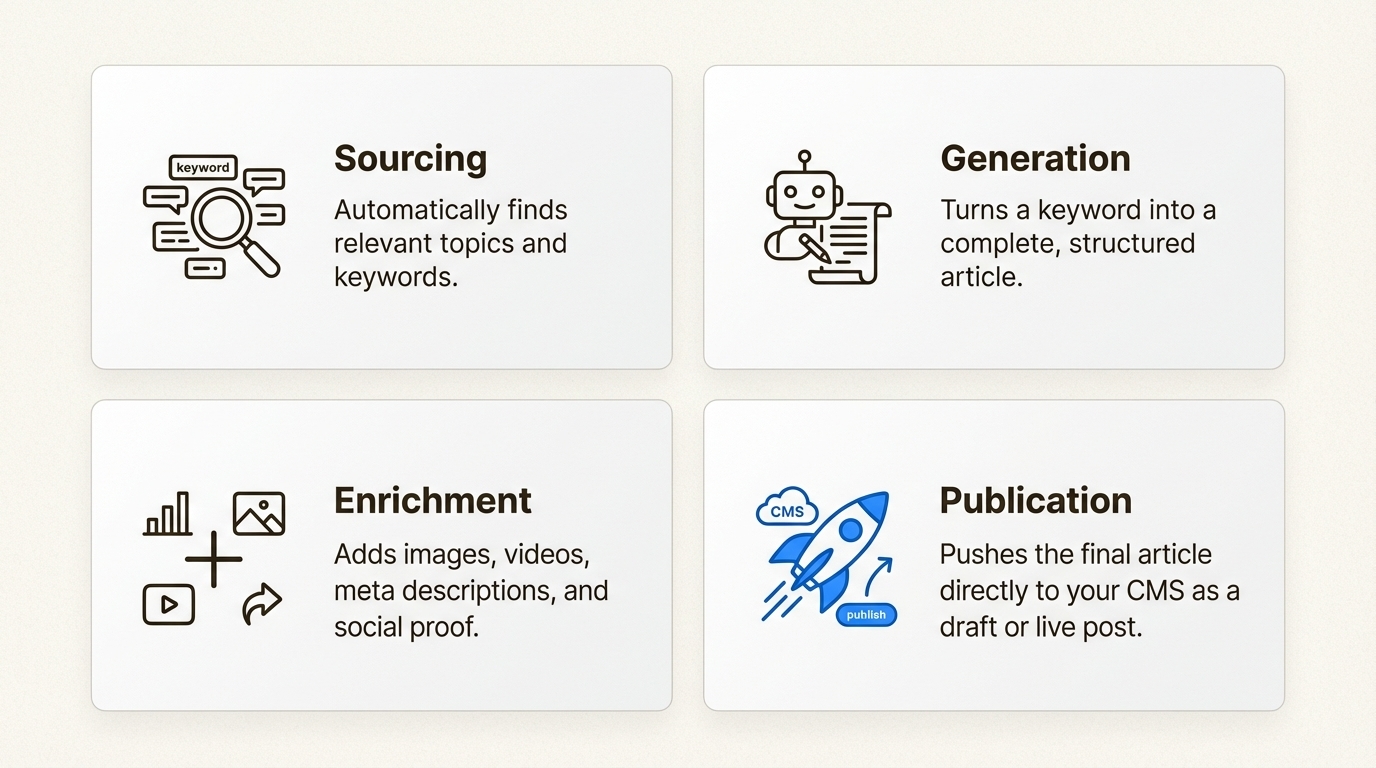
Hybrid workflows represent the most effective model for long-term growth. In this setup, AI handles the heavy lifting of data aggregation and drafting, while human experts focus on:
- Strategic Direction: Defining the intent and target audience for each piece.
- Editorial Judgement: Infusing the brand perspective and unique insights that AI cannot replicate.
- Validation: Ensuring factual accuracy and alignment with current market trends.
Measuring Success: Metrics That Matter for AI Search Visibility
To compete in the generative search era, you must move beyond traditional vanity metrics like page views or keyword density. Success in AEO (Answer Engine Optimization) is measured by your content’s ability to influence the answers search engines provide to users.
Focus your auditing on:
- Generative Presence: Are your insights appearing in AI-driven search snapshots or summarized answers?
- Intent Alignment: Does your content directly resolve the queries driving traffic to your competitors?
- Relevance Maintenance: Conduct ongoing audits to ensure your content remains current as search models update their knowledge base.
Sustainable growth requires a shift in mindset: focus on becoming the definitive, trusted source for your audience, and ensure your technological foundation is built for precision, not just volume.