The GEO Shift: Why Your Content Infrastructure Needs a Complete Overhaul
The digital visibility landscape has fundamentally fractured. While legacy search engine optimization (SEO) focused on keyword density and backlink acquisition to drive traffic to specific URLs, the rise of AI-powered engines—like Google’s AI Overviews, Perplexity, and ChatGPT—demands a transition to Generative Engine Optimization (GEO).

The core differentiator is the destination: SEO aims for a click; GEO aims for a citation. In this new ecosystem, your content is not merely a page to be indexed, but a data source to be synthesized by an LLM.
Transitioning from SEO to GEO requires moving beyond manual content production. To compete for placement in generative answers, your infrastructure must support:
- Structural Semantics: Content must be architected for machine readability, prioritizing factual clarity and hierarchical data organization over SEO-friendly keyword stuffing.
- Automated Trust Signals: Because AI engines prioritize source reliability, your pipeline must automate the injection of expert-level citations and verifiable data points.
- Continuous Synchronization: Unlike static SEO pages, generative content requires real-time feedback loops to ensure information remains accurate as LLMs refresh their training datasets.
Selection Criteria: How to Evaluate AI Content Platforms for 2026
Not every AI writing tool is built for GEO. As you evaluate your stack, move past simple copywriting features to assess the platform’s capacity for complex, data-driven content generation.
Core GEO Features vs. Marketing Gimmicks
A platform must go beyond natural language generation. Look for tools that offer Knowledge Graph integration, allowing you to ground AI output in your company’s proprietary data. Avoid platforms that prioritize “human-like” fluff over substantive, citeable information.
Scalability and Integration
Evaluate the platform’s API capabilities first. In 2026, content automation must be headless and integrated directly into your existing CMS. Assess whether the platform supports:
- Dynamic Brand Guardrails: Can it enforce strict style and compliance rules at scale?
- Multi-Channel Orchestration: Can it push content to web, social, and knowledge repositories simultaneously?
The ‘Buy vs. Build’ Matrix
- Buy: Best for organizations needing rapid deployment, pre-trained specialized models, and vendor-managed compliance updates.
- Build: Recommended only for enterprises with proprietary data moats who require custom RAG (Retrieval-Augmented Generation) pipelines to maintain a competitive advantage in niche industry search queries.
Top-Tier AI Content Platforms for 2026: A Comparative Analysis
When selecting your infrastructure, focus on platforms that offer high-precision output.
1. Jasper: The Brand-Voice Authority
Jasper excels in maintaining rigid brand identity across thousands of assets. It is ideal for enterprise teams that require sophisticated brand-voice training.

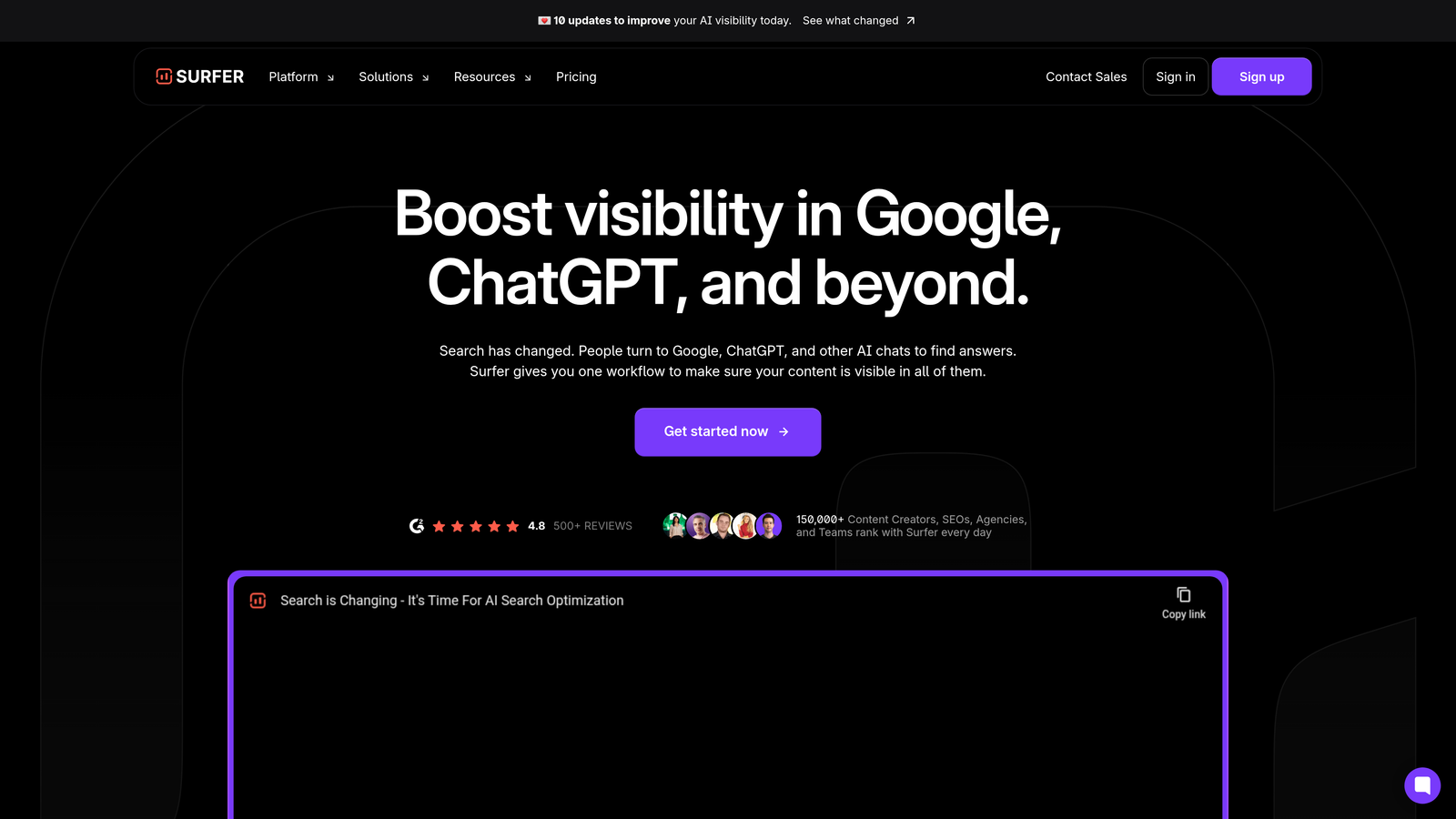
2. Surfer SEO: The Precision Engine
Surfer provides granular, real-time SERP monitoring that helps bridge the gap between traditional SEO and generative visibility. It is best for teams focused on optimizing existing content for LLM ranking factors.
3. Content at Scale: The Velocity Leader
Designed for high-throughput, this platform is built for enterprises that need to maintain massive, high-quality content factories with minimal human oversight.

GEO Readiness Matrix: Comparison Summary
| Platform | Best For | Key GEO Strength |
|---|---|---|
| Jasper | Brand Consistency | Enterprise Guardrails |
| Surfer SEO | Technical Optimization | Real-time SERP Data |
| Content at Scale | Massive Throughput | Automated Factory Workflow |
For organizations at a lower maturity level, prioritizing ease of use is critical. However, as your organization scales, prioritize platforms that offer API-first architectures and native knowledge graph support to ensure long-term generative visibility.
Implementing Your Automated GEO Strategy: From Selection to Scaling
Successful implementation is less about the tools and more about the workflow loops you build around them.
Workflow Integration
Embed your chosen platform into your CI/CD pipeline. Content should move from automated generation to a Human-in-the-Loop (HITL) verification layer, where subject matter experts (SMEs) validate factual accuracy before the content hits your distribution channels.
Metrics That Matter
Forget traditional click-through rates. Shift your KPIs to track:
- Citation Rate: How often your brand is cited by AI search engines.
- Semantic Coverage: The breadth of topics for which your brand appears in generative answers.
- Factual Velocity: How quickly your content is indexed and reflected in AI search summaries after updates.
Iterative Optimization
Treat your content as a living product. Use the data from your GEO performance to re-train or update the prompts and source inputs within your automation platform. This iterative loop ensures your content remains a primary, trusted authority in the evolving generative landscape.