Structuring Product Descriptions for AI Extraction
Ever poured hours into writing a beautiful product description that looks stunning, only to watch it get completely ignored by AI engines? You’re not alone. While human visitors appreciate your polished prose, AI search engines like ChatGPT, Gemini, and Google AI Overviews don’t “read” like we do—they extract facts. Imagine trying to explain this to a librarian: you might give them a poetic story, but if you want the answer, you need clear labels. AI engines are more like data scrapers; they need structured tags to find what matters.
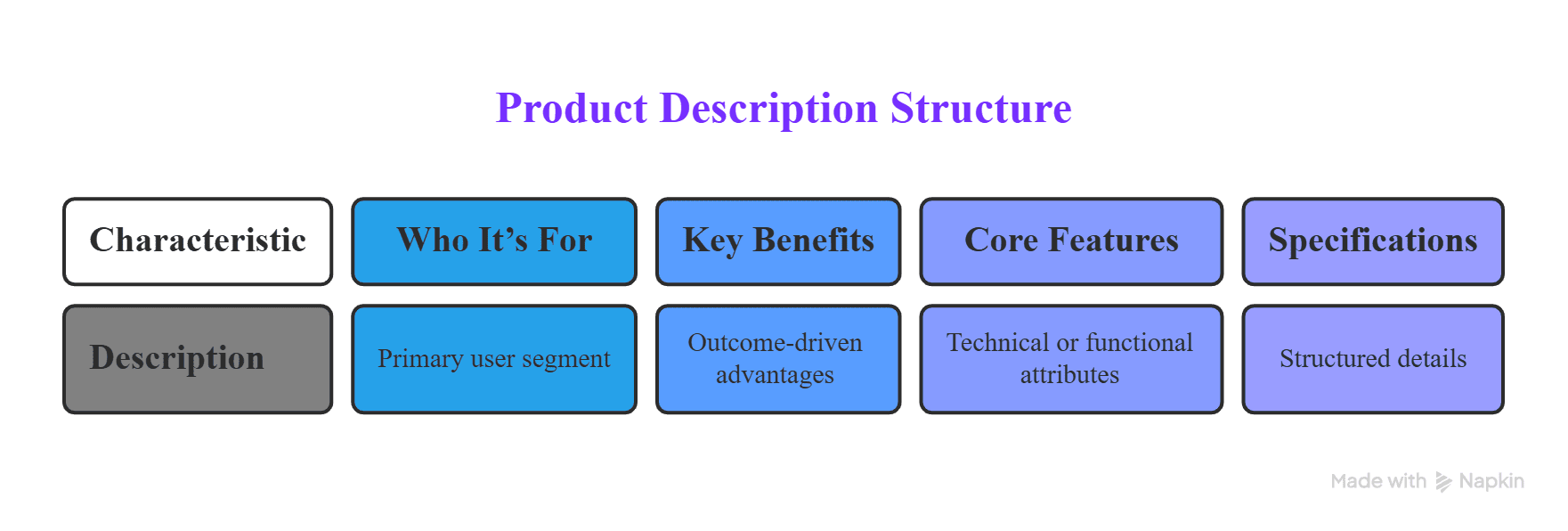
If you’re trying to boost your AI search optimization and get generative search traffic, the secret isn’t rewriting your words, but changing how you structure them. By flipping your approach to product description SEO, you can make your content irresistible to AI. In this guide, we’ll show you exactly how to write for AI using an effective LLM content strategy. Once you master these formatting tricks, your products will stop being ignored and start getting cited in AI overviews SEO answers everywhere.
Why AI Extracts Facts, Not Fluff
When you write product descriptions for traditional search, you are essentially playing a volume game. You stuff keywords into paragraphs, hoping a classic crawler finds enough relevance to rank your page. But AI search optimization is a different beast. Large Language Models (LLMs) don’t “read” your content like a human does. They don’t get bored by dry lists or inspired by poetic prose. They act more like sophisticated data scrapers, hunting for clear, machine-readable signals to answer a user’s question.
How LLMs Actually Process Your Content
To understand write for AI strategies, you need to know how LLMs decompose a query. When a user asks, “What are the best waterproof headphones for running?” the AI doesn’t just look for the word “waterproof.” It breaks the question down into sub-questions:
- Which headphones have an IP rating?
- Are they sweat-resistant?
- Do they stay in place during movement?
The AI then scans your content looking for structured answers to these specific sub-questions. If your product description is a dense, creative paragraph full of adjectives and metaphors, the AI has to “work” to extract the facts. It might guess, but guesswork leads to low-confidence citations. If your content is structured with clear facts, the AI can extract the answer instantly and quote your brand.
The Preference for Clarity Over Creativity
Creative, ambiguous prose is the enemy of generative search traffic. AI models prefer concise, direct statements. They thrive on data points, specifications, and unambiguous benefits. Consider this example of a dense paragraph versus a structured list.
Before (Dense Paragraph):
Our new UltraGrip headphones are designed for the active lifestyle. We’ve put them through rigorous testing in various weather conditions, and they hold up beautifully. The material is premium and comfortable, ensuring that you won’t feel fatigue even after hours of use. Plus, the sound quality is crisp and clear, making your workouts more enjoyable than ever before.
After (Structured List):
UltraGrip Wireless Headphones
- Waterproof Rating: IPX7 rated for rain and submersion up to 1 meter for 30 minutes.
- Comfort Fit: Memory foam ear cushions with ergonomic, lightweight design for all-day wear.
- Battery Life: 12 hours of continuous playback on a single charge.
- Audio Quality: 10mm dynamic drivers with deep bass and crystal-clear treble.
In the “After” version, the AI can easily map “IPX7” to the user’s question about waterproofing and “12 hours” to the battery question. This clarity is the foundation of a successful LLM content strategy. By prioritizing structure over fluff, you ensure that your product is the source the AI trusts.
The Header Hierarchy That Guides AI
Think of your product page as a digital library. A human reader can wander through the aisles, picking up books and glancing at titles. An AI crawler, however, is like a strict archivist who needs a precise cataloging system. If you hand the archivist a pile of unlabelled boxes, they cannot accurately extract the information they need. This is where header hierarchy becomes your most powerful AI search optimization tool.
Headers act as explicit signposts that tell AI models exactly how content relates. When you use semantic HTML correctly, you are not just styling text; you are teaching the algorithm the difference between a product name, a core benefit, and a technical specification. Without this structure, AI struggles to distinguish a marketing claim from a hard fact.
Using H2s for Main Sections
Your H2 tags should function as the primary chapters of your product story. They need to be clear, descriptive, and directly answer the high-level questions a potential buyer might have. Avoid vague labels like “Info” or “Details,” which provide no context to an AI engine. Instead, use specific, query-like headers that mirror how users and AI decompose search intents.
For example, instead of a generic “Features” header, use “Key Features and Benefits.” Instead of “Specs,” use “Technical Specifications and Dimensions.” These descriptive H2s help AI models map your content to specific sub-questions within a larger query. When an AI is compiling an answer, it looks for structured sections that clearly delineate performance, battery life, and usability.
Using H3s for Sub-Details
Once you have established a main section with an H2, use H3 tags to break down complex attributes into digestible chunks. This nested structure creates a clear path for AI crawlers to follow from general category to specific detail. For instance, under an H2 titled “Technical Specifications,” you might use H3s for “Screen Size,” “Processor Speed,” and “Battery Capacity.” This granular approach isolates individual data points, increasing the likelihood that the AI correctly assigns values to specific product attributes.
Bullet Points and Lists: The AI Favorite
When an AI model scans your product page, it doesn’t read sentences like a human. It scans for structure. Unordered and ordered lists are significantly easier for LLMs to parse than dense block paragraphs because they provide clear visual boundaries between distinct data points. In a list, each item is a discrete unit, making extraction nearly instantaneous.
The Formula for Extractable Bullets
To write for AI, you must structure your bullet points to reduce ambiguity. The most effective format follows a specific hierarchy: Subject + Action/Benefit + Specific Attribute.
| Structure Type | AI Extraction Ease | Human Readability | Ambiguity Level |
|---|---|---|---|
| Dense Paragraph | Low | Medium | High |
| Bulleted List (Structured) | High | High | Low |
| Unstructured List | Medium | Medium | Medium |
Using lists serves a dual purpose. It minimizes the cognitive load for the AI, allowing it to assign values to specific product attributes quickly. Second, it improves scannability for human readers. This alignment between user needs and machine readability is the foundation of effective generative search traffic capture.
Schema Markup: The Secret Sauce
While clear headers and bullet points help humans and AI scan your content, schema markup is the dedicated language that tells AI exactly what your product is. Product markup is the most reliable way to communicate specific attributes to AI engines. This structured data provides a machine-readable blueprint that removes ambiguity.
Essential Schema Fields
You need to include specific fields for the AI to extract accurate information. Every field should match the visible content on the page exactly. Here are the key fields you must include:
- Name: The exact product name as it appears in your store.
- Description: A concise summary of the primary features.
- Brand: The manufacturer or brand name.
- SKU: The unique identifier for inventory management.
- Price: The current selling price.
- Availability: The current stock status.
- AggregateRating: The average review score and count.
JSON-LD Structure Example
JSON-LD is the standard format for embedding this data. It is easy to implement and highly effective.
{
  "@context": "https://schema.org/",
  "@type": "Product",
  "name": "Wireless Noise-Cancelling Headphones",
  "description": "Premium over-ear headphones with 30-hour battery life.",
  "brand": {
    "@type": "Brand",
    "name": "SoundWave"
  },
  "offers": {
    "@type": "Offer",
    "price": "299.99",
    "priceCurrency": "USD"
  }
}
Mastering how to structure product descriptions for AI extraction requires a fundamental shift in mindset. By implementing clear headers, concise bullet points, and robust schema markup, you transform vague text into precise data. The core objective is to make your content machine-readable first, which naturally enhances the human experience. I encourage you to audit one product page today and apply these structural tweaks to drive your AI overviews SEO visibility.
AEO/GEO
Want to learn more?
Contact us for direct consultation and support.