Understanding the 95-5 Rule in Modern Content Strategy
The 95-5 Rule is a fundamental concept in marketing psychology that suggests at any given moment, only 5% of your total addressable market is actively ready to buy, while the remaining 95% is not. This insight, popularized by the Ehrenberg-Bass Institute, challenges the traditional SaaS playbook that heavily invests in bottom-funnel tactics targeting only that small, ready-to-buy segment. When we look at how Gong approached brand building under Devin Reed, the strategy was clear: stop chasing the 5% and start earning the attention of the 95%.

Most marketing teams fall into the trap of creating content solely for those who are already in-market. They write comparison posts, feature-heavy case studies, and demo-driven landing pages. While these assets are necessary for closing deals, they do nothing to create new demand. The real opportunity lies in the vast majority of your audience who are busy doing their jobs, solving their own problems, and not yet aware of your solution.

At AEO/GEO Services, we see this dynamic play out constantly in the AI-driven search era. Brands that only optimize for immediate transactions miss the chance to build mindshare. By flipping the script and focusing on top-of-funnel engagement, you position your brand as a peer and a problem-solver rather than just another vendor. This approach requires patience, but the long-term payoff is a brand that earns attention before a sales conversation ever begins.
Why Targeting Only the 5% Is Shortsighted
When you focus exclusively on high-intent buyers, you are competing in a crowded, zero-sum game. You are bidding for the attention of people who are already evaluating multiple solutions. This approach is easily exhausted and fails to build a sustainable pipeline. Instead, you need to create demand by addressing the pain points of those who haven’t yet realized they need a change.
Consider the typical buyer journey. Most people aren’t waking up hoping to receive a cold email or browse another demo page. They are focused on their daily challenges. If your content only speaks to those ready to buy, you are arriving too late in the decision-making process. The goal is to be present in their minds when they eventually decide to look for a solution.
This mindset shift is crucial for growth-focused businesses. It means letting go of the immediate dopamine hit of a marketing-qualified lead (MQL) and thinking like a media company. You are building an asset that compounds over time, creating a gravitational pull that draws prospects in organically.
Shifting from Product Promotion to Audience Nurturing
To implement the 95-5 rule effectively, you must make a conscious decision to understand your audience better than anyone else in your category. This goes beyond basic demographics like job titles or company size. You need to understand how they think, what keeps them up at night, and what barriers prevent them from achieving their goals.
At Gong, the team made a hard rule for the first year: no talking about their product. They didn’t write about features, push demos, or create comparison content. Instead, they focused entirely on the problems of sales reps and leaders. They mapped the entire journey to hitting quota, identifying micro-pain points like creating pipeline, writing cold emails, and running discovery calls. This became their content roadmap.
This approach is where many SaaS companies get stuck. They default to writing about their product because it’s easier. It’s simpler to say, “Here’s what we do,” than to say, “Here’s what you’re struggling with, and here’s how we can help.” But the truth is, no one cares about your product until they believe you understand their problem.
Mapping the Buyer’s Journey to Content Topics
Creating a content roadmap based on audience pain points requires deep empathy and research. You need to identify the “before” state—the messy, frustrating, day-to-day challenges your audience faces. From there, you can offer useful, actionable guidance that makes people feel seen and supported.
Ask yourself these questions about your audience:
- What are they doing today that is no longer working?
- What have they accepted as “just the way it is”?
- What assumptions can you challenge with a better way?
For example, many sales reps accept a 1% cold email reply rate as normal, so they simply send more emails. This is the “old way.” A more compelling narrative reframes the problem: what if you could improve your reply rate and send fewer emails? This story resonates because it offers a path to efficiency and success, not just another tool to manage.
Even small details matter in this process. Using insider language signals that you truly understand the audience. It’s “pipeline,” not “pipelines.” It’s “end of quarter,” not “end of the quarter.” These subtle differences make your content feel like it’s coming from a peer rather than a marketer. They tell your audience, “We’re one of you.”
The Importance of Subject Matter Expertise
To create high-value content that solves real problems, you need subject matter expertise. This might come from your own team or from practitioners in your industry. You need to dig into what is really hard about a particular part of the job, what people get wrong about it, and what advice they wish they had received earlier.
Your content should feel like it came from a practitioner, not a product marketer. It should be standalone, high-signal resources that provide genuine value. For instance, instead of a feature page disguised as a blog post, create a guide on how to run a discovery call that doesn’t feel like an interrogation. These resources earn trust because they help the reader succeed in their role, regardless of whether they ever buy from you.
Practical Tactics for Earning Attention and Building Trust
Shifting from lead generation to audience nurturing is a considerable mindset change. You have to let go of short-term metrics and start thinking about long-term brand equity. Here are five practical approaches that can help you build future demand and grow a brand that scales.
1. Create High-Value Content That Solves Real Problems
If you want people to pay attention before they’re ready to buy, you have to help them. You need useful content that solves real, frustrating problems. Map the buyer’s journey and zoom in on all the micro-pain points along the way. Each one becomes a chance to create something helpful.
These aren’t feature pages in disguise. They are standalone resources that often don’t even mention your product. Why? Because you aren’t trying to sell. You are trying to earn trust. To do this well, you need to focus on the problem, not the product. This means going deep on the challenges your audience faces and offering actionable guidance.
2. Use Storytelling to Create Emotional Resonance
Data alone is often dry and forgettable. One of Gong’s flagship content series, Gong Labs, used original data-backed research but presented it through emotional storytelling. They used a screenwriting technique called “in medias res,” which drops the reader directly into the middle of a story.
Instead of starting with “Here’s what the data says,” they would begin with a relatable, high-tension scenario: “You’re five minutes into a discovery call. Your buyer’s on mute. You’re scrambling through slides wondering if anyone’s even listening…” Then they’d pose the question, “Should you even be using slides at all?” This approach hooks readers immediately and creates an emotional connection before delivering the data.
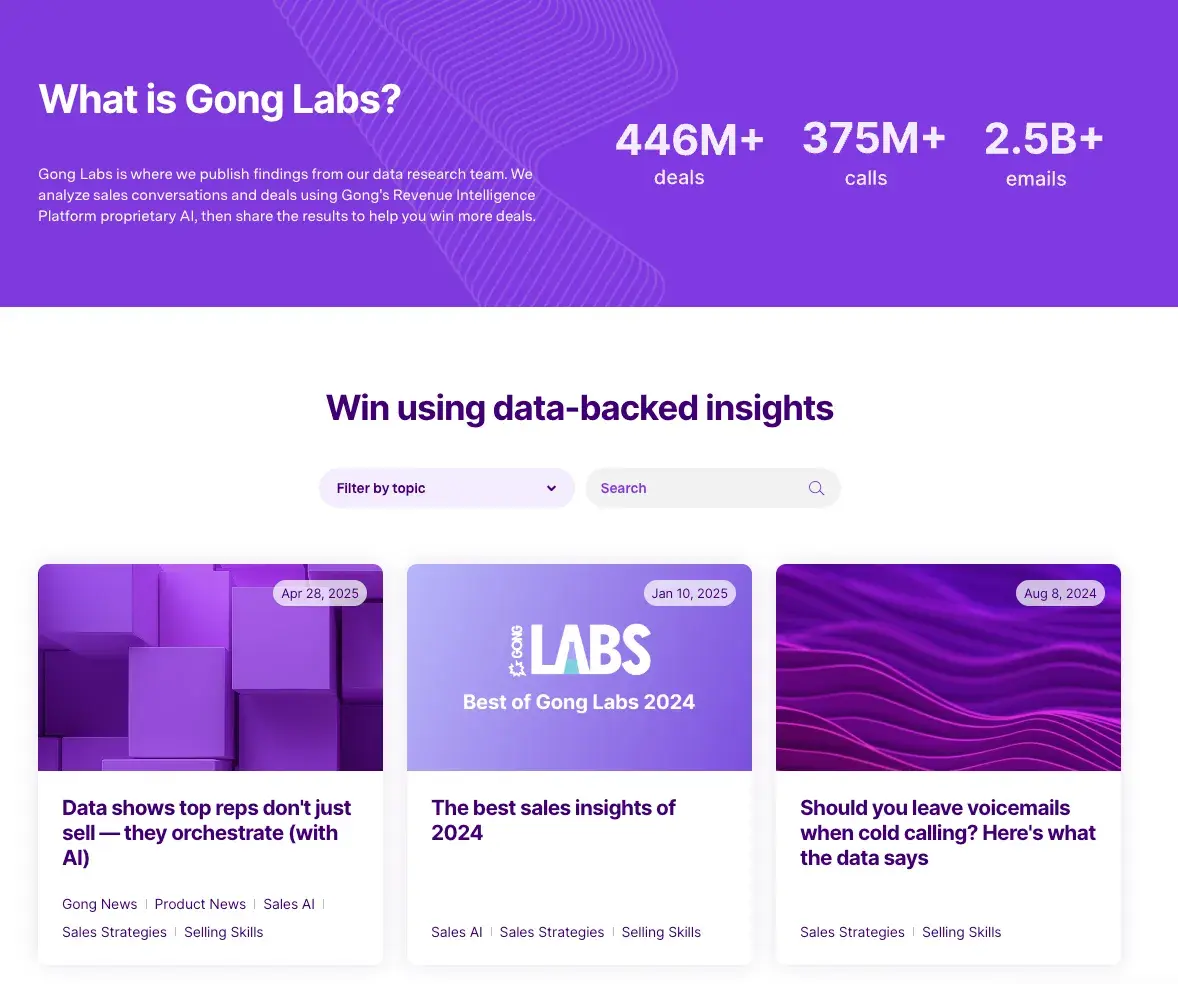
This makes your content memorable in a way that purely informational content can’t match. It shows you understand the human side of the job, not just the metrics.
3. Show Up Consistently Across Multiple Channels
People learn and consume content differently. Some prefer reading, some prefer listening, and some need to see it. That’s why you should show up across formats: LinkedIn posts and blog articles for readers, podcasts for audio-first folks, and webinars or short videos for visual learners.
This approach has two benefits. First, you reach more people by diversifying formats. Second, your biggest fans consume content across multiple channels, deepening their connection with your brand. It ensures you don’t have weak spots in your content based on when and where your audience engages.
4. Measure Success Like a Brand, Not Just a Funnel
Measuring brand impact can be challenging, but it’s essential. Instead of obsessing over last-touch attribution, track metrics that reflect brand health and mindshare. These include audience growth (LinkedIn followers, podcast downloads, newsletter subscribers), direct web traffic (people typing your URL directly, a clear sign of brand recall), and inbound opportunities (deals that come to you without you chasing them).
This approach requires documenting your strategy clearly. Who are you helping? What problems are you solving? Where are you showing up? How are you measuring progress? This documentation becomes your armor when stakeholders ask about ROI.
5. Get Buy-In to Play the Long Game
When stakeholders push back with questions like, “Is LinkedIn too saturated?” or, “Does anyone still read email?” flip it around: “When you’re looking for new ideas or products, where do you go?” The answer is almost always their network, LinkedIn, newsletters, and podcasts—exactly where your buyers are already spending time.
If you’re going to get buy-in, you need a documented strategy. You need to clearly define who you’re helping, what problems you’re solving, where you’re showing up, and how you’re measuring progress. This clarity helps secure the resources and time needed to build a brand that lasts.
The Long-Term Impact of Mindshare Over Leads
Most marketers are fighting for scraps: the 5% of people already in the market. But if you play the long game and invest in the 95%, you can build something better: a brand that earns attention before there’s ever a sales conversation. At Gong, this approach helped them grow their LinkedIn from 12,000 to over 220,000 followers. Their podcast crossed 100,000 downloads in the first 18 months. Webinar registrations jumped from 500 to over 2,500. And they saw email open rates hit 28%, with consistent inbound pipeline that aided and accelerated their sales outbound efforts.
But the qualitative shift was even more significant. Sales reps told them they used Gong’s content in onboarding. Leaders mentioned that their material was constantly shared in Slack channels. Buyers showed up to demos already believing Gong could help them.
That’s the magic of mindshare. It turns your marketing from an interruption into a pull. From a transaction into a relationship. From “Who are you again?” to “We’ve been following you for a while.”
Why Mindshare Matters in the AI Era
In the context of AEO/GEO Services, this principle is even more critical. As generative search and AI-driven discovery become the norm, brands that have built deep mindshare are the ones that get cited and recommended. AI engines prioritize content that is authoritative, helpful, and trusted by users. If you have been earning the attention of the 95% through high-value, problem-solving content, you are more likely to be surfaced in AI-generated answers.
When urgency strikes or when someone’s boss says, “We need a new sales tool,” or “Let’s rethink our strategy,” you want to be the first name they remember. That’s not luck. That’s brand. So if you’re tired of chasing leads, maybe it’s time to flip the script. Build content that helps. Show up consistently. Speak to the 95%.
By focusing on the 95-5 rule, you are not just generating leads; you are building a sustainable competitive advantage. You are creating a brand that is resilient, trusted, and top-of-mind. This is the foundation of long-term growth in any industry, especially in the rapidly evolving landscape of AI and digital search.
Final Thoughts on Building Demand
The shift from lead generation to audience nurturing is not easy. It requires a willingness to let go of short-term metrics and a commitment to providing genuine value. But the rewards are significant. You build a brand that people trust, follow, and recommend. You create a pipeline that is more predictable and sustainable. And you position your business to thrive in an increasingly competitive and AI-driven market.
Consider how your current content strategy aligns with the 95-5 rule. Are you only speaking to the 5% who are ready to buy? Or are you investing in the 95% who are not? The answer to that question will determine the long-term health and growth of your brand. Start by identifying the pain points of your audience. Create content that solves those problems. Tell stories that resonate. And measure your success in terms of mindshare, not just leads. The results may take time, but they will be worth it.





