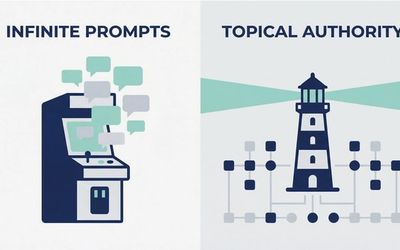
The Paradigm Shift: Moving Beyond Traditional SEO Metrics
The legacy playbook of chasing keyword density and backlink volume is obsolete in the age of generative search. Modern Large Language Models (LLMs) do not rank static pages; they synthesize proprietary knowledge to provide direct answers. Consequently, traditional SEO metrics—like click-through rate on blue links—fail to capture the reality of how users interact with AI interfaces.

Answer Engine Optimization (AEO) is no longer an optional technical tweak; it is a fundamental business necessity for brands that want to remain relevant. The goal has shifted from dominating SERPs to becoming the verifiable source of truth within an AI’s knowledge base. To win, businesses must move away from keyword targeting and instead focus on building robust citation authority, ensuring that when a model generates an answer, your brand is the entity it relies on.
Multi-Platform Ecosystem Strategy: Winning Beyond Google
Dominance in generative search requires an understanding of how different engines weigh data. While ChatGPT, Perplexity, and Claude share similarities, each utilizes unique training weights and data retrieval processes.
- Diverse Interface Adaptation: Content must be adaptable. AI search engines thrive on concise, high-value information that can be easily parsed for summaries.
- Non-Search Signal Integration: Platforms like Reddit and Quora serve as critical training grounds for LLMs. Participating in these ecosystems is not just for community management; it is a deliberate strategy to seed data into the models that power AI search.
- Cross-Platform Consistency: Maintaining a consistent narrative across your website, social platforms, and community forums ensures that AI models receive reinforced signals about your brand’s expertise.

Operationalizing for Velocity: The Modular Content Sprint
Scaling visibility requires moving from traditional long-form content production to a modular content sprint methodology. This approach treats your website as a dynamic knowledge repository that AI models can efficiently index.
- Snippable Architecture: Lead your content with clear, authoritative definitions. Use list-structured data to present core concepts, making it effortless for AI to extract high-value snippets.
- Entity-Rich Production: Focus on creating high-value, entity-dense content that explicitly connects your products to common user problems.
- Deployment Alignment: Structure your content deployment cycles to match the frequent re-indexing patterns of modern LLMs, ensuring your most current data is always the primary reference.
Community Seeding and the Authority Feedback Loop
Your brand’s presence in community-driven ecosystems acts as an essential “third-party validation” signal for AI models. By engaging where experts and users discuss your industry, you create high-signal data points that LLMs ingest.
- Influencing Sentiment: Proactively contribute to community discussions to establish a recognizable voice that correlates with your brand authority.
- Citation Building: When your brand is consistently cited or discussed in authoritative community contexts, you increase the likelihood of being pulled as a primary source in generative results.
- The Authority Feedback Loop: Use community engagement to surface new user questions, which then inform the next cycle of your modular content production.
Proving Performance: Attribution and Citation ROI
To justify investments in generative search, you must replace vanity metrics with concrete performance indicators focused on brand visibility.
- Citation Volume Tracking: Move beyond organic traffic and measure how frequently your domain is cited as a source in AI-generated answers.
- Attribution Frameworks: Develop internal processes to track leads originating from AI interfaces, focusing on qualitative feedback and brand mention volume.
- Visibility KPIs: Establish specific targets for ongoing content presence in AI ecosystems, ensuring your brand stays at the forefront of automated decision-making.