The Shift: Beyond Traditional SEO to Answer Engine Optimization
Traditional SEO was built for a world of link-based discovery, where users clicked through a list of blue links. The emergence of LLM-based search fundamentally shifts this dynamic. Search engines are evolving into answer engines, prioritizing synthesized, direct responses over directing traffic to external domains.
This shift necessitates a transition to Answer Engine Optimization (AEO). Unlike traditional SEO, which focuses on satisfying crawlers to rank in a list, AEO focuses on making information machine-readable and highly extractable. AI models prioritize content that is direct, authoritative, and structured to fulfill the user’s informational needs in a single, synthesized interaction.
Reverse-Engineering the AI: How Models Interpret Information
To secure visibility, one must understand how models process data. AI does not “read” content in the human sense; it performs entity extraction and identifies factual hierarchies within your text.
- Factual Hierarchy: AI prioritizes content that clearly establishes entities (people, products, concepts) and their relationships.
- The Problem with ‘Fluff’: Standard SEO often encourages long-form content filled with transitionary filler. For an AI, this noise obscures the core answer. AI models favor concise, dense information that directly addresses a query.
- Factual Clarity: Ambiguity is the enemy of AEO. Use precise terminology and avoid metaphors or overly flowery language that may lead to hallucinatory misinterpretations by the model.
Structuring Content for Machine Extraction: The AEO Framework
Your content structure must serve as a roadmap for the AI. By using specific formats, you signal to the model exactly how to use your information in a summary.
- Definitions: Provide an immediate, one-sentence definition followed by supporting context.
- Lists: Use bulleted or numbered lists for sequential steps or features.
- Comparisons: Utilize tables to clearly map out side-by-side differences between products or concepts.
Implement an AEO-first heading strategy. Headings should be phrased as direct questions or declarative statements that represent the information contained below them, allowing the AI to map your content directly to search queries. Keep paragraphs between 40–60 words to fit within typical answer-window constraints.
Tactical Keyword Research: Targeting the ‘Questions People Ask’
AEO requires moving away from high-volume, static keyword phrases to question-based intent mapping.
- Analyze PAA Data: Examine ‘People Also Ask’ (PAA) boxes to identify the specific granular questions your target audience is asking.
- Forecast Triggers: Map these questions to the core problems your product solves.
- Seed Questions: Integrate these exact questions into your H2s and H3s. By positioning your content as the direct, authoritative answer to a specific question, you force the AI to cite your content to fulfill its goal of providing a helpful response.
Technical Implementation Checklist for AI Visibility
While content is paramount, your technical foundation must facilitate easy crawling and extraction:
- Schema Markup: Use
Article,FAQPage, andHowToschema to explicitly define the intent and structure of your content to search bots. - Boilerplate Reduction: Limit repetitive, non-unique content (like long navigation menus or boilerplate disclaimers) that can dilute the ‘answer density’ of your pages.
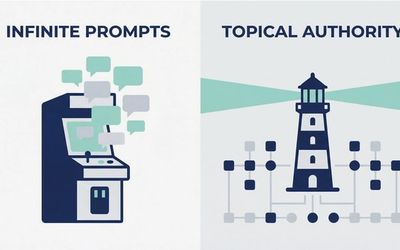
- Topical Authority: Use internal linking to connect related questions and topics, creating a web of expertise that confirms your site as a trusted, authoritative source on a specific subject.
Measuring AEO Performance: Beyond Clicks and Rankings
In the generative search era, the traditional click-through rate (CTR) is an incomplete metric. You must adopt a new set of KPIs:
- Brand Mentions in Synthesized Answers: Track how often your brand is cited or linked within generative AI results.
- Answer Position Impact: Measure the shift in traffic for terms where your site appears in the AI answer box versus standard listings.
- Entity Association: Monitor how often your brand is associated with core industry topics in LLM outputs.
Success in this new era is defined by your brand’s ability to become the authoritative source from which AI engines derive their answers.