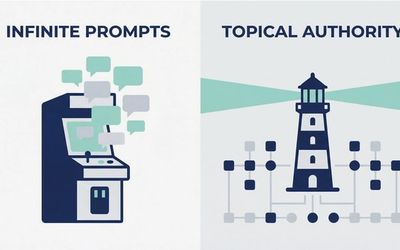
The Paradigm Shift: Moving Beyond Traditional SEO to AI-Ready Infrastructure
In the era of generative search, the primary objective has shifted from capturing clicks to establishing authoritative answerability. Traditional SEO relied on keyword-based retrieval, where search engines acted as indexes pointing users toward external pages. Today, AI models synthesize information internally, prioritize semantic intent, and select sources based on their utility as foundational knowledge.
To win in this ecosystem, brands must move beyond link-building and superficial keyword stuffing. Instead, success requires vector-ready content—information structured to be easily parsed, indexed, and retrieved by Large Language Models (LLMs). Authority is no longer measured by domain backlinks, but by factual density and the model’s ability to reliably cite your content as an accurate, primary source.
Assessing Your AIO Maturity: An Organizational Roadmap
Transitioning to an AI-first strategy requires moving through a structured organizational lifecycle. Many teams fail because they attempt to optimize for AI without first addressing internal process gaps.
The AIO Maturity Model consists of three distinct stages:
- Experimentation: The discovery phase. Teams begin by auditing existing documentation to identify semantic gaps—areas where the brand lacks clear, authoritative answers for target queries.
- Adoption: The integration phase. Organizations transition from manual content creation to building automated production workflows. The focus is on establishing consistency in how entities and facts are represented across all digital assets.
- Scaling: The operational phase. Here, organizations leverage feedback loops, where data from model responses directly informs and refines the content roadmap, ensuring a permanent presence in AI-generated answers.
Identifying internal bottlenecks—such as siloed content teams or lack of technical API access—is critical to moving from the experimentation phase into sustainable scaling.
Technical Foundations: Beyond Schema to Vectorized Retrieval Readiness
While structured data is a baseline requirement for web visibility, it is insufficient for AI retrieval. To ensure your content is prioritized by LLMs, it must be prepared for vectorization.
Modern AI systems convert text into mathematical representations (vectors) to determine semantic relevance. You can optimize for this process by:
- Logical Hierarchy: Organizing content into clear, predictable structures where H-tags reflect the primary relationship between entities.
- Factual Density: Prioritizing high-utility information over narrative fluff.
- Contextual Clarity: Using precise terminology that leaves little room for LLM misinterpretation.
Organizations should also implement API-driven testing. By simulating how LLMs retrieve and synthesize your brand data, you can tune your content to ensure your core messaging remains central to the model’s output.
Operationalizing AIO: From Audit to Continuous Feedback Loops
Achieving visibility is not a one-time project; it is an iterative, continuous loop.
To operationalize AI search optimization, follow this framework:
- Intent-Match Audit: Systematically map your current content against common user queries to identify where intent-match failures occur.
- Model Testing: Regularly verify how models respond to high-priority industry questions. If your brand is not being cited, investigate whether the deficiency lies in structural hierarchy, semantic clarity, or factual accuracy.
- Feedback Refinement: Use the insights gained from model responses to update your underlying knowledge base. By treating AI feedback as a primary data source for your content strategy, you move from reactive content production to proactive authority building.
Industry Case Studies: Applying AIO Maturity to Your Content Vertical
The impact of applying a structured AIO maturity model varies by industry, yet the core principles remain constant:
- SaaS Documentation: By refining troubleshooting guides into highly structured, semantically clear datasets, software companies can ensure LLMs provide accurate, step-by-step resolution answers, effectively reducing customer support volume.
- Agency Content Strategy: Agencies can pivot from traditional volume-based blogging to building industry-authority hubs. By focusing on deep entity mapping rather than long-tail keyword chasing, they secure consistent placement in competitive generative summaries, positioning their clients as the definitive industry experts.