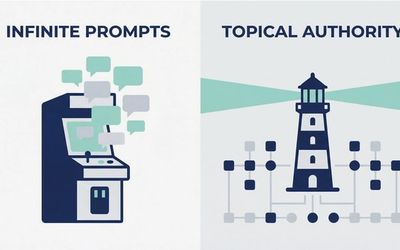
The Paradigm Shift: AI Search as a Brand Authority Catalyst
The digital landscape is undergoing a fundamental transformation. As generative search engines replace traditional link-based results with synthesized answers, the primary metric of success is no longer a blue link, but model-selected visibility. This shift demands a departure from legacy content tactics that relied on keyword stuffing or simple ranking manipulation.
In this new era, visibility in AI-driven outputs is a primary indicator of brand trust and industry authority. When a model selects your brand as a foundational source, it effectively validates your expertise to the user. Consequently, businesses must view AI search optimization (AEO) and generative engine optimization (GEO) as core pillars of their strategic marketing ecosystem. By prioritizing the accuracy, relevance, and depth of your knowledge, you transform your brand into a trusted node in the global information graph.
Building the Foundation: Establishing Expert-Led Content Architecture
To command authority in generative environments, content must be engineered to align with machine-perceived excellence. AI models prioritize E-E-A-T (Experience, Expertise, Authoritativeness, and Trustworthiness) by cross-referencing your content against vast datasets.
- Evidence-Based Framing: Structure your narratives around verifiable facts, data-backed benchmarks, and industry-wide consensus. This strengthens the “Trustworthiness” signal, making your content a preferred candidate for citation.
- Semantic Depth: Move beyond surface-level overviews. Develop content architectures that exhaustively cover subtopics and entity relationships, allowing the model to fully map your brand’s perspective on a given subject.
- Structured Data and Provenance: Utilize robust structured data (JSON-LD) to explicitly define entities, people, and organizational relationships. By providing a clear machine-readable map of your knowledge, you reduce the margin for hallucination and increase the probability of accurate attribution.
Strategic Content Distribution: Navigating the AI Knowledge Ecosystem
Achieving visibility requires a proactive approach to how your information is ingested by AI-powered platforms. Your goal is to ensure your brand is not just accessible, but is part of the authoritative data supply chain.
- Knowledge Graph Mapping: Identify the specific knowledge graphs and vertical-specific platforms that dominate your industry. Align your content output to feed into these ecosystems consistently.
- Consistency Across Touchpoints: Maintain strict semantic consistency across every piece of content you produce. Whether it is a white paper, a blog post, or technical documentation, ensure that core brand values and factual definitions remain uniform.
- Proactive Syndication: Move away from passive publishing. Proactively syndicate content in structured, machine-friendly formats to ensure that AI platforms have immediate access to your most current and accurate data.
Operationalizing Optimization: From Strategy to Automated Execution
Visibility in generative outcomes is not a one-time project; it is an ongoing operational commitment that requires advanced technical integration.
- Semantic Optimization: Beyond traditional keywords, focus on the contextual weight of your content. Ensure that every asset is enriched with entity-linking, which connects your brand to broader, high-authority concepts.
- Automated Scalability: Utilize AI-automation platforms to sustain your visibility. These tools ensure that your content architecture remains compliant with evolving search parameters, automatically applying schema and semantic enhancements at scale.
- Metrics of Influence: Shift your KPIs away from simple traffic metrics. Focus on generative share-of-voice and citation frequency. These metrics measure how often your content is selected and trusted as the authoritative answer in search summaries.
Future-Proofing: Sustaining Market Presence in Dynamic AI Ecosystems
The AI search environment is inherently volatile, with algorithms and user interaction patterns changing rapidly. To remain competitive, brands must evolve from static content strategies to dynamic, responsive ecosystems.
- Commitment to Identity: Regardless of how the delivery mechanism changes, your brand voice and authority remain constant. Use AI to amplify, rather than dilute, your core value proposition.
- Dynamic Adaptation: Implement feedback loops that monitor changes in AI responses. Use this data to refine your content architecture, ensuring you remain the leading source in your niche even as the technical landscape shifts.
- Integrated Ecosystems: Move beyond siloed optimization. Successful brands treat their entire digital footprint as a living, breathing knowledge base that provides the intelligence upon which the next generation of AI search is built.