The Blended ROI Model: SEO vs. AI Search Budget 2026
Modern digital marketers face a paradox: while traditional organic search traffic declines, brands cited in AI responses see a 35% organic lift. This shift signals that the rules of search have changed. Measuring ai search roi—by focusing solely on click-through rates and keyword positions—no longer captures the full picture. Because many searches end inside AI answer boxes, visibility without clicks is now a powerful form of brand equity.
Defining the ROI Landscape: SEO, AEO, and GEO
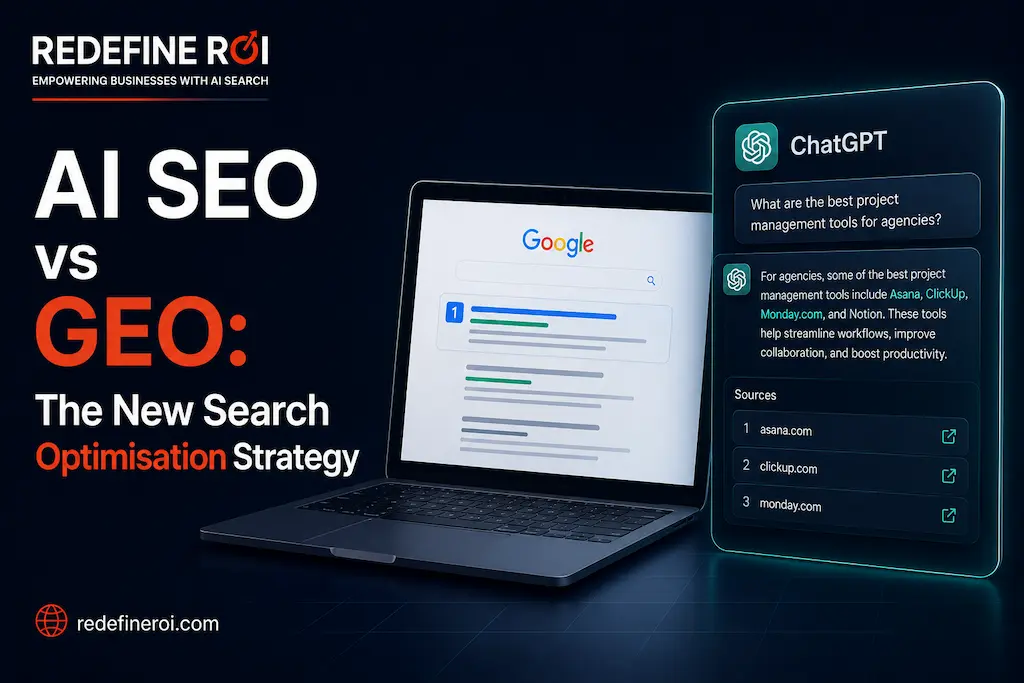
The traditional view of search visibility often pits channels against each other, creating a false binary between organic search and artificial intelligence. This perspective is strategically dangerous. To understand your search investment, you must recognize that SEO, AEO (Answer Engine Optimization), and GEO (Generative Engine Optimization) are not competitors. They are three interconnected layers of a unified ecosystem.
SEO remains the foundational layer, driving organic clicks through traditional Search Engine Results Pages. AEO optimizes content to be directly quoted or cited in AI-generated answer boxes, competing for authority within the answer itself. GEO takes this further, optimizing content to be referenced by large language models like ChatGPT, Perplexity, and Gemini.
| Feature | SEO | AEO | GEO |
|---|---|---|---|
| Primary Goal | Secure rankings and clicks | Secure snippets | Secure recommendations |
| Target Platform | Google, Bing | AI Overviews, Chatbots | ChatGPT, Perplexity, Gemini |
| Success Metric | CTR, Position | Quote Inclusion | Citation Frequency |
| Interaction | Site visit | Direct answer reading | Information synthesis |
The synergy between these layers creates Blended ROI. This model measures the total business value derived from organic clicks, AI answers, and long-term brand trust signals. When you optimize for all three, you create a presence that captures users regardless of their chosen interface.
The Data Case: Why Blending Beats Binary Choices
The decision between investing in traditional SEO or pivoting entirely to AI search optimization is a false dichotomy. Recent data reveals that visibility across both channels creates a compounding effect. Understanding this “Citation Lift” is critical for maximizing your ai search roi in 2026.
Brands cited in AI-generated answers experience a significant performance boost. According to 2026 data, organizations cited in AI responses see a 35% increase in organic clicks and a 91% increase in paid clicks. When an AI engine cites your brand, it acts as a third-party endorsement, making users more likely to click your link in traditional SERPs.
Furthermore, AI search traffic demonstrates higher conversion intent. Visitors from AI interfaces convert at rates up to 23x higher than traditional organic search traffic. These users are typically in the research phase, asking complex questions that require detailed, trustworthy answers. By providing those answers, you drastically shorten the path to purchase.
While “zero-click” searches account for 60-83% of queries, they remain authority-building events. Every citation reinforces your E-E-A-T signals in the eyes of models and users alike. Ignoring this visibility means ignoring the foundation of long-term digital trust.
The Blended Budget Allocation Framework
Effective strategy requires a hybrid financial model. A blended approach recognizes that search is a layered ecosystem. Based on current ai search trends, a recommended 60/25/15 distribution model ensures both foundational stability and emerging growth.
The 60% Foundation: SEO as Infrastructure
Sixty percent of your search budget should remain dedicated to traditional SEO. AI models retrieve and synthesize existing web pages; if you have no SEO footprint, you have no citation footprint. Focus your investment on technical health, content depth, and building clear E-E-A-T signals through author credentials and site architecture.
The 25% Acceleration: AEO for Snippet Capture
Allocate 25% of your budget to Answer Engine Optimization to ensure your content is structured for AI overviews. This includes deploying Schema.org markup and rewriting key pages to provide clear, 40–60 word direct answers. Pages with proper schema are 2.7x more likely to be cited by AI.
The 15% Multiplier: GEO for Entity Authority
The final 15% supports Generative Engine Optimization. GEO focuses on securing mentions in authoritative industry publications and consolidating your brand entity across digital directories. These efforts amplify your SEO by ensuring your brand is recognized as an authoritative source within AI knowledge graphs.
To calculate your true value, use a blended formula:
Blended ROI = (Organic Clicks × Conversion Rate × LTV) + (AI Citations × Trust Multiplier Value)
Execution: Optimizing for Synergy, Not Competition
To unify your efforts, adopt an “Answer-First” architecture. Write a concise, self-contained 40–60 word answer at the top of your most critical pages. This provides the exact snippet that AEO tools require and establishes the entity context that GEO models use for citation.
Implement E-E-A-T markers everywhere. AI models use these signals to determine if a source is credible enough to be quoted. Include named authors, professional bios, and links to third-party awards or press mentions. Finally, utilize content clustering to build topical authority. When you structure content around entities rather than just keywords, you create a web of relevance that is impossible for AI to ignore.
Measuring Success: New KPIs for the Blended Era
Traditional dashboards tell only half the story. You need a dual-track strategy to capture both direct traffic and invisible citation value. Monitor your AI Citation Rate to track how often your brand appears in LLM responses, and compare this against your competitors using Brand Mention Share.
Do not abandon your classic tools. Google Search Console impressions and keyword positions remain vital indicators of foundational health. Finally, set up GA4 custom channels to isolate referral traffic from AI platforms. Tracking these conversions allows you to perform an accurate seo roi calculation that accounts for your total generative search value. By ignoring the blended seo strategy, you risk irrelevance as AI becomes the primary interface for information discovery.
AEO/GEO
Want to learn more?
Contact us for direct consultation and support.