The Competitive Entity Gap: How to Optimize for AI Search
Picture this: you’ve published the perfect article. It targets the right keywords, flows beautifully, and answers every question a potential customer could possibly ask. Yet, when you type that query into Perplexity or Google’s AI Overview, your brand doesn’t appear. Not once. Meanwhile, a competitor with mediocre content sits front and center, trusted as the authoritative source.
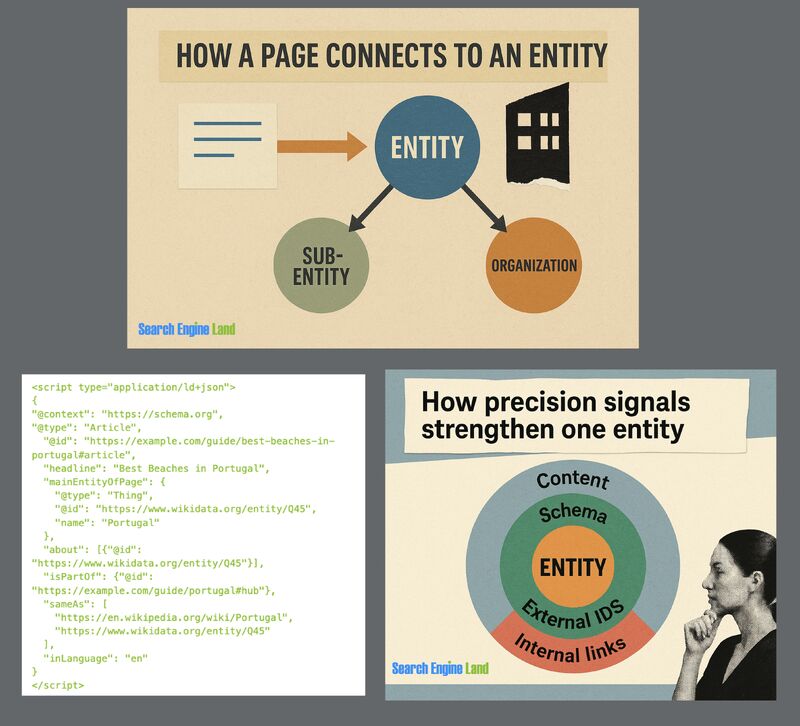
The answer lies in a fundamental shift in search. For years, we chased keywords, hoping that mentioning a term enough times would earn us a ranking. Today, AI search engines operate on an “entity-first” reality. They don’t just count words; they map relationships between people, places, products, and concepts. If your digital presence lacks the semantic connections that AI models expect, you remain invisible to the algorithms. We call this the “competitive entity gap”—the missing link that separates brands visible in AI answers from those left in the dark.
What is an Entity Gap Analysis?
Imagine asking a friend, “What’s the best project management tool for remote teams?” They don’t just scan a grocery list of product names. They consider your specific context, recall past experiences, weigh pros and cons, and synthesize a recommendation. This is exactly how modern AI search engines operate.
AI models rely on complex structures called knowledge graphs—vast networks of interconnected facts. To understand what you are selling, these systems look for specific entities and the relationships between them. If your content doesn’t explicitly connect these dots, the AI doesn’t see you as a valid source. An entity gap is the semantic distance between your content and the authoritative nodes that AI uses to construct answers.
| Criteria | Traditional Keyword SEO | Modern Entity Gap Analysis |
|---|---|---|
| Primary Intent | Match specific search terms | Build semantic relationships & trust |
| Measurement | Volume, Click-Through Rate (CTR) | Entity density, sentiment, connectivity |
| Core Focus | Individual words & phrases | Nouns, concepts, & their connections |
| AI Readiness | Low | High |
Fixing these gaps is how you win in Generative Engine Optimization. When you eliminate these semantic voids, you move from being a passive URL in a search result to an active voice in the conversation.
Step-by-Step: Auditing Your Competitors for Entity Gaps
Finding your competitive advantage in the AI era means mathematically identifying what AI models already associate with your rivals but overlook in your content. By treating your content as a dataset, you can pinpoint exactly which entities are missing from your semantic footprint.
- Define Your Core Seed Entities: Identify 5-10 primary topics or seed entities that define your niche, such as specific tech specs or industry regulations.
- Run NLP Extraction on Competitor Pages: Use tools to scan the top 10-15 ranking articles from competitors and extract detected entities.
- Calculate the Delta: Compare the entity lists from your competitors against your own. Flag entities that appear frequently in competitor content but have a count of zero in yours.
- Measure Sentiment Velocity: Track how AI models are interpreting the narrative context around your brand. Are competitors linked to positive sentiment markers like “reliable” while you remain invisible?
Visualizing these gaps helps you understand not just what is missing, but why it matters. If your brand is floating far from the main cluster of industry terms, AI search engines will struggle to place you firmly in the conversation.
Practical Tools for Your Semantic Audit Workflow
You don’t need a team of data scientists to perform these audits. By integrating specific tools into your existing workflows, you can uncover opportunities that traditional research misses.
- Diffbot: Ideal for massive entity extraction. It uses deep learning to organize messy web data into structured knowledge graphs, perfect for scanning an entire competitor’s website.
- spaCy: A fast, open-source library that is excellent for building custom NLP pipelines to process your own content and identify missing semantic anchors.
- Google Cloud NLP: This tool helps you analyze the sentiment and entity salience of your content, showing exactly which words carry the most weight in the eyes of an AI.
Set up a monthly “Entity Sync” to compare your pillar content against trending industry terms. Use embeddings to measure how closely your content alignment scores compare to industry benchmarks. If your score is low, inject the missing entities to ensure your content speaks the same language as the top performers.
Actionable Fixes: Closing the Gap in Your Content
Once you identify the missing pieces, your goal is natural integration. Don’t engage in “schema stuffing”—AI models value coherence and context over keyword density.
Use JSON-LD to explicitly define your entities. The sameAs property is your way of linking your brand to authoritative sources like Wikipedia or LinkedIn, while mainEntityOfPage confirms the primary subject of your content. Additionally, create entity-rich support content to anchor your main topics. If your main page is about “Cloud Security,” create supporting articles on “Zero Trust Architecture” or “Data Encryption Standards.”
Finally, avoid the “hallucination trap” by ensuring your data is consistent across third-party sources. If your website claims your company was founded in 2020, but external directories say 2018, the AI will distrust your data. Regularly audit your profiles on sites like G2 and Crunchbase to ensure your digital footprint remains uniform. Consistency is the foundation of AI trust.
By treating your website as a data-rich knowledge graph, you ensure your brand remains visible, authoritative, and ready for the future of search. Use these steps to close your entity gaps and secure your place as a primary source in AI answers.
AEO/GEO
Want to learn more?
Contact us for direct consultation and support.