Beyond Traditional SEO: The Paradigm Shift to Citation Authority
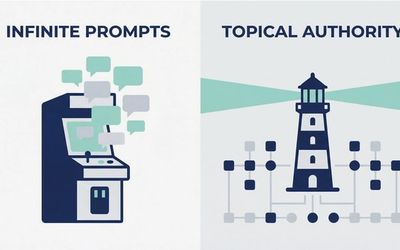
The search landscape has undergone a seismic shift. We have moved away from an era defined by keyword density, backlink counts, and traditional blue-link rankings. Today, generative search engines like Perplexity, ChatGPT, and Google’s AI Overviews operate on a different logic: Entity Commands and Citations.
Visibility in these systems is no longer about tricking an algorithm into showing a link; it is about establishing market authority that AI models feel compelled to cite. In this new ecosystem, Generative Engine Optimization (GEO) is the required strategy. Unlike classic SEO, which prioritizes click-through potential, GEO focuses on becoming the primary source of truth for specific industry queries. If your brand is not the entity being cited, you are effectively invisible to the next generation of high-intent search users.
The 5 Pillars of AI Visibility: A Strategic Framework
To secure consistent visibility, you must move beyond technical hacks and build a robust presence across these five critical pillars:
- Entity Clarity and Knowledge Graph Integration: Ensure your brand, products, and solutions are clearly defined as distinct entities. Use structured data to map these relationships, making it effortless for LLMs to understand who you are and what you command.
- E-E-A-T as the Engine for AI Trust Signals: AI models prioritize authoritative, credible, and trustworthy information. Demonstrating expertise at scale acts as a signal that differentiates your content from generic, low-effort responses.
- Content Architecture for Multi-LLM Parsing: Structure your information so that it is logically modular. AI models parse content better when it is organized into distinct, self-contained semantic hubs rather than long, wandering narratives.
- Citation Tracking and Cross-Platform Monitoring: You must treat citations as the new “traffic.” Monitor where and why your brand is mentioned by AI models to identify gaps in your authority coverage.
- Revenue-Centric Attribution: Connect your AI-generated visibility to real-world business outcomes. Visibility is meaningless if it does not correlate with qualified leads or revenue growth.
Operationalizing Your 100-Day GEO Sprint
Achieving dominance requires a disciplined, long-term approach to content engineering.
- Days 1–30: Audit and Entity Alignment: Conduct a comprehensive review of your digital presence to ensure your brand entities are accurately recognized by search ecosystems. Eliminate legacy contradictions in your messaging.
- Days 31–60: Content Restructuring and Semantic Hub Creation: Reorganize your existing content into thematic hubs. This architecture allows LLMs to navigate your expertise comprehensively, reinforcing your status as the preferred source.
- Days 61–100: Citation Expansion and Performance Correlation Analysis: Actively monitor your citation frequency across AI search platforms. Adjust your content strategy based on which topics are triggering consistent mentions and driving conversions.
Avoiding AI-Blindness: Pitfalls That Kill Visibility
Even well-funded campaigns fail when they fall into common traps.
- Siloed Content Architecture: When content is isolated from the broader context of your brand, LLMs fail to connect the dots, leading to omission.
- The Fluff Penalty: AI models are designed to be efficient. Filler, repetitive marketing jargon, or low-depth content triggers hallucination or, worse, disqualification from being sourced.
- Performance Beyond Schema: While structured data is necessary, it is not a silver bullet. If your underlying content lacks depth or fails to answer the user’s intent precisely, no amount of technical optimization will save it.

The System That Wins: Automating Sustainable Growth
The era of manual, single-page optimization is ending. To remain visible in rapidly evolving AI search ecosystems, you must transition to automated content engineering.
Using advanced platforms allows you to scale your content presence and maintain consistent entity authority. By automating the distribution of AI-ready content, you shift from chasing rankings to building an omnipresent digital identity. Long-term success is measured by your visibility score—a metric defined by how frequently your brand is cited and the sentiment associated with those mentions. Brands that adopt this systematic approach will not only survive the shift to generative search but will lead their respective industries.