The ROUGE-Friendly Article Template for AI Citations
Most marketers assume that AI citation is simply a reward for high-quality content. This misunderstanding costs brands visibility in generative search. Large Language Models do not evaluate quality in a human sense; they evaluate structure. An AI uses a mechanism called Retrieval-Augmented Generation to pull specific paragraphs based on signal clarity. This means a concise article with perfect structure can outperform brilliant content that is poorly organized.
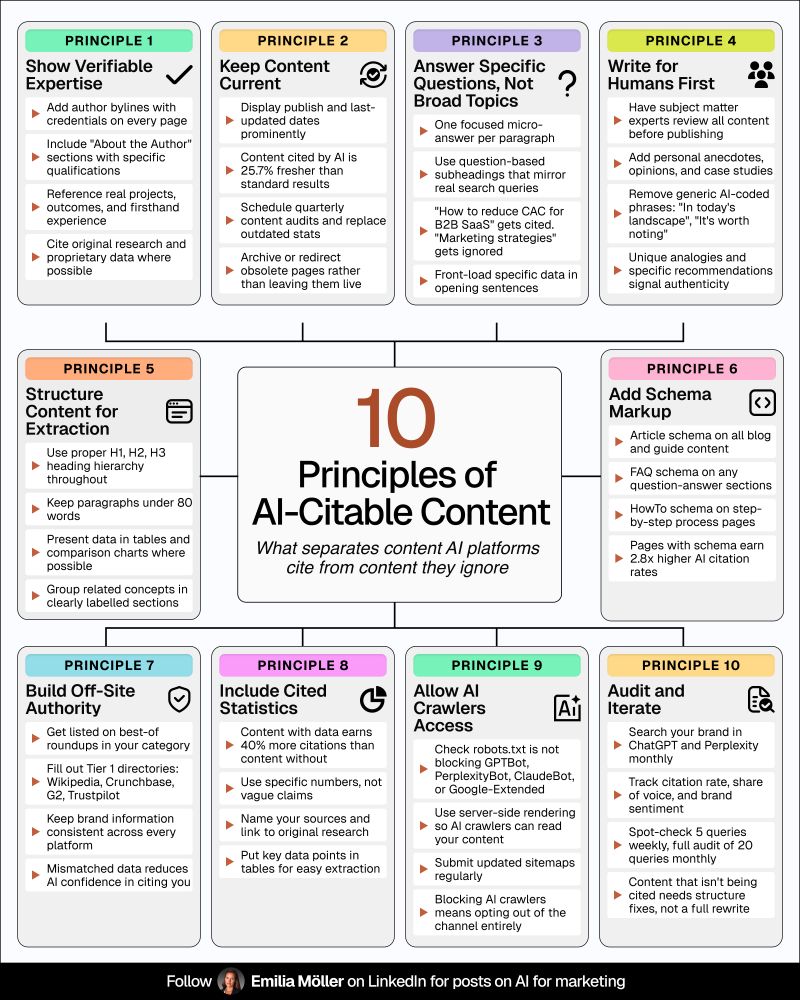
The secret to securing LLM citation lies in extractability. Extractability measures how easily an AI model can parse, verify, and quote content verbatim. It involves engineering content for machine consumption rather than human narrative. High-extractability content achieves high ROUGE similarity scores, indicating that the AI can copy phrasing directly into its response without needing to reinterpret it.
This shift requires a new approach to generative search optimization. You must move beyond traditional readability and focus on creating AI friendly content that acts as a clear signal for search visibility. By aligning your content structure with the mechanical logic of AI parsers, you ensure that your brand is the source the AI trusts.
The Mechanics of AI Citation: Extractability vs. Readability
To understand AI citation, we must dismantle the belief that search engines reward only the best-written content. In the era of generative search optimization, citation is a mechanical function of structure and signal clarity. The core metric is extractability—the ease with which an AI model isolates and quotes your content verbatim.
How LLMs Actually Read: Retrieval-Augmented Generation
Large Language Models do not read articles from start to finish. Instead, they use Retrieval-Augmented Generation (RAG) systems. When a user submits a query, the RAG system splits content into small chunks, converts them into mathematical fingerprints called vectors, and stores them in a database. The AI retrieves specific paragraphs matching the query’s semantic meaning rather than summarizing the entire article.
AI friendly content must be structured so individual paragraphs contain complete, self-contained answers. If a paragraph is vague or relies on context from previous sections, the AI cannot extract it accurately. High search visibility depends on making each paragraph a standalone unit of truth.
Human Readability vs. Machine Extractability
There is a critical divergence between writing for humans and writing for LLM citation:
| Feature | Human-Centric Readability | Machine-Centric Extractability |
|---|---|---|
| Sentence Structure | Complex, varied lengths | Short, direct, explicit |
| Information Flow | Narrative, builds context | Answer-first, self-contained |
| AI Interaction | Summarized or paraphrased | Directly quoted (High ROUGE) |
The Role of ROUGE in Measurement
To gauge how well AI can quote your content, we use ROUGE (Recall-Oriented Understudy for Gisting Evaluation). In the context of AI citation, ROUGE scores serve as a proxy for verbatim extraction. Higher ROUGE similarity indicates that the AI model found your content clear and easy to quote. Optimizing for these scores means ensuring your content is rigidly structured and free of noise.
Structural Pillars for High-ROUGE Content
To secure consistent LLM citation, you must engineer content for mechanical extraction. Four structural pillars influence how models parse your data.
Answer-First Architecture
Place the core conclusion within the first 40-60 words of every section. AI models prioritize the beginning of semantic units. If you bury your main point behind long introductions, the model may skip it. Front-loading the answer creates a clear signal for the AI to isolate.
Paragraph Density
AI extraction performs best with short, focused paragraphs. Maintain a density of under 80 words per paragraph to minimize noise during vector embedding. Long paragraphs introduce ambiguity, making it harder for the AI to define where one idea ends and another begins.
Semantic Hierarchy
Structure content using a strict H1-H2-H3 hierarchy. This provides navigation for AI parsers and mirrors user queries. When your headings align with common questions, AI models easily map your content to specific search intents.
Data Table Integration
AI models extract tabular data with higher fidelity than narrative text. Use structured tables for comparisons and statistics. Tables provide explicit relationships between variables, reducing the risk of misinterpretation.
Signal Verification: Schema, Freshness, and Authority
Content structure requires external signals to verify accuracy and authority. Without these, even well-structured content may be ignored.
The Role of Schema Markup
Schema markup provides instructions to crawlers. Article, FAQ, and HowTo schemas are critical for citation. Pages utilizing these schemas earn 2.8x higher AI citation rates compared to those without them.
Content Currency
AI models prioritize fresh information. Content cited by AI is 25.7% fresher than standard search results. To maximize currency, display ‘Last Updated’ dates and update content frequently. Pages updated within the last 90 days are 3x more likely to be cited.
Verifiable Expertise
AI models prefer content backed by specific sources. Use case studies, cite experts, and integrate data. Content containing data earns 40% more AI citations than content without it.
Off-Site Corroboration
AI models verify the legitimacy of a source by cross-referencing high-authority platforms. Ensure your brand is listed in directories like Crunchbase or G2. Notably, 90% of LLM citations point to earned media rather than owned pages.
Technical Access and Auditing for AI Visibility
Your content cannot secure AI citation if AI crawlers are blocked. Ensure your robots.txt file allows GPTBot, PerplexityBot, ClaudeBot, and Google-Extended.
Auditing Your Citation Footprint
Test direct queries in tools like ChatGPT and Perplexity to see if your domain appears. Note which external domains are being cited to identify gaps in your visibility. If auditing reveals low visibility, determine if you need a structural rewrite to improve extractability or a content overhaul to improve factual depth.
Avoiding Common Pitfalls
Avoid JavaScript-heavy pages that fail to render for crawlers. Furthermore, avoid AI-coded language—repetitive, buzzword-heavy content reduces trust signals and decreases the likelihood of citation.
High-extractability is a systematic engineering challenge. By aligning your content with LLM parsing logic and ensuring ROUGE-friendly formatting, you secure consistent search visibility. Audit your content monthly to adapt to evolving AI models.
AEO/GEO
Want to learn more?
Contact us for direct consultation and support.