The ‘Spicy Autocomplete’ Model: How LLMs Actually Rank Your Brand
To understand winning generative search visibility, we must discard the legacy notion that LLMs function like traditional search engines. Conventional SEO relies on crawlers indexing pages to serve links. Generative AI, however, does not “retrieve” a list; it performs a high-speed prediction of the most statistically probable sequence of tokens based on the vast, ingested corpus of training data.
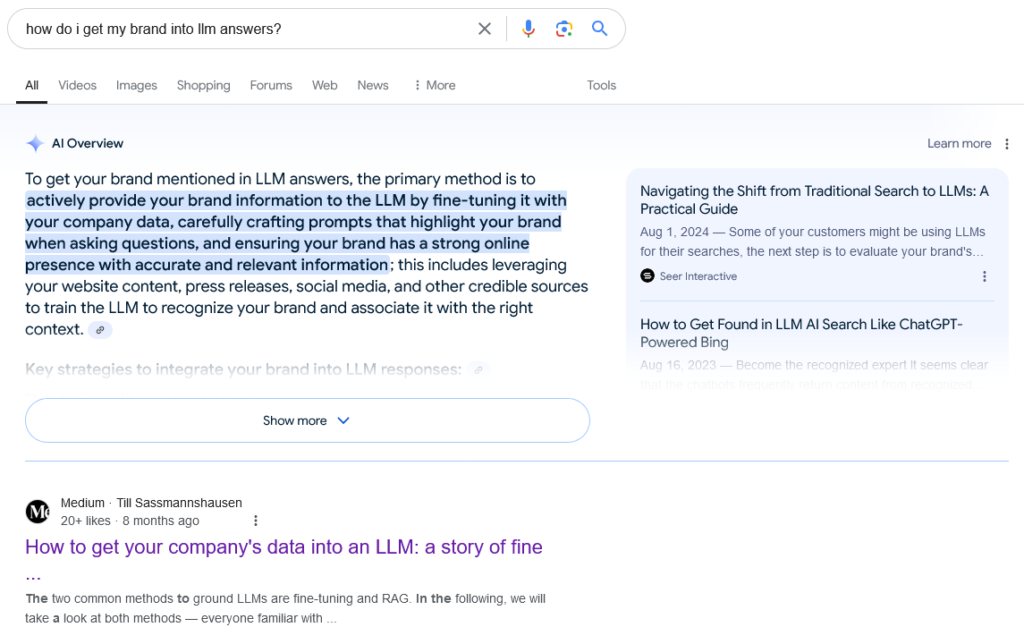
Think of it as a “spicy autocomplete” engine. When a user asks a question, the model evaluates the probability of information being associated with an entity. If your brand is deeply embedded in the high-authority datasets that trained the model, you become a high-probability candidate for the “answer.” If your brand is absent from these foundational training sets, you essentially do not exist in the model’s predictive reality. The focus must shift from technical site accessibility to establishing predictive brand recall.
Mapping Your Generative Affinity: Identifying Where the AI ‘Learns’
Visibility today is defined by entity-relationship mapping. You are not looking for search volume; you are looking for the specific, high-authority digital environments that inform the model’s “intelligence.”
- Audit the Knowledge Sources: Identify the niche-specific, high-authority domains that consistently appear in the model’s answers regarding your industry. These are the “training nodes” for your category.
- Entity-Relationship Analysis: Map how your brand is currently associated with key industry topics. Are you the primary entity mentioned when experts discuss your specific solution, or are you floating in a sea of non-contextual noise?
- Audience-Centric Domains: Use audience intelligence to pinpoint where your target demographic consumes information. The domains they trust are the same ones that carry the weight to tilt the probability in your favor.
Engineering External Validation: The Shift to Entity Authority
Building influence in the era of generative AI requires a fundamental pivot from chasing generic backlinks to engineering high-affinity mentions. Generic links are meant to pass “link juice” to a crawler; entity-specific mentions are meant to strengthen the statistical association between your brand and core industry concepts.
- Co-occurrence Strategy: Seek placement in long-form, expert-driven content alongside recognized industry authorities. When your brand name appears in close proximity to established leaders in high-context articles, you effectively “borrow” their predictive weight.
- Entity-Specific Precision: Your PR and outreach should prioritize depth over breadth. One feature in a highly respected, authoritative publication that the LLM ingests as “truth” is worth more than hundreds of mentions on low-authority, aggregated blog sites.
- Consistency as Authority: Ensure your brand identity—your core value proposition, key personnel, and unique methodology—is stated with precise, consistent terminology across all authoritative touchpoints.
The Predictive Probability Cycle: Measuring Influence in Generative Answers
Standard KPIs like click-through rates (CTR) are lagging indicators in a world of generative answers. To manage your influence, you must monitor the Predictive Probability Cycle.
- Share of Voice in Citations: Track not just if you are mentioned, but how frequently you are cited in response to specific, high-intent industry queries.
- Entity Relevance Shifts: Measure if your “entity-association” strategy is working by tracking the context of AI responses over time. Are you being framed as a commodity, or as an industry-leading expert?
- Thought Leadership Cycles: Align your distribution with the content cycles of your identified high-affinity domains. By inserting your brand into these conversations early, you ensure your entity is present when the model undergoes periodic training updates.
Ultimately, winning in this new environment means moving away from the static, technical-only checklist and toward a dynamic, influence-based strategy that secures your brand’s role as a trusted source of truth within the model itself.