Winning the AI Search War: Engineering Content for AI
Most brands are currently caught in a frantic race to produce more content, believing that volume will win the battle for attention in AI search. Yet, the real conflict isn’t happening on the surface of your blog; it is occurring deep within the technical architecture of how search models perceive your brand. If you rely on generic writing that simply mirrors what is already available, you remain invisible to the sophisticated algorithms powering modern search interfaces.
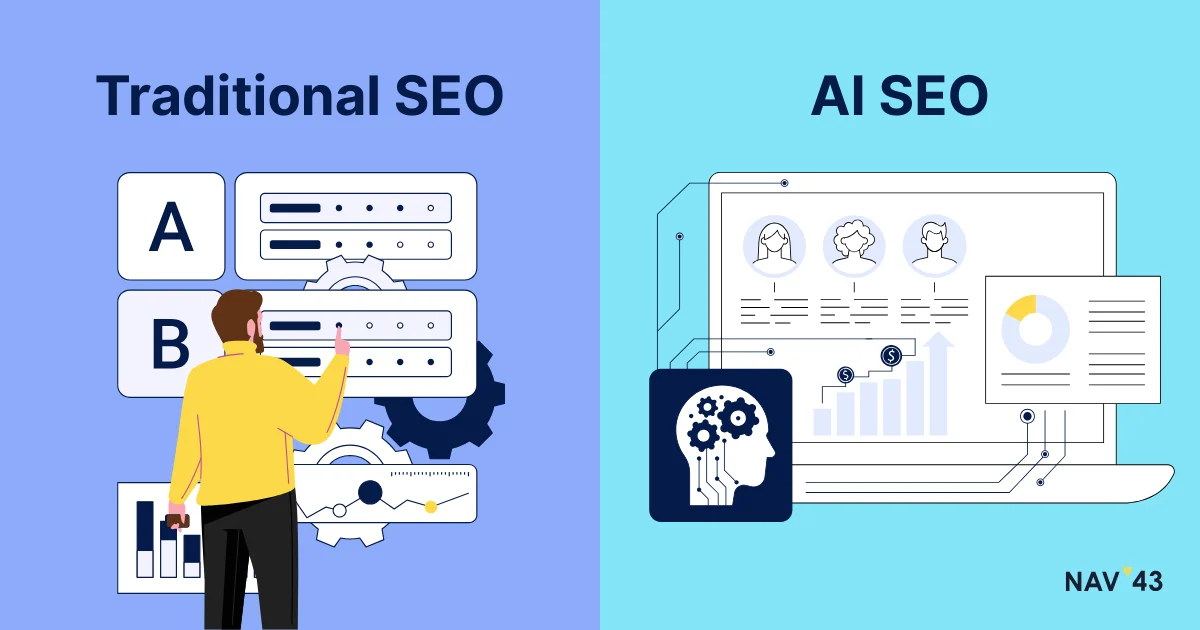
The turning point for your digital presence involves adopting a new AI Content Strategy for the AI Era, one that shifts the focus from simple readability to technical clarity. AI models are rapidly evolving toward a framework of “data provenance.” In this new landscape, search engines prioritize sites that act as trusted, structured primary sources—platforms that offer verifiable facts rather than just keyword-stuffed noise.
When your site becomes a reliable fountain of clean, machine-readable data, you stop competing for clicks and start becoming the foundation upon which generative answers are built. By re-engineering how your information is structured, you move your brand from being a distant voice in the crowd to an authoritative provider of answers.
Why Data Provenance Is the New SEO Authority
In the early days of the web, search engines functioned primarily as directories, indexing pages based on keyword density and link popularity. Today, we are witnessing a massive transition toward Retrieval-Augmented Generation (RAG). In this new landscape, AI models act as sophisticated knowledge synthesizers. They don’t just point users to a link; they ingest, digest, and summarize information to provide direct, factual answers. This shift makes data provenance for SEO the single most important factor for brands looking to maintain visibility.
| Feature | Traditional SEO | AI Provenance SEO |
|---|---|---|
| Primary Metric | Keyword Density | Fact Verifiability |
| Goal | Click-through Rate | Knowledge Attribution |
| Content Focus | Length and Prose | Structured, Semantic Data |
| Trust Signal | Domain Authority (Links) | Source Provenance & Accuracy |
| Crawlability | Page-Level Indexing | Knowledge-Graph Integration |
Data provenance is the process of tracking the origin, history, and reliability of data. Unlike traditional SEO, which rewarded keyword frequency, the AI era rewards how verifiable your claims are. If your content is grounded in proprietary facts, AI models are far more likely to prioritize your information in their responses.
Architecting Your Site for RAG Compatibility
Your AI Content Strategy for the AI Era must shift from writing for human consumption to engineering for machine intelligence. RAG is the engine behind modern generative search, allowing AI models to pull real-time data from the web to ground their answers. If your site is cluttered with non-essential UI elements, the AI will struggle to extract the core information.
The Role of Schema Markup
Schema markup is the universal language that helps AI models understand the context of your data. While traditional SEO uses schema for rich snippets, RAG optimization uses it to provide definitive factual claims.
- Article Schema: Essential for providing context, author details, and publication dates to verify freshness.
- FAQ Schema: The gold standard for Q&A-style outputs by providing pre-packaged data pairs.
- Product Schema: Vital for e-commerce, allowing the AI to extract specific technical specifications and pricing.
Beyond basic tagging, host a clean data index that mirrors your public site but is stripped of design elements. By providing a text-heavy version of your data, you ensure that the AI is processing your insights without parsing through navigation menus. This improves the accuracy of AI search engine attribution.
Beyond Text: Structuring Proprietary Data for AI Discovery
AI models crave clarity. By transforming your thought leadership into structured datasets, you simplify the digestion process for AI. This makes your brand’s insights more likely to be prioritized in generative results.
| Data Type | Best Use Case | AI Benefit |
|---|---|---|
| Statistics | Validating market trends | Provides objective, numeric evidence |
| Case Study Findings | Proving ROI or success | Establishes real-world, verified results |
| Expert Quotes | Humanizing complex concepts | Adds depth and author authority |
| Process Steps | Simplifying complex workflows | Directly addresses how-to queries |
| Proprietary Definitions | Establishing niche terminology | Defines unique industry language |
You can achieve this by systematically identifying core claims and wrapping them in semantic structures. Use JSON-LD to explicitly define entities, ensuring the model can map your findings to its internal knowledge graph without ambiguity.
Establishing Brand Authority Through Verifiable Truth
AI models often struggle with hallucinations, where they generate confident but factually incorrect information. By shifting your strategy toward verifiable truth, you build a competitive moat that generic content cannot cross.
Implement an editorial fact-check layer that explicitly tags content as high-confidence. Add a Source and Verification block at the bottom of your articles containing primary source links and expert credentials. This signals to the model that the text is a well-researched information asset, which is the ultimate way to build brand authority in AI search.
The Future of AI Attribution
To remain essential to these models, your brand must transition from being a content publisher to acting as a trusted, primary data source. Follow this roadmap to become an AI-ready brand:
- Structural Cleanup: Eliminate redundant, outdated content to ensure a lean, high-signal domain.
- Data Indexing: Map your insights into machine-readable formats.
- Consistent Authority Signaling: Use your site to consistently publish verifiable facts.
By treating your knowledge as a verifiable asset, you ensure your brand remains the foundation of future search results. Focus on technical precision to secure your role as an essential source in the future of information discovery.
AEO/GEO
Want to learn more?
Contact us for direct consultation and support.