You’ve spent years mastering SEO, chasing blue links to secure the top spot
You’ve spent years mastering SEO, chasing blue links to secure the top spot. Lately, the game has shifted. Your traffic might be steady, yet engagement and inquiries aren’t growing. The destination has changed; users now ask AI chatbots for immediate, synthesized answers.
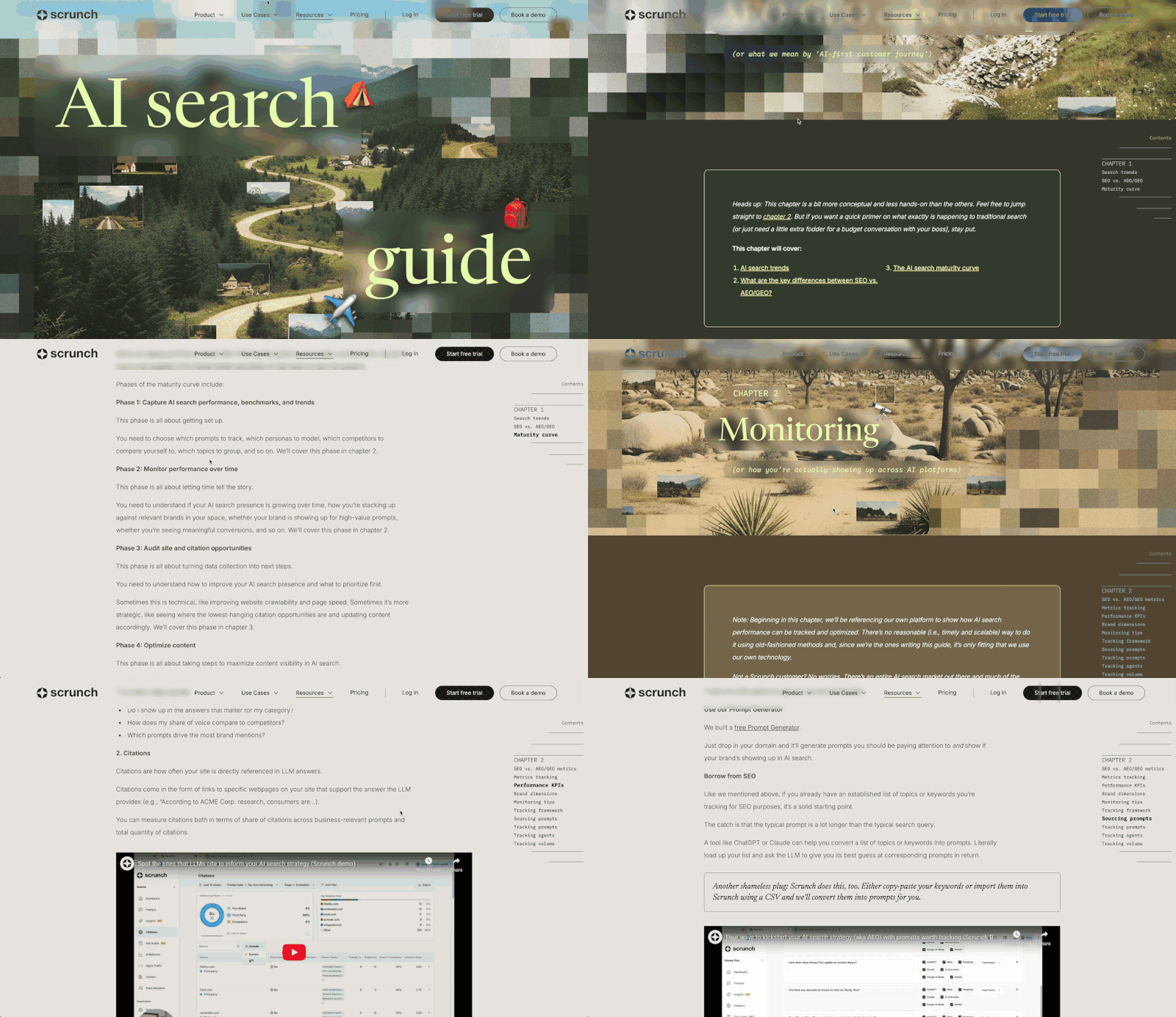
If your content isn’t built to be pulled into those summaries, you become invisible to a growing segment of your audience. Learning how to optimize for AI search engines isn’t about gaming an algorithm. It is about becoming the authoritative source that an AI feels confident citing as a primary resource. This guide provides a roadmap to help you navigate this landscape, ensuring your brand stays recommended in an AI-driven search ecosystem.
The Big Shift: Why Your Old SEO Strategy is Hitting a Wall
The primary objective is no longer just ranking; it is being cited. When a user asks an AI like Perplexity or ChatGPT, they want a concise, factual, and helpful answer.
This evolution toward Generative Engine Optimization (GEO) represents a fundamental shift in how search functions. If your content strategy relies on gaming an algorithm to get a click, your visibility in the new AI-driven search landscape will likely plummet.
From Ranking to Being Recommended
Think of SEO as a velvet rope at an exclusive club. You did everything possible to get to the front of the line. However, AEO vs SEO represents a shift in venue: once inside the club, you must prove you are worth recommending.
AI models act as digital concierges. They curate the most authoritative information for the user. If your content is heavy on buzzwords but light on real utility, the LLM will ignore you. These models prioritize structured, factual, and consistent information. This is how you achieve meaningful AI-driven content visibility.
SEO vs. AEO: The Core Differences
To understand why your current approach may be failing, consider the fundamental shift in objectives between traditional SEO and AEO.
| Feature | Traditional SEO | AEO/GEO Strategy |
|---|---|---|
| Primary Goal | Earn a high-ranking URL | Secure an AI-generated citation |
| Content Style | Keyword-rich | Direct, factual, structured |
| User Interaction | Clicking a link | Reading an AI-provided answer |
| Metric of Success | Click-Through Rate | Brand mentions |
| Value Proposition | Driving traffic | Providing trusted answers |
Why LLMs Value Substance Over Fluff
Large Language Models (LLMs) operate differently than traditional search crawlers. They are not scanning your page to see if you repeated a keyword. They parse your content to understand the logic, facts, and entities within your text.
Claiming your service is “the most revolutionary, game-changing solution” tells the AI nothing. In contrast, stating, “We provide specific services for specific audiences to solve specific problems” creates a high-value signal. When you learn how to optimize for AI search engines, you begin to value clarity above cleverness. This transition makes you a reliable, expert voice that an AI can comfortably cite as an AI answer engine citation source. By focusing on facts, you stop fighting the machine and start feeding it exactly what it needs.
Speaking the Machine’s Language: Semantic SEO and Clarity
Semantic search strategy is the art of teaching the machine what your content actually means through stable, predictable terminology. In the era of LLMs, you are training a digital collaborator to understand your expertise.
The Power of Consistent Terminology
To excel in AI-driven content visibility, treat your website as a definitive encyclopedia for your niche. This requires using a single, repeatable definition for every core service or concept across all pages.
LLMs look for patterns. When you use identical phrasing to define a concept, you create a knowledge anchor that the AI can easily grab, verify, and cite. This is the foundation of building trust with LLMs. By standardizing your vocabulary, you remove the guesswork for the model, increasing your chances of becoming a go-to AI answer engine citation.
Master the Art of Content Chunking
When optimizing for Generative Engine Optimization, structure is vital. Modern search engines excel at digesting concise, high-density facts. Use a chunking approach:
- The Direct Answer: Start every section with a clear, declarative statement that answers the primary question (40–80 words). No fluff.
- The Deep Dive: Follow that answer with supporting details, data points, and examples (200–300 words).
This structure allows the LLM to easily identify the core answer unit while providing enough substance to justify a citation.
Removing the Noise: Why Clarity Wins
AI systems prioritize factual accuracy over tone. While your brand voice remains important, it should not obscure the facts. Irony, sarcasm, and ambiguous metaphors are notorious for misleading AI models.
Every sentence should define a concept, provide evidence, or solve a problem. When you strip away filler and present clear, objective information, you make it effortless for an AI to digest your expertise. By focusing on direct communication, you ensure that your content is highly usable for the next generation of search.
The Role of Structured Data and AI-Ready Architecture
To win in the era of Generative Engine Optimization, recognize that search engines now interpret concepts. Schema markup serves as the universal translator, bridging the gap between your raw website data and the requirements of LLMs.
A clean, logical sitemap and site-wide consistency in your brand narrative are vital for AI-driven content visibility. If your site presents conflicting definitions, you confuse the model, which degrades your trust score. AI crawlers favor environments where the hierarchy is predictable. Ensure your internal linking reflects a coherent expert-level view of your topic.
The Power of Evidence Units
Beyond the technical backend, restructure your content to favor evidence units. These are the granular building blocks an AI uses to cite your brand.
| Evidence Unit Type | Example Requirement | Why LLMs Love It |
|---|---|---|
| Data Point | Reduced overhead by 22% in 2023 | Provides concrete proof |
| Case Study | Client saw 3x growth in 4 months | Demonstrates application |
| Source Link | According to our 2024 report | Improves authority |
Your Checklist for AI-Ready Page Structure
To ensure your pages are primed for an AI answer engine citation, every high-value page should follow a structured layout:
- Clear H1 Heading: Use a specific, high-intent question.
- Direct Answer: Provide a concise summary at the top of the page.
- Evidence-Backed Body: Use paragraphs to expand on the why and how.
- Mini-FAQ: Include a 3-question section to capture long-tail queries.
- Clear Citations: Link to credible third-party sources or your own data.
Building a Winning AI Content Workflow for Small Businesses
Success lies in shifting your daily habits toward creating question-based content clusters. By grouping pages around specific problems, you create a cohesive knowledge hub that LLMs find easy to index.
The Power of Question-Based Clusters
AI models thrive on context. When you create a series of articles answering interconnected questions, you provide the evidence an AI needs to trust your expertise. For example, if you sell home security systems, create clusters covering specific use cases, sensors, and hardware. This approach creates a semantic map for search engines, making it easier for tools to surface your content.
Integrating the AI Discovery Habit
One of the most effective strategies to learn how to optimize for AI search engines is to treat LLMs as your primary quality assurance tool. By integrating an AI discovery habit, you stop guessing and see how your site is perceived.
- Test your summaries: Paste your content into Perplexity or ChatGPT and ask for a summary.
- Analyze the gaps: Did the AI mention your unique selling points?
- Refine: Edit your content to be more direct, adding definitions the AI missed.
Auditing for Quote-Worthiness
Not every paragraph is quote-worthy. AI models specifically scan for concise, factual, and relevant snippets.
| Audit Step | Action Required |
|---|---|
| Identify Core Answer | Does the first paragraph answer the main question in under 60 words? |
| Validate Data Points | Are statistics and facts clearly labeled? |
| Remove Filler | Strip out marketing jargon that confuses interpretation. |
| Structure for Citations | Ensure each section has a subheading reflecting search intent. |
Start today by auditing one core service page for clarity and schema. When you make your information easier for machines to understand, you make it more valuable to the people searching for your expertise. Build your reputation as a trusted source, and watch your AI-driven content visibility grow. According to AEO/GEO, focusing on machine-readable structures is the key to mastering the modern search ecosystem.
AEO/GEO
Want to learn more?
Contact us for direct consultation and support.