AI Content Gap Audit Template: Capture GenAI Traffic
Your website may dominate page one rankings, yet your brand remains invisible where modern decisions are made: inside ChatGPT, Gemini, and Google AI Overviews. This disconnect is a significant hurdle for growth in the generative era. Traditional SEO audits focus on keyword volume and backlink profiles, but they often ignore the primary metric of the new search landscape: AI citation. If an answer engine synthesizes a response without quoting your brand, you are effectively absent, regardless of your search engine results page (SERP) position.
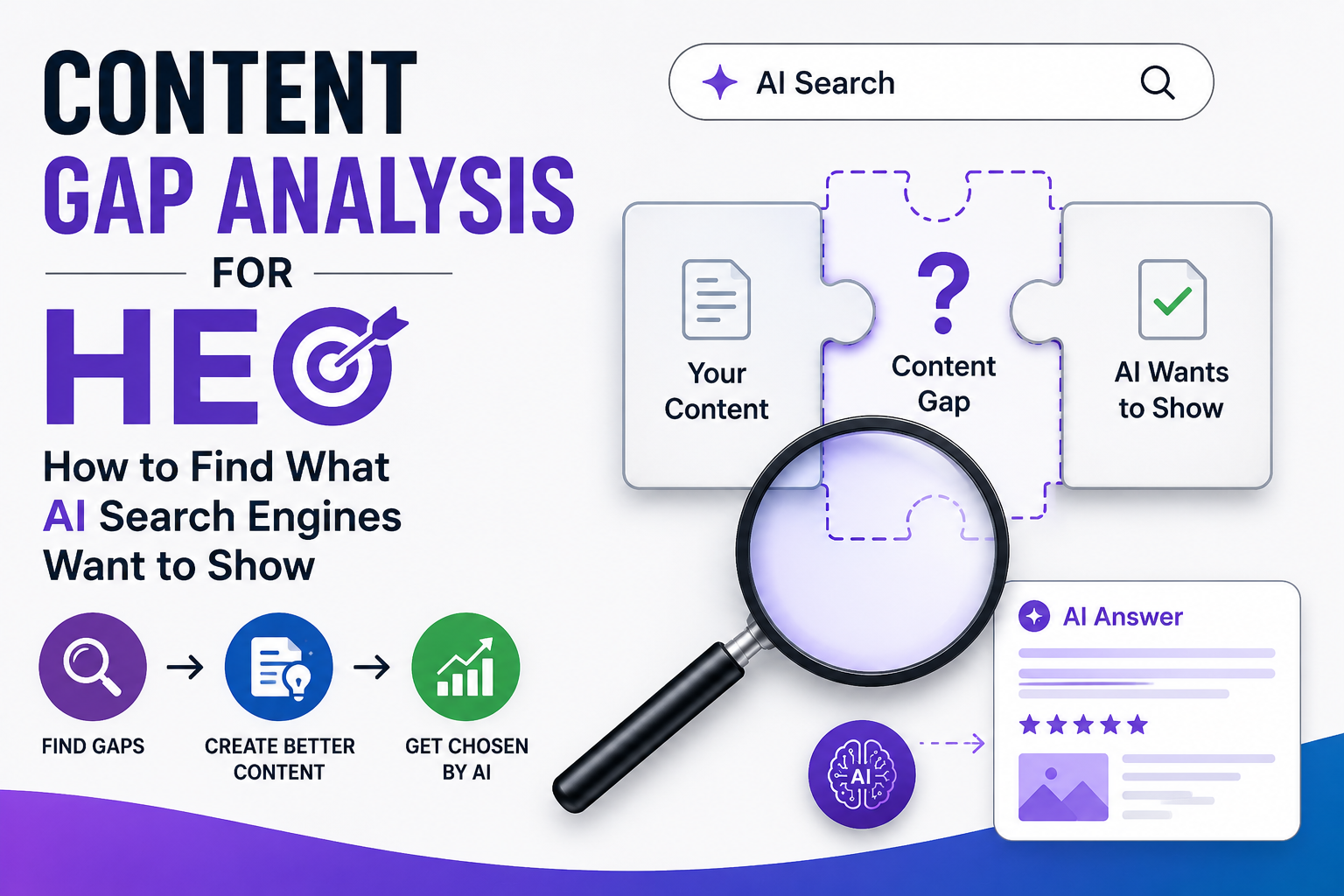
The solution is a specialized ai audit template designed to identify why you are left out of AI-generated answers. Unlike generic content gap analysis tools that only track keyword rankings, this framework performs a deep generative search audit focused on answer engine optimization (AEO). It shifts your strategy from competing for clicks to competing for citations. By mapping ai content gap types—from missing direct answers to weak entity signals—you can systematically close these loopholes. This template provides a roadmap to achieve sustainable ai traffic capture, ensuring your brand becomes the trusted source that AI models rely on.
Why Standard SEO Audits Miss AI Citation Opportunities
Most organizations treat SEO audits as a static checklist for ranking, but generative AI has shifted the objective. In the era of answer engine optimization, ranking first for a keyword is no longer the only goal; being cited as the primary source within an AI-generated answer is often more valuable.
The Shift from Ranking to Being Cited
Traditional content gap analysis relies on keyword matching. It identifies terms competitors rank for that you do not, assuming that creating content for those terms will drive organic traffic. This model operates on a “one query, one page” logic. If you rank for “best CRM,” you win the click. However, AI models like ChatGPT and Perplexity do not simply display links. They synthesize answers from multiple sources, often ignoring your top-ranking page if it lacks the structural triggers required for citation.
When an AI generates an answer, it constructs a response from diverse sources. If your content is buried in the third position of a SERP but is structured as a direct answer, it may be ignored in favor of a competitor who wrote in a format the AI prefers. The gap is no longer just about keywords; it is about ai content gap types such as format mismatches and insufficient authority signals within the AI’s context.
The Five Core Gap Types Specific to AI
To capture visibility in a generative search audit, you must identify five distinct types of gaps that traditional SEO overlooks:
- Answer Gap: Your content addresses the topic, but you lack a direct, concise answer that the AI can extract.
- Entity Gap: The AI does not associate your brand with the specific topic or keyword.
- Format Gap: Your content is structured for human narrative rather than machine extraction. AI models favor structured data and bullet points.
- Freshness Gap: Your content is outdated. AI models prioritize recent information for time-sensitive queries.
- Authority Gap: Your domain lacks the perceived trust signal (E-E-A-T) required for the AI to cite you, especially for sensitive topics.
The AI Content Gap Audit Template Structure
A successful audit requires a structured, column-based workflow that captures how AI models cite sources. This ai audit template serves as your control tower, allowing you to track and prioritize opportunities across multiple AI engines.
Core Column Definitions
Each column in your template serves a distinct purpose in identifying where your content is missing from the AI-generated answer space:
| Column Name | Purpose |
|---|---|
| Query | The exact user search term or prompt you are testing. |
| Primary AI Target | The specific engine (e.g., ChatGPT, Gemini) where the gap was identified. |
| Competitor Citations | A list of brands the AI cited for this query. |
| Gap Type | The category of the missing content (Answer, Entity, Format, etc.). |
| Intent Score | A rating (1-10) indicating the business value of the query. |
| Priority | A final ranking (High, Medium, Low) based on impact and ease. |
Scoring Intent and Citation Density
Not all gaps are created equal. Prioritizing based on business value is essential. Assign an Intent Score from 1 to 10 based on the query’s potential to drive revenue. Additionally, measure Citation Density. This metric calculates how frequently your competitors appear across multiple AI engines for the same query. High citation density indicates strong model trust, while low density suggests a potential entry point for your brand.
Execution Guide: How to Populate the Template
Transitioning to action requires a repeatable process. Follow these steps to uncover high-value opportunities.
- Identify Target Queries: Align your audit with business objectives using support tickets, “People Also Ask” boxes, and core industry terms.
- Run Queries Across AI Engines: Test your queries through platforms like ChatGPT, Perplexity, and Google AI Overviews. Log the sources each engine cites.
- Categorize the Gaps: Determine if the issue is a format error, a lack of authority, or a simple missing answer.
- Log Results: Use your template to track these findings, ensuring you record which engine cited which competitor.
Prioritization Logic: Scoring and Fixing Gaps
To maximize ai traffic capture, use the ICE (Impact, Confidence, Ease) scoring model adapted for AI gaps.
Remediation Strategies
| Gap Type | Remediation Strategy |
|---|---|
| Format Gaps | Implement schema markup and restructure content into concise answer blocks. |
| Answer Gaps | Rewrite content to lead with a direct 40-60 word definitive answer. |
| Entity/Authority Gaps | Build off-site mentions and improve E-E-A-T signals across your domain. |
Format gaps are generally the easiest to resolve. By adding FAQPage or HowTo schema, you provide AI models with machine-readable data that acts as a direct feeding tube for their citation logic. Entity and Authority gaps require long-term investment in brand reputation and consistent off-site signals.
Measuring Success: Tracking AI Citation Growth
Measuring the return on your audit requires moving beyond traditional organic traffic metrics. You must monitor citation frequency, brand mention volume, and referral traffic from AI platforms. Treat your ‘Gap Inventory’ as a living document. Update the status of each identified gap from ‘Open’ to ‘Verified’ as you implement changes. This turns your audit into a sustainable engine for growth, ensuring you remain a trusted source in the generative search landscape.
AEO/GEO
Want to learn more?
Contact us for direct consultation and support.