The Shift to GEO: Defining High-Authority Content in the AI Era
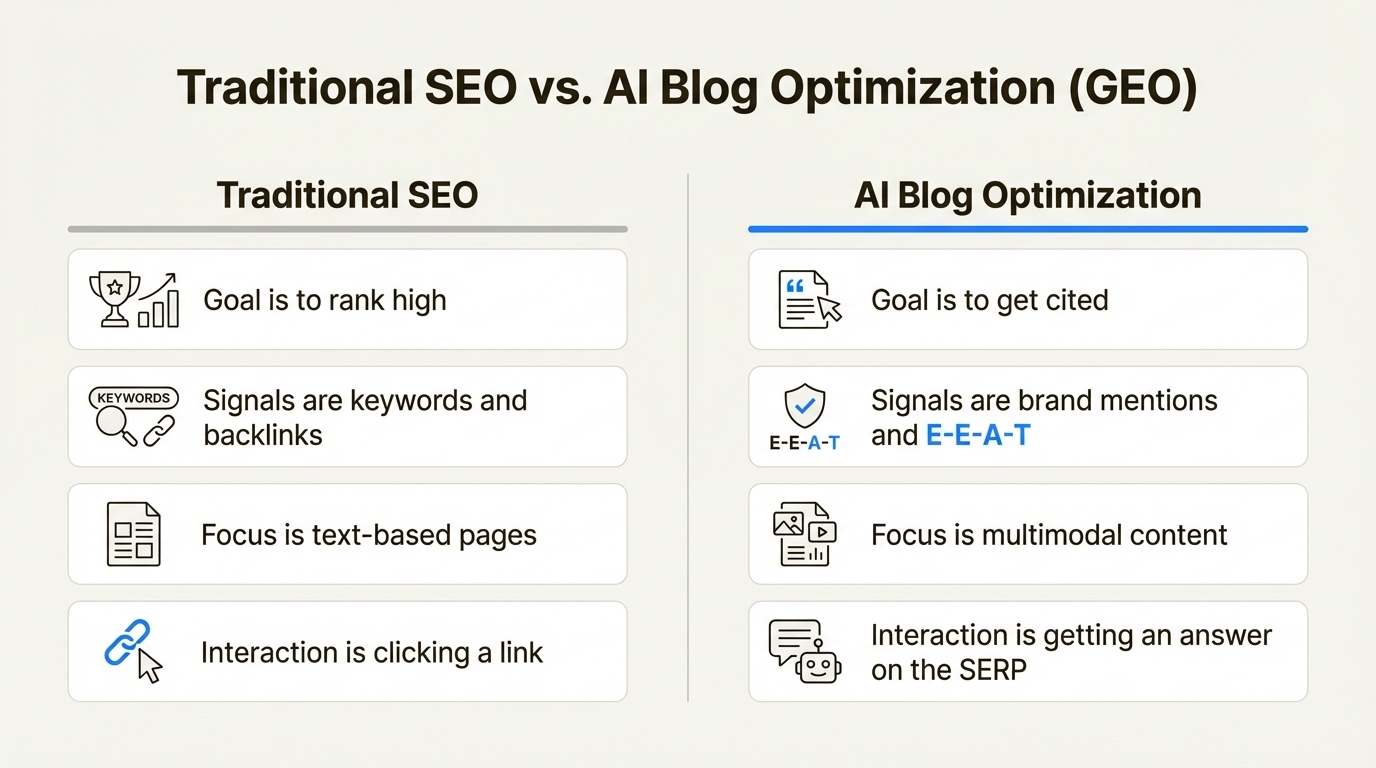
Traditional search engine optimization (SEO) is built on keyword ranking, but generative search prioritizes something else entirely: source-of-truth status. AI models do not “rank” links; they synthesize information to provide direct, authoritative answers. Success is no longer measured by a top-ten placement, but by being the primary entity cited by an AI engine to resolve a user query.
To thrive, brands must transition from keyword-centric content to Generative Engine Optimization (GEO). This framework rests on three non-negotiable pillars:
- Authorship: Verifiable, expert-led content that signals human credibility to AI models.
- Authority: Explicit signals linking your content to foundational, peer-reviewed, or industry-recognized data.
- Answer-Friendly Formatting: Content structured for rapid ingestion, extraction, and citation by LLMs.
Strategic Assets: Building Content Types AI Engines Prioritize
AI engines perform best when they can extract data-heavy or highly structured information. Shift your content pipeline toward “high-intent” assets that resolve specific user queries immediately.
Prioritize These Asset Types:
- Interactive ROI Calculators: These tools provide quantifiable value and structured data that AI models can easily parse.
- Benchmark Guides: Industry-specific data reports allow AI to cite your brand as the expert source for performance metrics.
- Dynamic Glossaries: Defining industry-specific terms clearly creates a direct path for AI to use your definitions in informational summaries.
Structure these assets to address “conversational entry points.” If your content answers the “what,” “why,” and “how” within a single, well-structured section, you drastically increase your chances of becoming the preferred AI citation.
The Tactical Execution Checklist: Implementing Authority Signals
AI models are trained to prioritize information from highly credible sources. You must explicitly bridge your content to these entities.
- Standardize Source Referencing: Always link to primary data sources, such as government reports, academic journals, or verified industry-leading research. This creates a “trust chain” that AI algorithms identify as authoritative.
- The Authorship Mandate: Every piece of content should be attributed to a verifiable human expert. Use structured data (Schema) to associate the content with the author’s professional profile and credentials.
- Co-Branded Syndication: Distribute expert commentary through industry publications. Aligning your brand with established authoritative platforms creates powerful external validation signals that AI models recognize.
AI-Friendly Formatting: Optimizing for Natural Language Delivery
AI consumes content differently than humans. Your layout must facilitate rapid ingestion while maintaining readability for users.
- Use Conversational Syntax: Write in a direct, natural language style. Use headers to pose questions that mirror user search intent.
- Optimize for Ingestion: Use bulleted lists and concise, single-paragraph definitions. AI engines prioritize blocks of text that can be cleanly pulled into a snippet or answer box.
- Structure over Flow: Traditional long-form storytelling often obscures key facts. Use a “TL;DR” summary at the start of every article to provide the AI with the core answer immediately.
Measuring the New Authority: Beyond Rankings to Citations
The metrics of the past, like organic traffic and keyword position, are lagging indicators in an AI-first environment. Your performance dashboard must evolve.
- Track AI Citations: Monitor how often your brand is mentioned or linked as a source within AI-generated responses.
- Monitor Source-of-Truth Status: Utilize AEO/GEO platform signals to identify where your brand is emerging as the primary answer source for specific industry queries.
- Iterative Refinement: Treat AI-generated answers as feedback loops. If an AI provides an incomplete answer using your content, update the asset with clearer data or more concise formatting to improve future inclusion.