AI Content Strategy for the AI Era: Mastering Velocity
You spend weeks crafting the perfect evergreen post, hitting every SEO checkbox, only to watch it slide down search results as algorithms shift their focus. The old strategy of “publish once, rank forever” is losing its edge. Today’s generative search engines, such as Google’s AI Overviews and Perplexity, aren’t looking for a static archive of information; they are hunting for the most relevant, up-to-date answer available right now. When content sits untouched for months, it signals to AI that your brand is a museum rather than an active participant in the industry conversation.
This is where the shift toward Content Velocity becomes critical for your business. By transforming your articles from stagnant pages into living assets, you align your presence with what AI models prioritize: accuracy, relevance, and temporal freshness. Developing an effective AI Content Strategy for the AI Era means moving away from the “set it and forget it” mindset and adopting a cycle of continuous refinement. If you want to maintain your visibility as search habits evolve, you must treat your content like an ongoing dialogue. This transition establishes your brand as the reliable, real-time source these new platforms depend on.
The Death of Static SEO: Why AI Demands Freshness
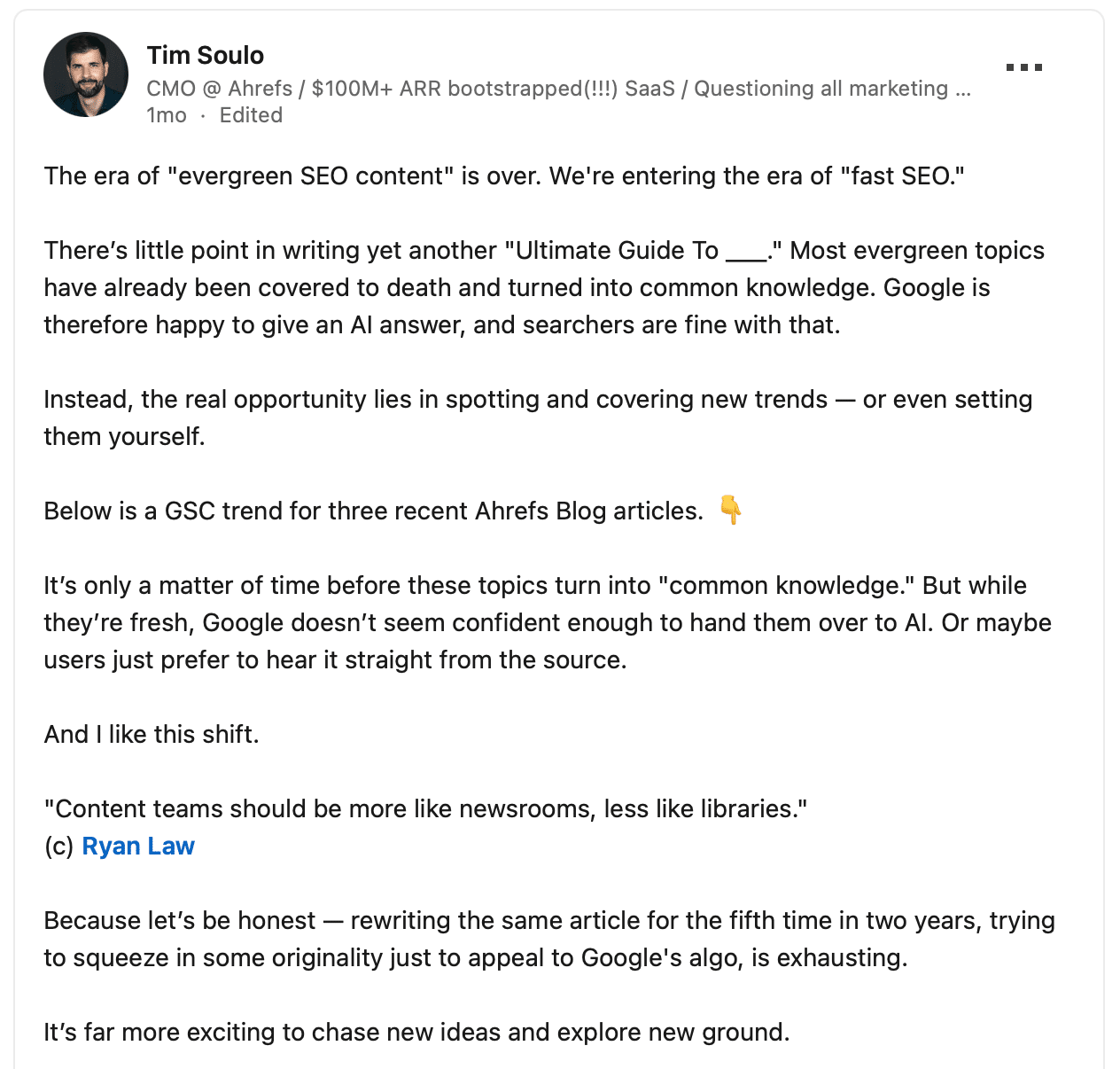
The golden era of “set it and forget it” content is behind us. For years, the standard of SEO was writing a massive, high-quality evergreen article and watching it hold the top spot for months. Today, however, generative AI models like Perplexity and Google’s AI Overviews have fundamentally shifted the landscape. These engines synthesize information in real-time, prioritizing the most recent data to ensure users get an accurate answer. If your content doesn’t show active, ongoing updates, AI simply skips over you.
The Rise of High-Velocity Content
Unlike traditional evergreen content, which aims to stay relevant for years with minimal changes, high-velocity content is built to evolve. Think of it as a living asset. When you integrate current industry trends or the latest statistics, you send powerful freshness signals to LLMs. These models value accuracy above historical authority. If an AI platform must choose between a perfectly written article from 2022 and a decent, updated post from this month, it will choose the recent one every time.
Why AI Ignores the Stagnant
When an AI lacks current information, it is forced to either hallucinate—creating plausible but factually incorrect details—or pull from secondary sources that reported on the topic recently. When a brand demonstrates active monitoring of a topic, AI tools learn that this specific domain is a reliable source for current data. By keeping your content updated, you build trust with the algorithm, making your brand a preferred citation in AI-generated summaries.
Static SEO vs. AI Content Velocity
To compete in this new environment, you must understand how your metrics and processes need to pivot.
| Feature | Static SEO Approach | AI Content Velocity |
|---|---|---|
| Update Frequency | Quarterly or yearly refreshes | Ongoing, rolling updates |
| Primary Goal | Keyword ranking positions | AI citation and answer placement |
| Intent Alignment | Broad search queries | Specific, query-driven answers |
| KPI Tracking | Clicks and traffic volume | AI visibility and brand mention share |
Adopting a model of constant improvement is the prerequisite for staying visible. By shifting your focus from static page authority to Content Velocity, you align your brand with the way modern users find information.
Building a Dynamic Content Velocity Framework
Shifting toward a high-velocity AI Content Strategy for the AI Era requires moving away from static publishing. You need a systematic approach to identifying which pages are losing their competitive edge so you can refresh them before they drop out of AI-generated summaries.
Identifying Decaying High-Value Pages
To maintain strong AI Search Visibility, treat your website like a garden that needs constant pruning. Analyze your top-performing pages in your analytics dashboard. Filter for pages that have seen a 15% or greater drop in organic traffic over the last 90 days. These pages are your primary candidates for an update.
- Traffic Trend Audit: Identify pages that were previously top-performing but have shown a steady decline.
- AI Citation Check: Manually query your target keywords in tools like Perplexity or Google’s AI Overviews. If your page no longer appears in citations, it is a priority.
- Data Staleness: Look for pages with outdated statistics. AI models prioritize the most recent, accurate figures.
Implementing a News-Jacking Approach
News-jacking—the process of injecting your brand into a trending industry topic—is a powerful way to signal to AI engines that your site is a hub for current data. When a major story breaks, don’t wait for a weekly blog cycle. Instead, create a brief, high-value update that provides expert commentary on the news. By quickly adding new industry data points to existing pillar pages, you provide AI models with the freshness signals they crave.
The Expert-in-the-Loop Workflow
To ensure your updates maintain E-E-A-T (Experience, Expertise, Authoritativeness, and Trust), implement an “Expert-in-the-Loop” workflow. You need human nuance to complement automated tools.
- Expert Review: Have a subject matter expert review every update to ensure technical accuracy.
- Author Updates: Update the “last modified” timestamp and include a brief note explaining who performed the update, which reinforces credibility to AI crawlers.
- Synthesized Insights: Have your expert synthesize why new news matters. AI engines reward content that connects broad news to specific, actionable advice.
Monthly Content Audit Checklist
Consistent maintenance is the backbone of any effective AEO strategy.
| Audit Item | Focus Area | Action Required |
|---|---|---|
| Statistics Check | Data Accuracy | Replace numbers older than 12 months with current data. |
| Link Integrity | Trust Signals | Scan for broken links and replace them with recent sources. |
| Trend Alignment | Contextual Depth | Add 1-2 sentences regarding current industry shifts. |
| Citation Review | AI Visibility | Test core terms in AI tools to verify inclusion in citations. |
Structuring Data for AI Interpretation
If you want your brand to appear in AI-generated answers, you must treat your content like a well-organized database. LLMs rely on predictable patterns to extract meaning. When you structure your content using a logical hierarchy, you provide a clear roadmap for AI to follow.
Designing for Machine Readability
To master your AEO strategy, use a strict, intuitive hierarchy for your headers:
- H2 Tags: Use these to outline the major pillars of your argument. They act as the primary labels for the AI to understand your content scope.
- H3 Tags: Nest these beneath H2s to break down sub-points, creating a logical tree structure.
- Short Paragraphs: Limit each paragraph to 3-4 sentences. AI models prefer concise chunks over sprawling text.
The Power of Direct Answer Blocks
One of the most effective ways to capture AI search visibility is by including a Direct Answer block at the very top of your article. This is a 40-to-60-word summary that acts as a standalone snapshot. By providing a clear, accurate, and concise answer to the user’s query immediately, you make it effortless for an LLM to cite your text as an authoritative source in an AI summary.
Semantic HTML and Conversational Language
Search crawlers appreciate semantic HTML. When you use proper tags—like lists, blockquotes, and tables—you provide context that goes beyond plain text. Furthermore, avoid heavy corporate jargon. Generative search models thrive on plain, conversational language. Writing in a way that sounds like a helpful human makes your content more accessible to LLMs.
Measuring Success: Beyond Traditional Rankings
In an age where generative engines answer queries directly, clinging solely to old-school tracking feels like using a map from 1995 to navigate a modern city. To truly thrive, you must shift your focus toward how your brand is cited by LLMs. Prioritize metrics like Brand Mention Velocity—how frequently your brand appears in AI-generated responses—and your AI Citation Rate.
Modern Metrics vs. Traditional Vanity Data
Transitioning to a robust AEO strategy requires understanding the trade-off between legacy indicators and the data that moves the needle.
| Metric Category | Traditional Vanity Metrics | Modern AEO Metrics |
|---|---|---|
| Primary Focus | Traffic & Keyword Rank | Brand Presence & Trust |
| Key Indicators | Total Pageviews | AI Citation Rate |
| Audience Signal | Click-through Rate | Sentiment in AI Summaries |
| Content Impact | Bounce Rate | Brand Mention Velocity |
Communicating Growth to Stakeholders
When reporting to leadership, explain that every time an LLM cites your content, you are cementing your status as a verified expert. This isn’t just about traffic; it’s about being the foundational knowledge that fuels AI search results. When your brand consistently shows up as a primary citation, you are becoming the go-to source that the next generation of AI-powered research relies on.
The days of setting a piece of content live and walking away are behind us. Adopting an AI Content Strategy for the AI Era isn’t just about tweaking meta descriptions; it is a fundamental shift in how you maintain your brand’s digital presence. Commit to this new cadence today, and transform your content into a dynamic force that captures the attention of both humans and intelligent machines alike.
AEO/GEO
Want to learn more?
Contact us for direct consultation and support.