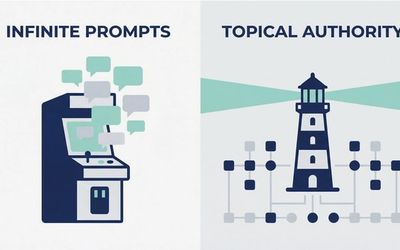
The digital search environment has transitioned from a keyword-matching exercise to a model of semantic synthesis. For businesses, this means the traditional quest for ranking is evolving into a more complex requirement: winning selection by generative AI engines.
The Shift from Search Intent to Model Comprehension
Traditional search operated on the principle of indexing and retrieval. AI-driven search, however, operates on the principle of comprehension and synthesis.
- From Indexing to Training: While traditional SEO focuses on getting a page indexed, AI optimization focuses on providing the foundational data that grounds LLMs. You are no longer just writing for a user; you are providing data points that models use to form their knowledge base.
- The Selection Paradigm: In generative engines, ranking is being replaced by selection. Models choose the most authoritative, fact-dense, and contextually relevant information to include in their generated summaries. Your goal is to be the primary source that the model trusts to synthesize the answer.
- Content Authority in a Post-Keyword World: Authority is now determined by the depth of your entity knowledge and the precision of your factual claims. Keywords have been demoted in favor of semantic density and verifiable expert consensus.
Structured Data as the Language of Machines
To be “seen” by an AI, your content must be machine-readable. Structured data, particularly JSON-LD, is the bridge that turns raw text into a coherent entity graph.
- Mapping Entities: By explicitly defining your brand, products, and services as distinct entities, you assist search engines in building a precise knowledge graph. This reduces the ambiguity of your content.
- Defining Relationships: Schema markup allows you to describe how your content connects to broader industry topics and customer needs. When an AI understands the relationship between “Software X” and “Problem Y,” it is significantly more likely to cite your content in a solution-oriented response.
- Semantic Interoperability: Using standardized vocabularies ensures that LLMs interpret your data consistently, regardless of the specific architecture powering the search engine.

Engineering High-Accuracy, Citable Content Blocks
Generative models are designed to reduce hallucinations, which means they prioritize high-accuracy, verifiable information. Structuring your content for RAG (Retrieval-Augmented Generation) compatibility is essential for winning citations.
- Prioritize Fact-Density: Use declarative, concise sentences. Avoid fluff; AI models perform best when extracting information from clear, data-backed statements.
- Establish Expert Consensus: Cite primary research and industry benchmarks within your content. When your information aligns with verified external data, the model perceives higher confidence, increasing the likelihood of a citation.
- Modular Architecture: Organize content into self-contained blocks that answer specific user questions directly. This makes it easier for the retrieval mechanism to isolate and “pull” your content as a relevant source.
The Distribution Loop: Automated Publishing for AI Ecosystems
Maintaining visibility is an ongoing operational requirement, not a static achievement. As LLMs undergo training updates, your content must remain fresh and aligned with current knowledge states.
- Continuous Synchronization: Integrate your content pipelines directly with distribution channels that feed AI search. This ensures that the latest data from your organization is always available for retrieval.
- The Freshness Factor: Models are continuously updated. Consistent updates to your technical documentation and thought leadership ensure that your brand is represented using the most accurate, current data available.
- AEO/GEO Automation: Utilizing automated platforms to manage the publishing cycle allows for consistent, scalable presence. By standardizing your content architecture at the point of creation, you ensure that every asset is inherently optimized for the generative search era.