The landscape of search is undergoing a structural transformation. As generative search engines replace traditional link-based interfaces with synthesis-driven models, brands must shift from optimizing for keyword frequency to engineering for entity authority. This guide outlines the technical architecture required to thrive in this new ecosystem.
The Shift: From Keyword Ranking to Entity Authority
Traditional SEO was predicated on capturing traffic through keyword density and backlink volume. In contrast, generative search optimization treats the search engine as a knowledge retrieval system. AI models operate by constructing Knowledge Graphs—complex maps of entities and their relationships.
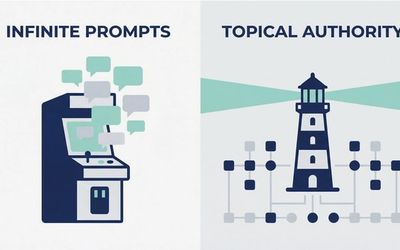
To achieve visibility today, brands must move beyond surface-level content. AI systems prioritize authoritative answerability, which is the capability of your content to serve as a precise, factual source for LLM synthesis. Success is no longer determined by ranking in a list of blue links, but by becoming a foundational node in the AI’s understanding of a specific industry entity. When your content maps clearly to an entity’s attributes and context, you become the definitive source the AI pulls from to generate its responses.
Engineering Content for Machine Consumption
To make your information accessible to AI, you must treat your content as a structured dataset. Algorithms ingest and rank information based on how easily it can be parsed and verified.
Atomic Fact Synthesis
AI models perform best when information is broken down into atomic facts. Instead of long-form, narrative-heavy paragraphs, decompose complex topics into granular, distinct units of information. This clarity allows AI systems to retrieve and cite specific facts without needing to process conflicting or ambiguous prose.
Programmatic Structuring
Effective AI-ready architecture relies on two primary technical levers:
- JSON-LD: Implementing comprehensive schema markup is non-negotiable. It provides machine-readable context for your entities, ensuring the AI correctly categorizes your brand and its offerings.
- Hierarchical Granularity: Use H-tag hierarchies that mirror the logical structure of a database. Each section should represent a distinct subject or entity attribute, enabling the AI to navigate and index your content architecture programmatically.
Building an AI-Ready Content Supply Chain
Achieving visibility requires a departure from manual content creation in favor of a scalable, automated supply chain. This involves shifting production towards a continuous loop of accuracy and structural optimization.

Automated Workflow Integration
Your infrastructure should integrate content generation with automated distribution channels that push updates directly to search-facing indexes. By automating the application of structured data at the point of creation, you ensure every piece of content is machine-ready upon publication.
The Feedback Loop
AI search performance should dictate your content roadmap. By monitoring the performance of entities within generative outputs, you create a feedback loop where AI attribution data informs future content production. If your brand is cited frequently for specific entity queries, double down on that technical architecture; if citations are absent, refine the entity mapping to clarify your authority.
Measuring Success in AI Search Environments
Traditional metrics like Click-Through Rate (CTR) and standard rank tracking are becoming obsolete. In a generative environment, you must pivot to metrics that measure impact within the AI response itself.
Share of Answer
Focus on Share of Answer metrics—tracking how often your brand is included, cited, or linked within the AI-generated summary. This shifts the focus from traffic acquisition to authority verification.
Monitoring Attribution
Use attribution data to track the following:
- Direct Citations: How frequently your URLs are included as sources in AI summaries.
- Entity Association: How often your brand is mentioned alongside relevant industry terms in AI responses.
- Content Refinement: Leveraging attribution gaps to pivot your internal entity mapping and improve the density of your authoritative information.
By adopting this architectural approach, businesses can move from reactive SEO tactics to a proactive strategy that secures long-term visibility in evolving AI search ecosystems.