The Shift: From ‘Discoverable’ to ‘Agent-Ready’ Content Systems
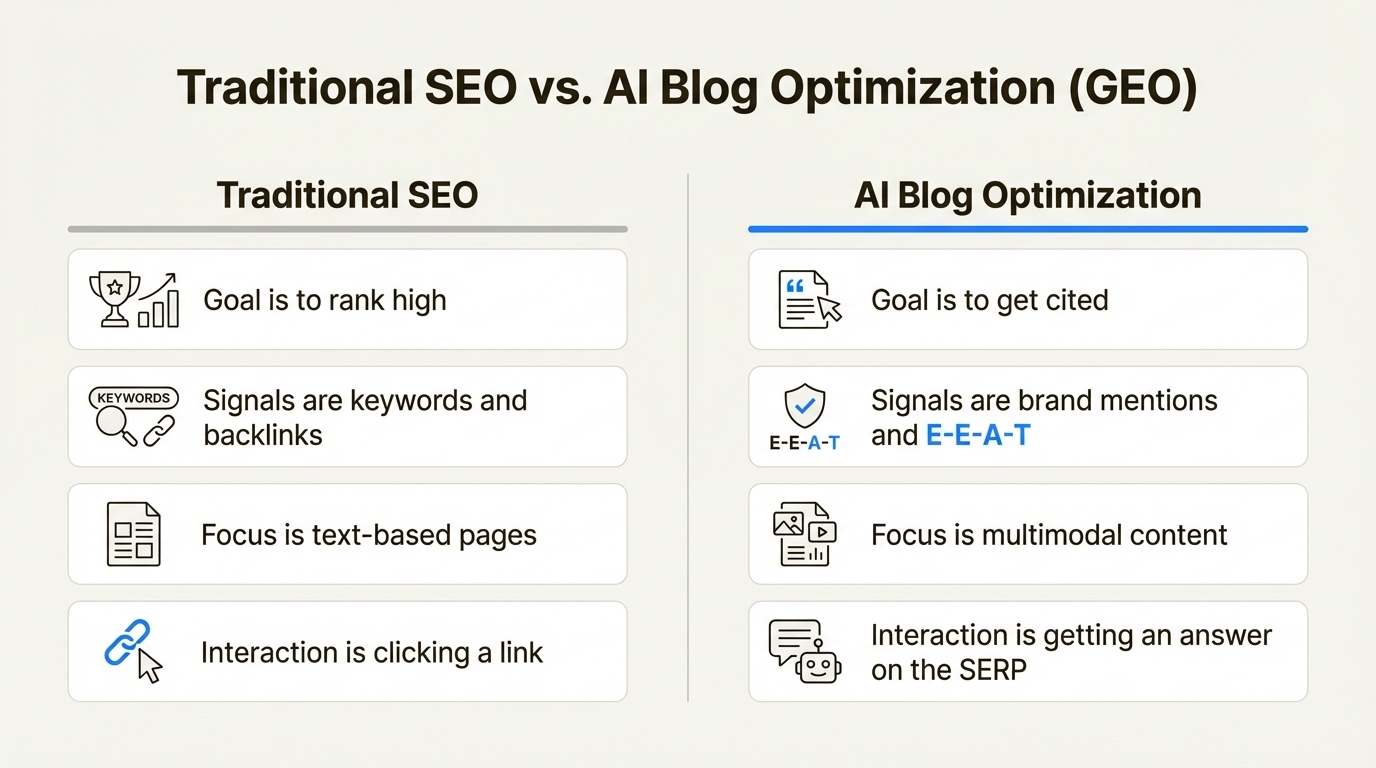
In the generative search era, the objective of content management is no longer mere indexation by crawlers; it is technical accessibility for Large Language Models (LLMs). Visibility is redefined as your system’s ability to provide high-fidelity, machine-readable data on demand.
To thrive, businesses must treat content as an API—a structured, programmatic feed of knowledge. This shift requires moving away from human-centric narratives toward a robust information architecture that prioritizes:
- Semantic Precision: Clear, unambiguous definition of entities and their relationships.
- Predictable Serialization: Uniformity in formatting that allows models to parse logic without ambiguity.
- Programmatic Retrievability: Designing systems where information is easily queried rather than just “discovered.”
Implementing Standardized Machine-Readable Formats
To ensure your documentation is native to AI consumption, you must move beyond standard HTML. Implement machine-native protocols that speak directly to LLM context windows.
The llms.txt Standard
Deploy an llms.txt file at your site root. This acts as a primary entry point for AI agents, providing a summarized, token-optimized version of your documentation. It enables models to crawl and understand your knowledge hierarchy without navigating complex front-end interfaces.
Markdown as the Source of Truth
Markdown is the lingua franca of LLM fine-tuning and retrieval-augmented generation (RAG). By enforcing a strict Markdown structure, you provide clear semantic boundaries. Headers, lists, and code blocks provide the tokenization cues necessary for models to accurately segment your content.
Server-Level Content Negotiation
Configure your origin servers to respond to AI user agents with Accept: text/markdown. By detecting these agents, you can deliver the clean, structured data they require while serving a stylized, human-optimized version to browsers, all from the same URI.
Developing Interactive Capabilities: Skills and MCP Integration
Passive information is no longer sufficient. To differentiate, enable AI agents to “act” on your knowledge base through active interfaces.
Model Context Protocol (MCP)
By adopting the Model Context Protocol (MCP), you allow AI assistants to interface with your documentation in real-time. MCP transforms your static content into an interactive tool, enabling LLMs to fetch the latest product specs or troubleshooting data dynamically.
Designing Agentic ‘Skills’
Go further by exposing “Skills”—tools that agents can invoke via API to query proprietary data. This moves your brand from a static reference point to an active participant in the AI reasoning process. When an agent can programmatically query your “how-to” data or product configurations, you become a core component of its utility.
Embedding Documentation for Technical and Product Assets
Visibility must be baked into the software development lifecycle. For technical brands, documentation is code.
- SDK-Level Integration: Embed machine-readable documentation directly within SDKs and software packages.
- AI-Assistant Discoverability: Ensure code comments and documentation headers are formatted specifically for tools like Cursor or GitHub Copilot, allowing them to index your libraries automatically.
- Context Blocks: Develop structured, JSON-LD or YAML context blocks for complex product features that are inherently difficult for LLMs to infer through scraping alone.
Governance and Lifecycle Sustainability for AI Context
Content-as-infrastructure requires an operational shift. You are no longer managing a library; you are managing a live data service.
The RAG Maintenance Workflow
Implement a “freshness” tracking system for your RAG pipelines. If your underlying documentation changes but your RAG context doesn’t, you create “hallucination traps” where the model provides outdated, inaccurate information.
Feedback Loops
Establish monitoring for AI-agent consumption. Analyze logs to determine which portions of your docs are most frequently queried by agents and where they struggle to parse intent. Use this data to refine your information architecture, closing gaps that lead to inaccurate model responses or “ghosting” by AI search engines.