Auditing Startup Brand Narratives for AI Search Engines
You spend months refining your pitch deck, obsessing over every detail to ensure your value proposition resonates with investors and enterprise buyers. Yet, when a lead or venture capitalist asks an AI-powered search engine about your startup, the summary often misses the mark. This disconnect represents a tangible risk to your fundraising momentum and B2B sales pipeline. When AI models synthesize fragmented data from across the web, they frequently strip away the positioning you have worked to build, leaving behind a generic representation of your business. If your digital footprint is not explicitly engineered for machine comprehension, you lose control of your narrative. Applying an AI brand mention audit checklist is a fundamental requirement for any founder serious about maintaining credibility. By systematically reviewing how your entity is interpreted, you bridge the gap between human intent and machine output. This process ensures that your brand’s actual value, not an AI’s hallucinated synthesis, remains the primary source of truth for your stakeholders.
The Narrative Gap: How AI Reinterprets Your Startup’s Value Proposition
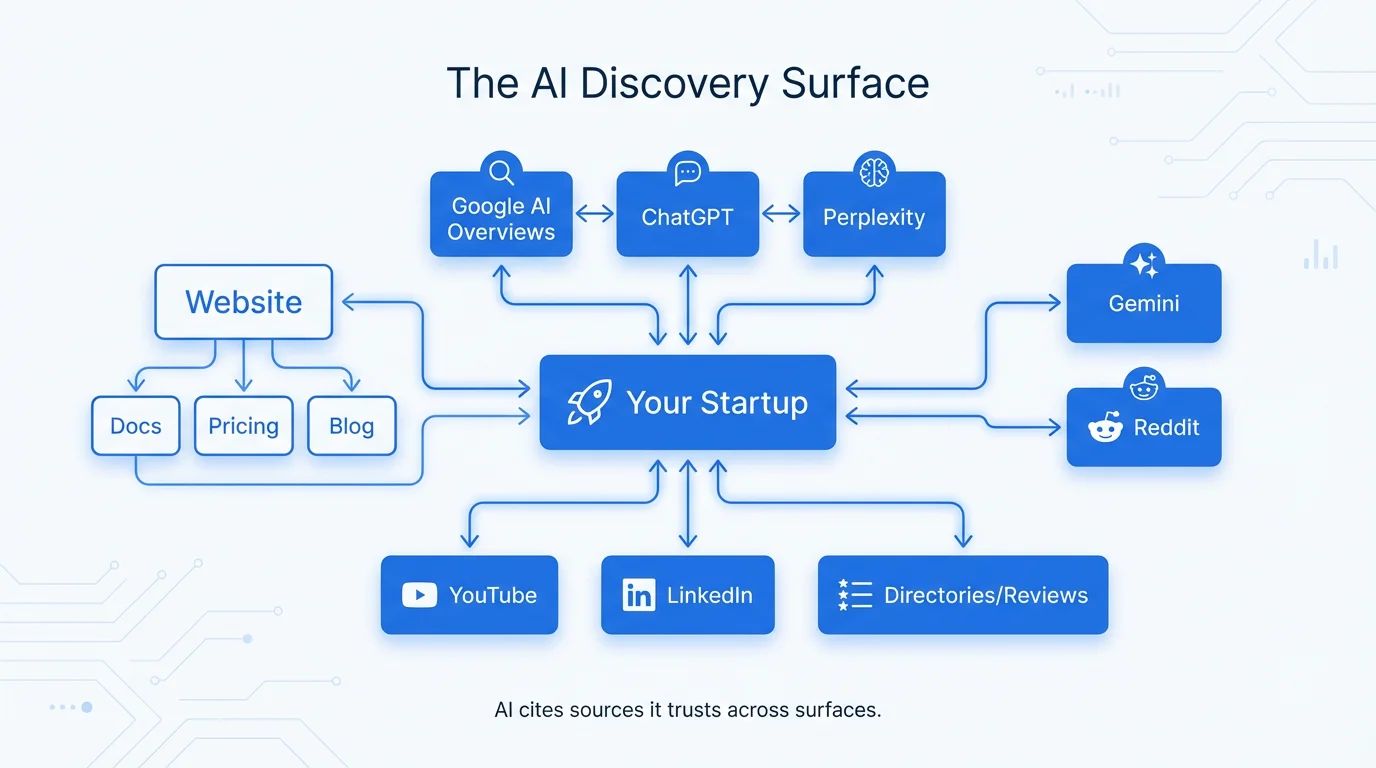
The narrative gap is the discrepancy between the deliberate brand story you present in your pitch deck and the synthesized summary generated by AI search engines. While your team refines every word of a Series A deck, Large Language Models ingest an uncontrolled ecosystem of third-party signals, blog posts, and aggregate data to construct their own version of your identity. This AI interpretative bias poses a direct threat to your valuation and investor perception. If an investor queries your startup to validate your market position, the AI might hallucinate a narrative that misses your core value, effectively misclassifying your category.
The Risk of Category Misclassification
One of the most dangerous outcomes of this gap is category misclassification. Investors rely on AI to quickly grasp the landscape of a specific vertical. If your website lacks clear, machine-readable positioning, the AI may default to classifying your startup under a broader, less lucrative market segment. This misclassification diminishes your perceived innovation level, shrinking your addressable market and distorting your premium pricing argument during due diligence.
Consensus vs. Unique Positioning
AI models favor broad consensus over outlier narratives. When an engine synthesizes information, it prioritizes patterns found across the majority of your indexed mentions, essentially averaging out your unique value proposition. Founders often design a narrative that emphasizes disruptive features, but these are filtered out by the model if they are not consistently reinforced across external sources. Checking brand citations in generative AI is no longer optional; if your unique selling point is not cited across authoritative, entity-linked domains, the AI will likely ignore it to favor the lowest common denominator of your presence.
| Criteria | Human-Led Pitch | AI-Generated Summary |
|---|---|---|
| Value Clarity | Precision-engineered, benefit-focused | Often feature-heavy, lacks nuance |
| Tone | Authoritative, visionary, emotive | Neutral, aggregate, descriptive |
| Accuracy | High (founder-controlled) | Variable (subject to source quality) |
| Competitive Differentiation | Highlighted as central focus | Frequently marginalized or omitted |
A thorough startup brand narrative audit reveals that relying on internal documents is insufficient. If your pitch is not accurately mirrored in the training data and live retrieval context that powers search, you lose control of the narrative the moment investors go to verify your claims. You must aggressively manage your brand entities to prevent the AI from defaulting to an inaccurate, generic summary.
Entity Auditing: Validating Your Brand Identity in Generative Engines
Your brand’s Entity Kit is the bedrock upon which generative search models construct their understanding of your company. If your positioning statement, founder biography, and About page lack structural cohesion, AI agents will struggle to classify your startup accurately. Conducting a rigorous startup brand narrative audit is the only way to ensure your intended market positioning matches the synthesis delivered to investors and buyers.
Auditing Your Brand Entity Kit
Treat your digital footprint as a unified knowledge graph. Start by standardizing your core descriptors. When AI crawls your site and social profiles, it cross-references these signals against third-party databases. Discrepancies between your internal messaging and external directory listings—such as Crunchbase, LinkedIn, or PitchBook—create AI interpretative bias, leading the model to hallucinate or misidentify your core category.
Ensure that your value proposition is identical across these high-authority domains. If your website claims you provide AI-driven supply chain analytics, but your LinkedIn profile labels the firm as a general SaaS consulting agency, the discrepancy forces the Large Language Model to choose the more authoritative signal or default to an average, diluting your brand identity.
Consistency Checklist for Investor Directories
To maintain authority, you must systematically audit your brand across top-tier investor and B2B directories. Follow this AI brand mention audit checklist to standardize your data:
- Category Mapping: Verify that the primary industry tag is identical on your website’s schema markup and directory profiles.
- Founder Attribution: Ensure founder bios are uniform, focusing on the same professional milestones and expertise to reinforce authority.
- Funding History: Confirm that total funding amounts, lead investors, and stage classifications match your official press releases.
- Value Statement: Use a singular, 150-character elevator pitch for all bio sections to maximize extraction.
- Product Taxonomy: Standardize the terminology for your core features so that AI agents do not conflate your services with competitors.
Rectifying Contradictory Data
When you find that AI is presenting inaccurate descriptions of your startup, you are likely battling outdated training data or inconsistent third-party citations. Checking brand citations in generative AI involves identifying which authoritative sites are feeding the LLM incorrect information.
Once you pinpoint the source, implement these steps:
- Update Schema Markup: Explicitly define your company’s properties using JSON-LD on your website’s homepage to provide LLMs with an unambiguous source of truth.
- Request Direct Updates: Manually update your profiles on high-authority directories like Crunchbase or G2, as these platforms often serve as primary data sources for model fine-tuning.
- Publish Authoritative PR: Issue a definitive brand update press release through a reputable wire service. Large language models often prioritize newer, high-authority news content over legacy directory listings.
- Consistent Social Footprint: Audit your social media bios to ensure they reflect the updated, corrected narrative, effectively pushing back against older data patterns.
Auditing Content Alignment and Value Proposition Synthesis
Your high-intent content—pricing pages, feature sets, and comparison charts—serves as the primary data source for Large Language Models when they synthesize answers about your startup. If your marketing site touts enterprise-grade security, but your technical feature pages fail to explain the specific ISO certifications or encryption protocols, an AI may hallucinate your security posture or ignore it entirely. Conducting an AI brand mention audit checklist ensures your granular technical claims match your overarching value proposition.
Avoiding Synthesis Traps
A synthesis trap occurs when an AI conflates a single feature with your entire product identity. If your homepage highlights an AI-powered scheduling tool but your documentation focuses heavily on CRM integrations, the model might misclassify you as a generic task manager. This misinterpretation occurs because Large Language Models prioritize frequent keyword density over strategic narrative intent.
To mitigate this, categorize your content by its role in the decision-making funnel:
| Content Type | Potential AI Misinterpretation | Correction Strategy |
|---|---|---|
| Pricing Page | Views price as the sole value driver | Add descriptive benefit blocks near price tiers |
| Feature Page | Treats tool as a standalone utility | Frame as part of a larger business outcome |
| Comparison Page | Focuses only on competitor weaknesses | Anchor in your unique category-defining philosophy |
Checklist for AI-Extractable Value
Your core content assets must be explicitly structured so that Large Language Models can extract high-fidelity value statements. If an AI cannot identify a clear relationship describing your value, it will fall back on generic descriptions. Use this checklist to audit your pages:
- Declarative Hero Statements: Does every primary H1 follow a Target Audience + Core Outcome + Mechanism structure?
- Feature-to-Outcome Mapping: Does every feature list immediately explain the business result?
- Structured Data Markup: Are your key value propositions wrapped in semantic HTML or JSON-LD to assist AI spiders in parsing intent?
- Vocabulary Consistency: Do you use the same nomenclature for your product and category across every page?
- Direct Comparison Claims: Are your versus pages built with objective benchmarks that allow an AI to generate a factual, non-biased comparison?
The Necessity of Citation-Worthiness
For investors, the quality of your brand’s narrative in an AI summary is only as good as the citations backing it up. If your site lacks citation-worthy content—defined as authoritative, data-backed pages that experts can reference—the AI will rely on secondary sources to form its opinion of your brand.
Checking brand citations in generative AI is an investor-grade credibility audit. If a potential investor prompts an LLM to evaluate the market authority of your startup, and the AI provides a summary without citing your proprietary research or expert-led documentation, you lose the opportunity to control the narrative.
Quarterly AI Brand Reputation Audit Procedure
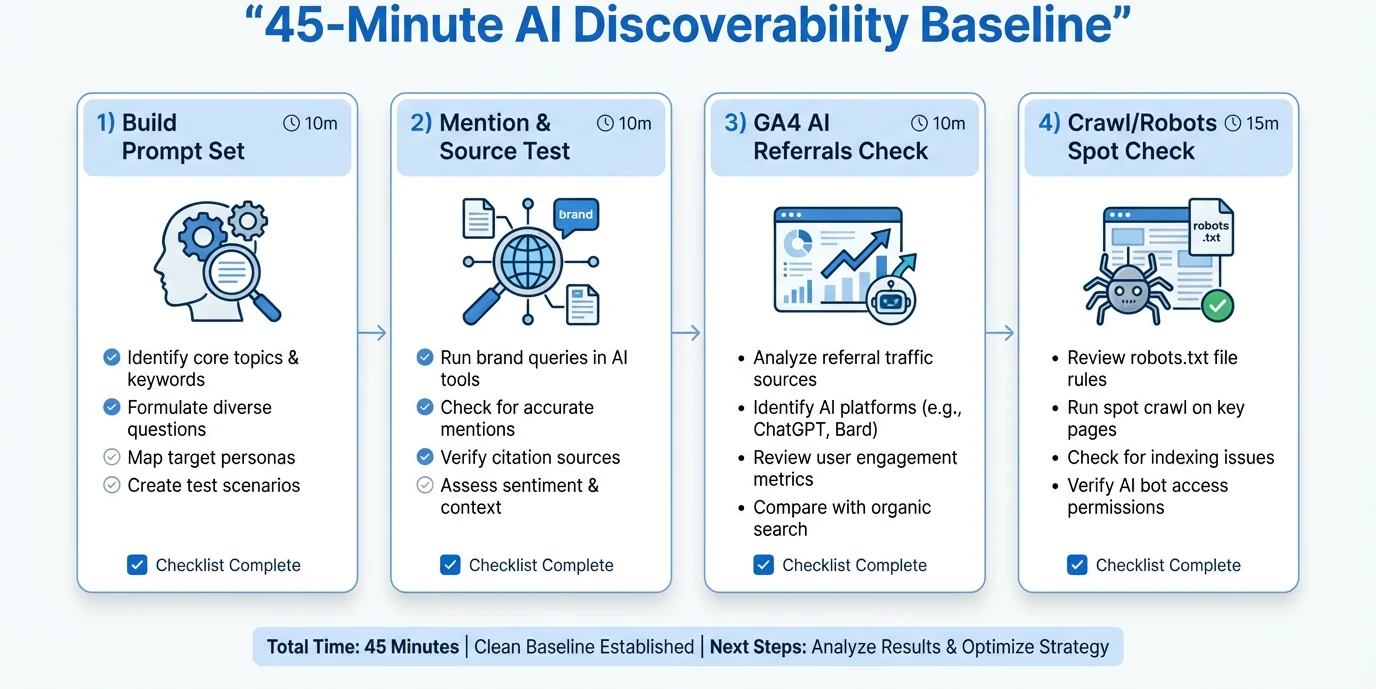
To maintain control over your digital identity, implement a recurring AI brand mention audit checklist. This process moves your startup from passive observation to active narrative management. Establish a 4-step audit loop: Query, Analyze, Align, and Re-verify. First, execute standardized prompts across LLMs to extract current output. Second, analyze the results against your North Star value proposition. Third, align your core entity assets by injecting high-precision descriptive data. Finally, re-verify the output 14 days later to confirm the model has ingested the corrected signals.
Investor-Facing Prompt Strategy
Your audit must simulate the skepticism and specificity of a potential investor. Use these 10 prompts to test how ChatGPT, Gemini, and Perplexity synthesize your brand. These queries challenge AI interpretative bias by demanding comparative and evidence-based answers.
- What is [Company Name]’s primary revenue model, and how does it differentiate from [Competitor A]?
- Summarize the core technical defensibility of [Company Name] in three bullet points.
- Which market segments does [Company Name] prioritize according to their most recent public filings?
- How does the leadership team at [Company Name] describe their vision for the next 24 months?
- Compare the target customer profile of [Company Name] to the industry standard.
- Provide a critique of [Company Name]'s market position based on expert sentiment.
- Does [Company Name] face significant risks regarding regulatory compliance or data privacy?
- List the top three strategic partnerships [Company Name] has secured in the last year.
- What are the common criticisms or limitations associated with [Company Name]'s product suite?
- If I were an investor, what are the primary red flags I should investigate regarding [Company Name]?
Defining Success: Beyond Citation Counts
When checking brand citations in generative AI, founders often fall into the trap of counting mentions. The true KPI is Narrative Accuracy, which measures how closely the AI’s synthesized answer matches your intended strategic positioning. Use the following table to track your progress.
| Query Type | Narrative Accuracy (1-5) | Tone Consistency | Data Integrity (Links/Dates) | Action Item |
|---|---|---|---|---|
| Category Positioning | 4 | High | Accurate | Refine meta tags |
| Competitive Differentiator | 2 | Neutral | Outdated | Update ‘About’ page |
| Revenue Model | 5 | Professional | Accurate | None |
| Leadership Vision | 3 | Vague | Mostly accurate | Revise founder bio |
| Market Segment Focus | 4 | Professional | Accurate | None |
This startup brand narrative audit framework requires quarterly repetition. When you treat AI output as a living component of your brand’s digital footprint, you ensure that when investors query your identity, the narrative they encounter is the one you designed. Brand narrative control is an active management process that evolves alongside the data streams powering AI search. By consistently refining your primary brand signals, you reduce the likelihood of contradictory information polluting AI summaries. This is about establishing a high-fidelity source of truth that generative engines find reliable. By treating the AI brand mention audit checklist as a cornerstone of your growth strategy, you secure the credibility necessary to compete in the current era of AI-driven discovery.
AEO/GEO
Want to learn more?
Contact us for direct consultation and support.