Measuring AI Search Visibility: A Dual-Layer Approach
If you are still looking at your analytics dashboard and seeing only standard organic search traffic, you are missing half the story. Modern search isn’t just about blue links anymore—it is about generative answers.
When users query ChatGPT, Perplexity, or Gemini, they aren’t scanning a list of websites; they are looking for an synthesized answer. For businesses, the challenge is that the old ways of tracking “rank” no longer apply. We need a more sophisticated, two-layer approach to track and improve AI brand mentions and visibility.
The Non-Deterministic Shift: Why Old SEO Metrics Fail in AI Search
Traditional SEO was built on the premise of a deterministic environment: you optimize a page, Google crawls it, and it receives a specific position in the SERPs.
Generative AI, however, is non-deterministic. It does not “rank” websites in a static list. Instead, it processes vast amounts of data to synthesize a unique response for every user. There is no such thing as “ranking #1” anymore; there is only inclusion (did the AI find you?) and citation (did the AI trust you enough to credit you?).
Because these models act as a “black box,” you cannot rely on simple rank trackers. You need a dual-layer strategy that bridges the gap between what users actually do and what the AI models are seeing.
Layer 1: Empirical Behavioral Evidence (The ‘What Users Actually Do’ Data)
This layer focuses on the real-world impact of your AI visibility. It is the “ground truth” of your efforts.
- Filter Dark Traffic: Many AI referrals are stripped of standard UTM parameters. Use your analytics to identify patterns in “direct” or “referral” traffic spikes that correlate with specific content releases.
- Conversion Attribution: Look for high-intent visitors who arrive at your site and exhibit behaviors consistent with “answered” intent—users who are deeper in the funnel because they already received the core solution from an AI.
- The Citation-to-Click Ratio: This is your new core performance indicator. Monitor how many users arrive on your site specifically through AI-generated citation links compared to the total number of times your content is surfaced in AI answers.
Layer 2: Synthetic Model Sampling (The ‘What the AI Sees’ Data)
Because AI is non-deterministic, you cannot wait for users to report back. You must proactively audit the AI.
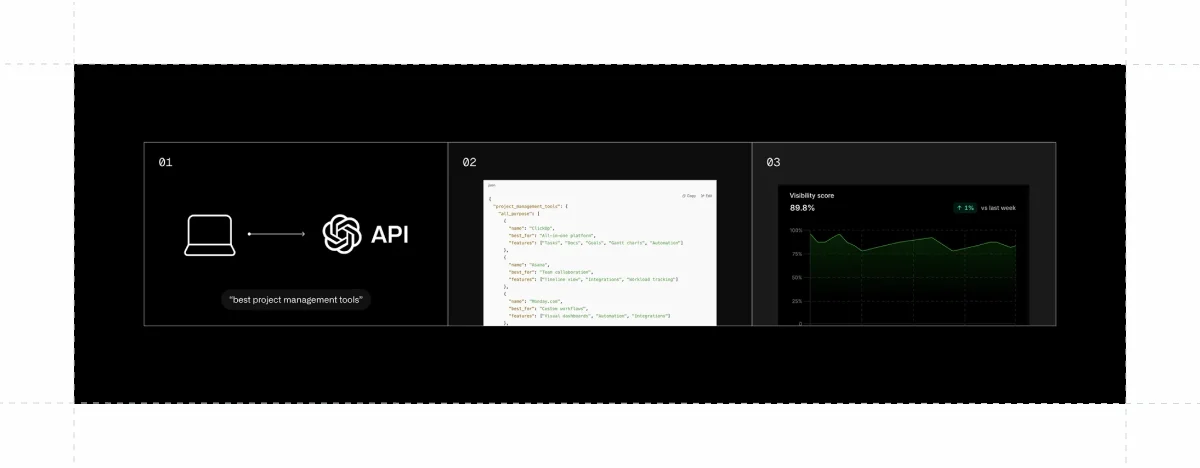
- Prompt-Based Clusters: Create a defined list of high-value queries relevant to your industry. Use automated tools to run these queries across major engines like ChatGPT, Perplexity, and Gemini repeatedly.
- Multi-Run Averaging: Since AI models can produce different answers even for the same prompt, run these queries in clusters. This allows you to account for model volatility and see the percentage of time your brand appears as a cited source.
- Platform Coverage: Track how consistently your brand is referenced across different AI ecosystems. If you are strong in ChatGPT but absent from Perplexity, your brand-entity mapping may need refinement.
Essential AI-Native KPIs for Your Dashboard
To keep your strategy on track, move these three metrics to the center of your dashboard:
- AI Indexing Ratio: This measures what percentage of your core content topics are being synthesized into AI answers. It is the best metric for understanding your “share of knowledge” in an AI-powered world.
- Citation Rate: Don’t just look for brand mentions. Measure how often your brand is included as a high-authority source within the generated response.
- Source-Level Quality: Use sentiment analysis to assess the context of your citations. Are you being cited as a primary authority, or simply an anecdotal data point?
Building Your Technical LLM Health Scorecard
The ultimate goal is to synthesize these layers into a single LLM Health Scorecard. By combining empirical behavioral data with synthetic sampling, you can create a clear, actionable view of your brand’s AI presence.
As you scale, integrate this measurement into your content automation workflow. Do not let the complexity of AI search slow you down. Start by establishing a baseline for your most important topics, and refine your approach based on which platforms are driving the most qualified traffic.
By balancing data depth with the need for speed, you can ensure that your brand isn’t just surviving in the era of AI search—it is dominating it.
AEO/GEO
Want to learn more?
Contact us for direct consultation and support.