Building Content Hubs for AI Visibility & Authority
Why Topical Authority is the New Domain Authority for AI
In the world of traditional search engines, Domain Authority (DA) reigned supreme. It was a numbers game: how many backlinks can you gather to boost your site’s credibility? But when it comes to AI search engines like Perplexity, Gemini, or ChatGPT, the rules have fundamentally shifted.
AI models are trained to synthesize consensus and identify true expertise. They aren’t counting your links; they are evaluating your topical relevance. If your content is scattered across hundreds of disconnected topics, the AI sees noise, not authority.
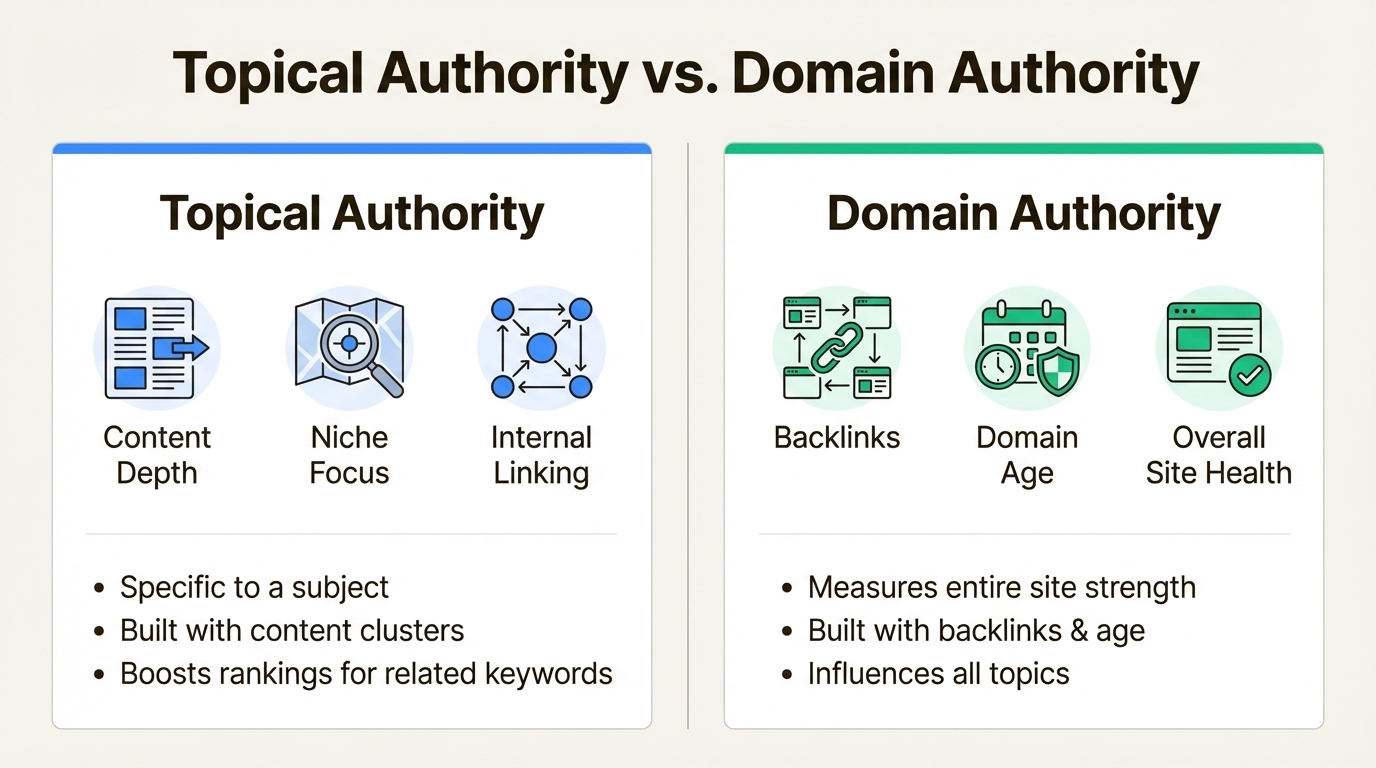
Topical vs. Domain Authority
| Feature | Domain Authority (Legacy SEO) | Topical Authority (AI Era) |
|---|---|---|
| Primary Metric | Backlink count/quality | Semantic relevance & depth |
| AI Focus | Often ignored or de-prioritized | Highly prioritized for synthesis |
| Content Goal | High traffic volume | High “knowledge density” |
| Success Sign | Ranking for broad, competitive keywords | Being cited as the “trusted answer” |
“Knowledge density” is the goal here. By creating a content hub—a tightly interconnected network of information—you provide the AI with a cohesive map of your brand’s expertise. When an AI crawler visits, it finds a wealth of consistent, deep information that makes it easy for the model to “trust” your brand as a primary source.
The Anatomy of an AI-Ready Content Hub: Architectural Blueprint
Building a hub isn’t just about dumping blog posts into one category. It requires a structural approach that AI models can interpret logically.
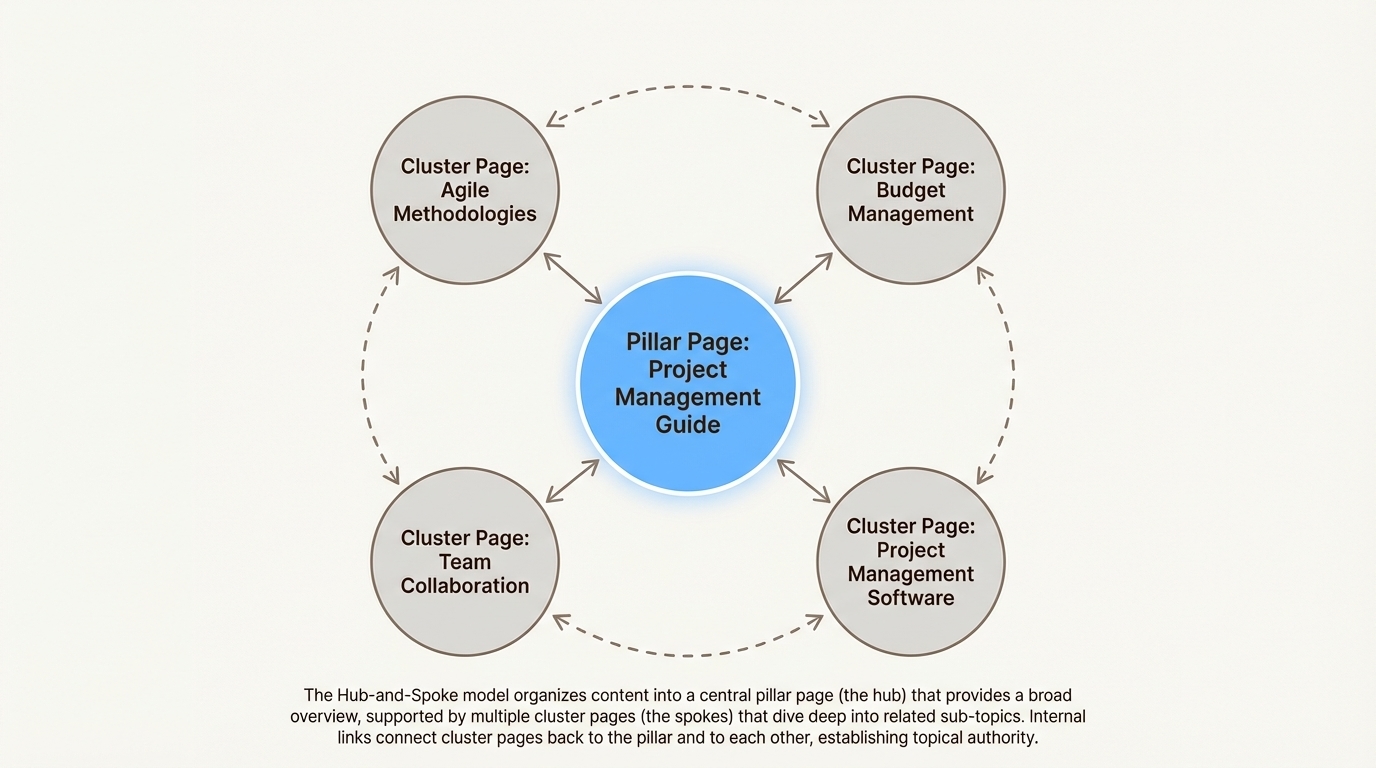
The Hub-and-Spoke Model
Think of your hub as a wheel:
- The Hub (Pillar Page): A comprehensive, long-form page that defines your core topic. It covers the “what” and “why,” providing a bird’s-eye view.
- The Spokes (Clusters): Individual, detailed articles that dive deep into specific sub-questions or technical aspects of the core topic.
By creating strong semantic relationships through internal linking—where your spokes link back to the pillar, and the pillar distributes authority to the spokes—you create a clear hierarchy.
AI-Friendly Structural Elements
To help the AI “read” your content better, structure your pages with:
- Q&A Blocks: Use structured headers that directly mirror common user questions.
- Data Tables: AI models love structured data. Summarize complex processes or comparisons in tables whenever possible.
- Semantic Internal Links: Ensure anchor text is descriptive and relevant to the linked content’s topic.
Feeding the Engine: Vital Trust Signals for AI Crawlers
AI engines are inherently cautious—they prioritize information that feels “safe” and consistent. To build this trust, focus on three signals:
- Consensus: AI models look for consistent definitions and facts across your pages. If one article defines a term differently than another, you trigger a “low-confidence” flag in the AI. Audit your hub regularly to ensure your brand’s narrative is consistent.
- Source Authority: Citations are to AI what backlinks are to traditional SEO. If your content cites reputable, verified sources within your industry, you signal to the AI that your information is vetted and reliable.
- Freshness: AI models are constantly updating. Content that hasn’t been updated in years may be ignored in favor of newer, more relevant answers. A “freshness” audit—where you update data, dates, and insights—tells the AI that your hub is a living, current source of truth.
Step-by-Step: The Practical Workflow for Execution
Want to start building? Use this two-step framework to manage the complexity.
Phase 1: Planning
- Entity Mapping: Identify the core “entity” or topic you want to own. Break it down into sub-topics based on real user queries.
- Keyword/Entity Integration: Ensure every cluster page has a primary keyword, but more importantly, covers the entity-related sub-queries that your audience is searching for.
Phase 2: Creation & Auditing
- Content Workflow: Focus on high-quality, long-form content that incorporates the trust markers mentioned above (citations, Q&A sections).
- Ongoing Auditing: Use a recurring schedule to check for “information drift.” If new developments change your industry, update your hub immediately. Consistency is the key to keeping your spot in the generated answer.
Measuring Success: Beyond Standard SEO Rankings
Stop obsessing over raw SERP rankings. In the AI era, success looks different:
- Generative Visibility: Are you appearing in the summary boxes or “AI-overviews” of major search engines?
- Topical Gaps: Use auditing tools to identify questions your competitors are answering that you aren’t. Filling these gaps is the fastest way to expand your authority.
- Persistent Presence: When a user asks a nuanced question about your industry, does the AI synthesize an answer that sounds like it came from your brand?
Building content hubs for AI is about moving from “chasing keywords” to becoming the “definitive voice” in your niche. Start building your knowledge repository today, and watch your brand become the go-to source for AI-generated answers.
AEO/GEO
Want to learn more?
Contact us for direct consultation and support.