Building Scalable Generative AI Content Systems
Many organizations treat generative AI as a standalone novelty rather than a structural component of their marketing technology stack. This fragmented approach often leads to disconnected content, unreliable outputs, and a failure to capture visibility within the evolving search landscape. As search behavior shifts toward AI-driven answer engines like ChatGPT, Google AI Overviews, and Perplexity, businesses must evolve beyond tactical experimentation.
True digital dominance requires moving from disparate tools to a unified architecture that synchronizes generative output with core business data. By implementing scalable generative AI content systems, your organization can move past siloed workflows and establish a consistent, authoritative presence across both traditional search and AI-driven platforms. Successfully building an automation stack for AI search content requires bridging the gap between validated internal data and the generative models that influence user decision-making.
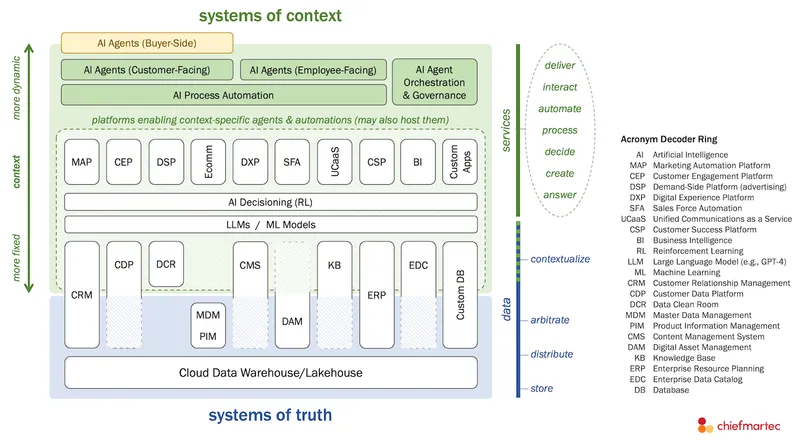
Moving Beyond Tool Sprawl: The Systems of Truth Framework
Achieving a sustainable advantage in the age of answer engines requires moving beyond the fragmented nature of modern marketing technology. Many organizations fall into the trap of tool sprawl, where disconnected AI applications generate content that lacks a unified foundation of facts. To build scalable generative AI content systems, you must transition from reactive content creation to an architecture built on a System of Truth.
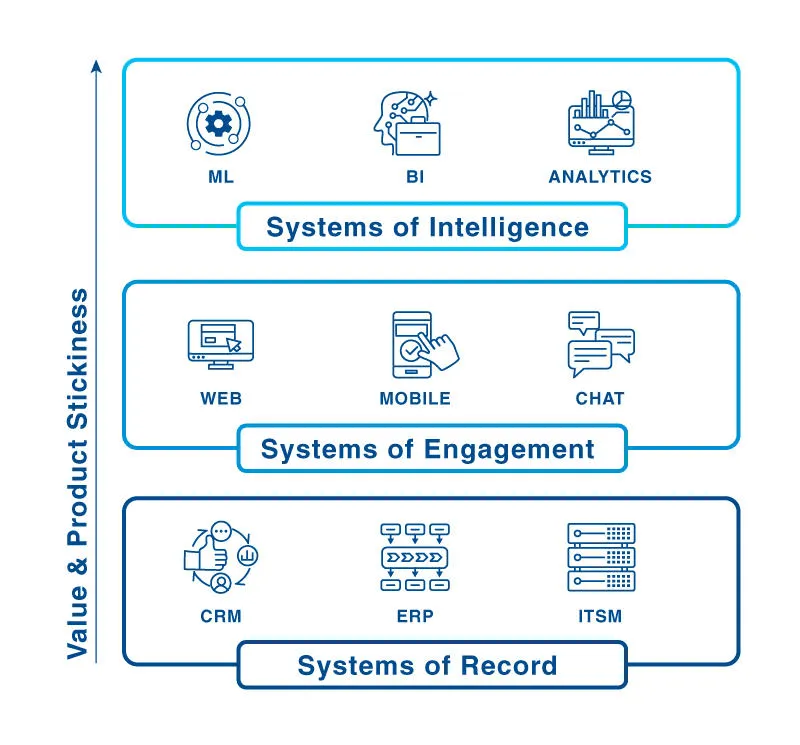
The Distinction Between Systems of Record and Intelligence
To understand where your organization stands, you must distinguish between two fundamental types of technology. A System of Record—such as your CRM, CDP, or Product Information Management (PIM) platform—acts as the authoritative ledger for customer data, product specifications, and company history. In contrast, Systems of Intelligence, including generative AI engines and LLM-powered interfaces, are designed to process, synthesize, and create new content based on available inputs.
The challenge arises when these two systems operate in isolation. When your AI engine lacks a direct, real-time connection to your System of Truth, it often defaults to generalized training data rather than your verified brand guidelines. This creates an architectural gap where the output is disconnected from actual business realities, increasing the risk of hallucinations and inconsistent messaging.
Solving Data Silos Through Architectural Interoperability
Data silos represent the greatest barrier to an effective automation stack for AI search content. Relying on manual workflows, such as copying and pasting information from internal wikis into chatbot interfaces, is fundamentally non-scalable and error-prone. This manual approach prevents your brand from maintaining the high level of accuracy required for AI-driven answer engines to consistently cite your business as a trusted source.
The solution lies in architectural interoperability, specifically through the use of APIs and the Model Context Protocol (MCP). By connecting your content management layer directly to your central data repositories, you create a pipeline that ensures the AI always has access to the most recent, verified documentation.
| Feature | Manual Content Generation | API-Driven Content Architecture |
|---|---|---|
| Data Freshness | Subject to human update delays | Real-time synchronization |
| Consistency | High risk of manual error | Hard-coded brand compliance |
| Scalability | Limited by personnel bandwidth | Automated and high-volume |
| Trust/E-E-A-T | Variable and unverified | Inherently tied to verified sources |
Architecting the Data Pipeline: Connecting AI to Your CMS
Building scalable generative AI content systems requires a robust infrastructure that bridges the gap between static content management and dynamic AI processing. To achieve high-quality output, your content must be grounded in verified enterprise data. The most effective technical architecture for this is Retrieval-Augmented Generation (RAG). By integrating your Customer Data Platform and Content Management System as a unified source of truth, you ensure that LLMs retrieve accurate, real-time data before generating responses.
The RAG Technical Workflow
At the core of a professional automation stack for AI search content lies the RAG pipeline. This workflow transforms your internal databases from passive repositories into active knowledge bases for AI agents. The process follows a precise sequence:
- Data Ingestion: Raw data from your CMS and CDP is synchronized and cleaned.
- Vectorization: Verified data is converted into numerical vectors and stored in a vector database, creating a searchable index.
- Retrieval: When a search engine queries the system, the pipeline performs a semantic search within your vector store to fetch relevant snippets.
- Augmentation & Generation: The LLM receives the prompt and the retrieved brand data, instructing it to synthesize an answer based on your verified facts.
Comparing Content Workflows
Choosing the right integration level determines your operational efficiency. Moving from manual updates to native API-based automation is the defining characteristic of mature, scalable generative AI content systems.
| Workflow Type | Accuracy | Speed | Consistency | Technical Barrier |
|---|---|---|---|---|
| Manual Workflow | High | Low | Low | Low |
| Middleware Integration | Medium | Medium | Medium | Moderate |
| Native API Automation | High | High | High | High |
Operationalizing Content Scalability for Answer Engines
Building scalable generative AI content systems requires a strategic shift from traditional long-form production toward structured, machine-readable formats. When you implement an automation stack for AI search content, the primary objective is to make information frictionless for LLMs to ingest and parse. Your output must prioritize clarity, logical hierarchy, and explicit semantic structure.
Structuring for LLM Extraction
LLMs prioritize content that is modular and self-contained. To maximize your chances of being cited, your automation stack for AI search content should generate output that relies on specific structural patterns. Start every key section with a 40–60 word direct answer block. This brief, descriptive snippet serves as the source of truth for an AI model.
| Format Type | Strategic Purpose |
|---|---|
| FAQ Schema | Targets question-answer pairs for snippet surfacing |
| Structured Lists | Provides clear, rankable steps for RAG pipelines |
| Definition Blocks | Uses X is a Y phrasing to improve entity recognition |
| Comparison Tables | Synthesizes complex product data for rapid comparison |
Maintaining E-E-A-T in Automated Systems
Scaling does not mean sacrificing quality. To maintain E-E-A-T—Experience, Expertise, Authoritativeness, and Trustworthiness—while utilizing scalable generative AI content systems, you must programmatically bake in signals that verify credibility. This includes dynamic author attribution, real-time citation of primary data sources, and transparent publication dates.
Measuring Impact: Governance and Continuous Optimization
Establishing effective measurement for scalable generative AI content systems requires a departure from vanity metrics. Monitoring the ROI of your automation stack for AI search content depends on your ability to track how AI models ingest and attribute your content.
| KPI Category | Focus Area | Impact Measurement |
|---|---|---|
| Visibility | AI Citation Rate | Frequency of brand mentions in generated answers |
| Efficiency | Content Production | Time saved through automated generation cycles |
| Accuracy | Truth Alignment | Reduction in brand-fact hallucinations |
| Authority | E-E-A-T Signaling | Frequency of links from high-authority sources |
| Conversion | AI-Referral Leads | Downstream goal completions from AI-driven traffic |
The future of search visibility hinges on owning the technical infrastructure that delivers your brand narrative. By investing in scalable generative AI content systems, you transform your digital presence into a dynamic resource that answer engines trust. Prioritize structural integrity and data-driven governance to secure your brand’s authority in the engines of tomorrow.
AEO/GEO
Want to learn more?
Contact us for direct consultation and support.