The Current State of Blog Readership
There is a persistent myth in marketing circles that the long-form article is dying. You may have heard executives claim that attention spans are shrinking to the size of a goldfish, or that video and social media snippets have entirely replaced the written word. These narratives are compelling, but they often ignore the actual behavior of consumers when they are looking for answers. The question of whether people still read blogs is not just a rhetorical device for industry conferences… it is a strategic question that determines where you invest your content budget.

To get a clear picture of the current landscape, we looked at survey data involving 325 consumers to understand their reading habits. The results challenge the notion that blogs are irrelevant. In fact, the majority of respondents indicated that they read blogs regularly. Specifically, 29% of people read blogs one to four times a month, and 18% engage with blog content every single day. When you combine these groups, a significant portion of the audience is consistently consuming written content.
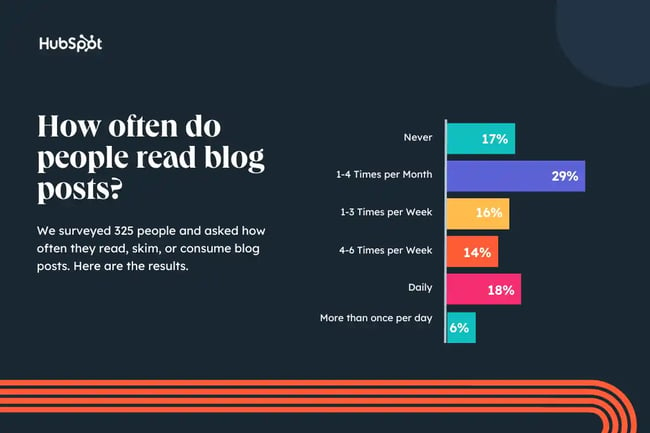
This visual breakdown illustrates that while 17% of respondents never read blogs, the number of daily and frequent readers far outweighs the non-readers. More people are reading blogs daily than never at all. This suggests that the medium has not only survived but has stabilized as a core part of the information diet for a large segment of the population. The data indicates that for every person who ignores blogs, there are multiple others who rely on them for information, education, and decision-making.
Consumption Trends Over Time
One might assume that as new platforms emerge, blog consumption would inevitably decline. However, the data tells a different story. When asked how their reading habits compared to the previous year, 57% of respondents said their consumption remained the same. Even more telling, 35% reported that their blog consumption has increased. Only a small fraction, 9%, said they read less than they did in the past.
This stability and growth are significant for businesses relying on content marketing. It suggests that blogs are not a fading trend but a sustained channel. The increase in consumption among over a third of respondents indicates that as the digital world becomes noisier, people are turning to structured, in-depth written content to cut through the clutter. They are seeking clarity and depth, which short-form social posts often fail to provide.
How Readers Engage with Content
Understanding that people read blogs is only half the equation. The other half is understanding how they read. Are they deeply engaged, or are they skimming headlines before bouncing? The survey reveals a mixed but encouraging pattern. About 35% of readers admit to skimming most of the time, which aligns with the general behavior of scanning for relevant information online. However, 38% of respondents engage in a mix of skimming and deep reading.
What stands out is that 13% of readers deep-read more than they skim. These are the highly engaged users who are absorbing your arguments, analyzing your data, and building trust with your brand. Only 6% of users navigate to a specific piece of information and leave immediately without reading the rest. This means that for the vast majority of your audience, the effort you put into crafting a well-structured, comprehensive post is worth it. They are not just grabbing a fact and leaving; they are staying to learn.
Strategies to Increase Blog Readership
Knowing that an audience exists is valuable, but capturing that audience requires more than just publishing text. To stand out in a crowded digital environment, you need to adapt your content format to match how people consume information today. This means moving beyond static text and embracing a multi-modal approach that integrates video, visuals, and data. The goal is not to abandon writing but to enhance it with elements that improve engagement and retention.
Integrating Video and Text
Video has been the most popular marketing media format for several years running. It is effective because it appeals to visual and auditory learners, and it can convey complex information quickly. Integrating video into your blog posts does not replace text; it complements it. Some readers prefer to scan the written summary, while others may want to watch a demonstration or hear an expert explanation.
When you embed a relevant video in a blog post, you provide a richer experience. For example, if you are writing about a software feature, a short screen recording can show the user exactly how it works, while the text explains the benefits and use cases. This dual approach caters to different learning styles and keeps users on the page longer. Furthermore, video content can rank in video-specific search results, giving your content an additional avenue for discovery. If you are concerned about the cost or technical complexity of video production, there are accessible tools and AI generators available that make it easier to create high-quality visuals without a large budget.
The Power of Original Visuals
Text-heavy pages can feel intimidating or dry to readers. Breaking up long paragraphs with original images, charts, and infographics makes the content more digestible and visually appealing. You do not need to be a professional graphic designer to create effective visuals. Tools like Canva allow you to design clean, branded graphics that illustrate key points or summarize data.
Original images serve two purposes. First, they improve the user experience by making the content easier to scan and understand. Second, they are highly shareable. When you create a unique infographic or chart, other websites and social media users are more likely to share it, often linking back to your original post. This not only drives traffic but also builds backlinks, which are crucial for search engine optimization. Investing time in creating branded templates for your graphics can pay off in increased visibility and engagement over time.
Publishing Original Data and Insights
One of the biggest mistakes bloggers make is producing thin, generic content that adds little value. Short posts with 200-300 words may get some search traffic, but they rarely build authority or trust. To compete with established sites, you need to offer something that cannot be found elsewhere: original data, expert quotes, and unique insights.
Conducting your own surveys, analyzing industry trends, or interviewing experts can provide the raw material for high-value content. When you publish original data, you become a source that other journalists and bloggers cite. These citations result in backlinks, which signal to search engines that your content is authoritative and trustworthy. Additionally, readers are drawn to content that teaches them something new. In the survey, 61% of respondents said they were attracted to blogs because they wanted to learn something or educate themselves. By providing deep, data-backed insights, you meet this demand and position your brand as a thought leader.
Leveraging SEO for Organic Growth
While social media and email can drive immediate traffic, organic search remains the primary source of views for most blogs. To capture this traffic, you must optimize your content for search engines. This involves more than just adding keywords; it requires a strategic approach to how your content is structured and linked.
Start with keyword research to understand what your audience is searching for. Then, ensure your content answers those queries comprehensively. Use internal linking to connect related posts, which helps search engines understand the context and depth of your site. Also, do not neglect technical elements like image alt text, which helps with accessibility and image search rankings. SEO is a long-term strategy, but it provides a steady stream of qualified leads who are actively looking for the information you provide.
Promoting Content Across Channels
Publishing a blog post is only the first step. To maximize its reach, you need to promote it across your marketing channels. Social media is a powerful tool for driving non-organic traffic. In the survey, 30% of respondents discovered blog posts through social media, compared to 18% who found them via search results. This highlights the importance of sharing your content where your audience already spends their time.
When you share a blog post on social media, tailor the message to the platform. On LinkedIn, you might highlight a key statistic or insight. On Twitter, you might share a provocative quote or a visual snippet. Email newsletters are also effective for driving traffic to recent posts, especially for your existing subscribers. By promoting your content consistently, you increase the chances of it being seen, shared, and linked to, which further boosts its search visibility.
Building a Sustainable Blog Strategy
As we move further into the era of AI-driven search, the role of blogs is evolving. Generative AI models often pull from high-quality, authoritative written content to answer user queries. This means that having a robust blog presence is not just about traditional SEO; it is about ensuring your brand is visible in AI-generated answers. The strategies discussed above—integrating video, using visuals, publishing original data, optimizing for SEO, and promoting across channels—are all essential for building a blog that performs well in both traditional search and generative AI environments.
Key Takeaways for 2024 and Beyond
To build a better blog, focus on these core principles:
- Embrace Multi-Modal Content: Combine text with video and graphics to cater to different learning styles and increase engagement.
- Prioritize Originality: Publish data, quotes, and insights that cannot be found elsewhere. This builds authority and attracts backlinks.
- Optimize for Search and AI: Use clear headings, structured data, and comprehensive answers to help search engines and AI models understand and cite your content.
- Promote Actively: Share your content on social media and email to drive immediate traffic and increase visibility.
The Future of Content Visibility
The data is clear: people still read blogs, and they are reading more than ever. The challenge for marketers is not to convince audiences to read, but to provide content that is worth reading. By focusing on quality, depth, and multi-format engagement, you can build a blog that not only attracts readers but also builds trust and authority for your brand.
In the context of AI Search Optimization (AEO), this is even more critical. AI models prioritize content that is accurate, comprehensive, and authoritative. By following these strategies, you ensure that your content is not only visible to human readers but also recognized by AI systems as a reliable source. This dual visibility is key to staying competitive in the evolving digital landscape.
Final Thoughts
Blogging is not dead; it is transforming. The businesses that succeed will be those that adapt to the changing consumption habits of their audience. They will provide value through original insights, engage readers with multi-modal content, and optimize their presence for both traditional search and AI-driven discovery. The question is no longer whether people read blogs, but how you can make your blog the one they choose to read.
What steps are you taking to ensure your content is ready for the AI era? Are you focusing on depth and originality, or are you still relying on thin, generic posts? The data suggests that the answer to these questions will determine your visibility and success in the coming years.





