The Fall of Keyword Isolation: Why Generative Search Demands Entity Architecture
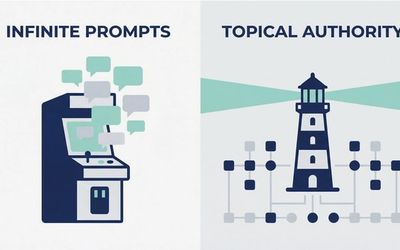
The era of chasing singular keywords is effectively over. In generative search environments, Large Language Models (LLMs) do not “rank” a webpage; they synthesize an answer based on a graph of connected entities. Relying on keyword density or traditional SEO isolation renders content invisible to AI, which prioritizes topical depth and logical connection over volume.
An entity acts as the fundamental building block of an LLM’s knowledge base. By defining your brand, products, and core competencies as discrete, interconnected nodes within a broader knowledge graph, you transition from competing for a blue link to being the source of truth that the model cites to resolve user intent.
Structuring Authority: The Pillar-Cluster Entity Mapping Model
To achieve visibility, you must move toward a Pillar-Cluster architecture designed for machine readability. This model organizes information hierarchically to mirror the semantic associations an AI model expects.
- Pillar Pages: Function as the high-level authority anchors, defining the primary entity and its high-level attributes.
- Cluster Pages: Provide the granular semantic depth, addressing sub-entities and specific queries that strengthen the pillar’s relevance.
- Semantic Linking: Internal links must be explicitly structured to map relationships, not just provide navigation. Every link should reinforce the proximity between a sub-entity and the core pillar entity.
The On-Page Blueprint: Technical Definition and Disambiguation
AI crawlers require programmatic clarity to map your content to a real-world entity. Without explicit technical definitions, your content risks being categorized under the wrong topic or ignored entirely.
Core Anatomy for AI Crawlers
- Entity Definition: Explicitly define the subject in the opening paragraph using clear, declarative prose. Avoid jargon that cannot be reconciled with common ontologies.
- Schema Markup: Implement advanced JSON-LD schema that explicitly links your pages to external authority sources like Wikidata or Google’s Knowledge Graph. Use
@idreferences to create a unique identifier for every entity on your site. - Disambiguation: Utilize structured data to distinguish your entity from similarly named concepts, ensuring the AI model assigns authority to your specific brand rather than a generic term.
Operationalizing at Scale: Deploying AI Agents for Entity Maintenance
Manual content management cannot keep pace with the iterative nature of generative search. The solution is to transition to agentic workflows, where AI systems perform the heavy lifting of entity maintenance.
- Audit Agents: Automatically scan your pillar-cluster network for link decay, orphaned nodes, or outdated entity attributes.
- Expansion Agents: Identify gaps in your knowledge graph where sub-entities lack sufficient coverage, automatically drafting supporting content to maintain topical density.
- Citation Maintenance: Monitor how your content is referenced in AI-generated answers, triggering updates to the source material to improve alignment with the model’s evolving requirements.
Measuring Topical Authority: Beyond SOV Metrics
Traditional rank tracking and basic Share of Voice (SOV) metrics are insufficient for generative search. You must pivot toward tracking how the AI perceives your brand’s authority.
- Topical Coverage Depth: Track the number of nodes in your knowledge graph that are successfully indexed and linked within your pillar-cluster network.
- Citation Performance: Measure how often your specific pages are used as definitive sources in AI-generated responses.
- Internal Link Health: Audit the strength of semantic pathways to ensure the authority signal flows correctly from cluster content back to your core entity pillars.
By shifting focus from keyword positioning to building a robust, entity-based knowledge architecture, you ensure your brand is not just indexed, but essential to the answers AI generates for your target audience.