Forty-two percent of salespeople report that prospecting is the most difficult part of their daily workflow. Yet, consistent outreach remains the single most important activity for revenue growth. Email is a central component of any effective strategy, but the challenge lies in efficiency. The average representative gives up after two attempts, while data suggests eight attempts are often required to close a sale. This gap creates a significant opportunity for improvement through automation and better planning.


Sending more of the same generic messages is not the solution. Many reps simply forward their original message, adding guilt-tripping phrases like “Have you seen my previous emails?” This approach rarely works. To succeed, you need to plan what to say and how to say it, varying your approach at each touchpoint. By creating reusable, customizable email template sequences and automating the scheduling, you can speed up your sales cycle without sacrificing quality. Below, we explore how to build a system that respects your time and your prospect’s inbox.
Strategic Planning and Scheduling
Effective prospecting campaigns require significant upfront planning. Many companies take a haphazard approach, giving salespeople a handful of templates and a CRM login. This lack of structure leads to inconsistent outreach and missed opportunities. Instead, use sales software to schedule multiple attempts at once. Tools like HubSpot’s email sequences allow you to deploy prospecting campaigns automatically. You can personalize and schedule a series of emails at predefined intervals for each prospect. When a buyer responds, they are automatically unenrolled from the sequence, ensuring no further automated emails are sent.
This process saves considerable time. Once you schedule a set of emails, you do not need to worry about which message to send next or when to send it. You can also schedule tasks for the salesperson, such as making a call before or after an email is sent, or checking if prospects are opening emails. This structured approach ensures that every prospect receives the right amount of attention without manual tracking.
Subject Lines That Drive Opens
Subject lines are critical for maximizing open rates. If a prospect does not find the subject line interesting, they will not read your email. Recipients are more likely to open emails with intriguing subject lines, so include personalization, exclusivity, and questions. Personalized subject lines might include “[Name], interesting piece of advice” or “Your profile is impressive, [Name].” Exclusive subject lines, such as “Invite Only – [Event Name],” work well if you have a genuine exclusive offer. Question-based subject lines, like “What do you think of X?” or “How do you do X?”, can also spark curiosity and encourage engagement.
Personalization and Customization
No one likes to feel like they are receiving a generic email. A potential customer wants to be recognized as an individual. To effectively customize your messages, start by using personalization tokens to automatically populate messages with the prospect’s name, company, and title. Ensure your CRM information is accurate to avoid errors. Next, use a persona. Make sure your recipient matches your target persona and share content related to their common pain points. Finally, conduct research. Find something unique about the individual you are contacting and incorporate this into your message. Focusing your first message on your findings can significantly increase response rates.
Crafting Engaging and Concise Messages
In addition to personalizing and targeting your messages, you must write engaging and concise copy. Customization will not matter if your email is poorly written. Many salespeople make the mistake of including their product’s full value proposition in every email. Instead, focus on something relevant to your prospect. Bite-sized messages are more likely to get read precisely because they are short. There is no need to cram everything you want to tell someone into a single email. People want to know how your product or service will benefit them, not how it works.
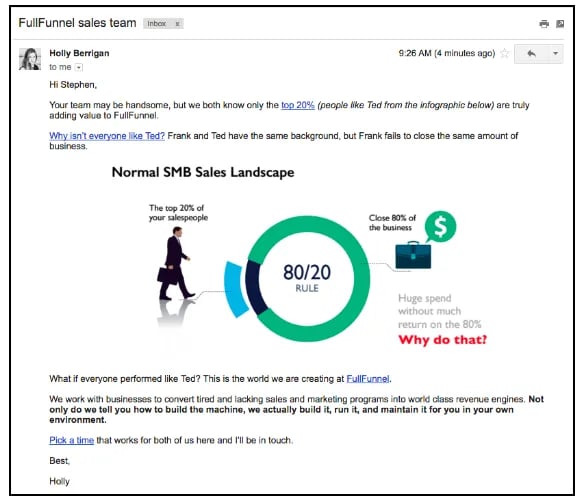
Experiment with tone in your emails. Keeping your language familiar and friendly can be effective, but your ideal tone may vary depending on your target personas. A mock example of a successful email shows that you do not need to go into specifics about what your company does. Instead, show the potential benefit to the recipient’s company. Write in a voice that feels authentic and relatable. This approach helps build trust and encourages prospects to engage with your content.
Using Images for Relatability
Images can increase relatability and break the ice. Educational infographics work well when you want the prospect to come to the same conclusion you are proposing. Funny images or humorous GIFs can quickly grab attention, especially for difficult-to-reach personas like those in IT, or for social personas like those in sales or recruiting. Animated GIFs are supported by almost all email clients, making them a versatile tool for your outreach. Use images strategically to support your message and make your email stand out in a crowded inbox.
Content and Clear Calls-to-Action
Increasing your email open rate is only valuable if you can get prospects to reply or convert on your website. The content and call-to-action (CTA) you choose should vary based on the stage of the buyer’s journey. For contacts less familiar with your offerings, include a link to a landing page with relevant educational offers. Use simple action words such as “click here,” “discover,” or “download” to make it clear what you want the reader to do. If the lead is aware of your offerings and likely interested, link to a meeting scheduler so they can book time with a rep. For later-stage leads, include a link to a case study. Progressive profiling can also help capture more information about a lead over time, allowing you to send increasingly targeted offers.
Maximizing Efficiency with Reusable Sequences
Creating reusable sequences for different personas maximizes efficiency. For each persona, recommend creating five or more emails per cadence. Each message should address pain points your persona may struggle with and present proof that you can help eliminate the problem. Save each series of emails as a sales sequence to automate your prospecting touches without sacrificing personalization. This approach ensures that every prospect receives a tailored experience while allowing your team to focus on high-value activities.
Choosing the Right Prospecting Software
Selecting the right email prospecting software is crucial for implementing this strategy. Several tools offer features that support automated and personalized outreach.
| Software | Key Features | Pricing Model |
|---|---|---|
| Sales Hub | Email sequences, pipeline organization, targeted emails | Starter: $50/mo; Professional: $500/mo; Enterprise: $1200/mo |
| Apollo | Automated sequences, click-to-call, CRM logging | Free; Basic: $32/mo; Professional: $100/mo |
| PersistIQ | Smart variables, out-of-office detection, modern templates | Lite: $40/mo; Starter: $60/mo; Growth: $90/mo |
| Outreach.io | Multi-channel outreach, open/click tracking, inbox integrations | Pricing upon request |
| SalesLoft | Personalized templates, A/B testing, timezone detection | Pricing upon request |
| Reply | Onboarding to re-engagement, delivery/open/click stats | Individual: $55/mo; Business: $200/mo |
| Mixmax | Meeting booking, performance metrics, CRM logging | Starter: $9/mo; Small Business: $24/mo; Growth: $49/mo |
Each of these platforms offers unique features that can help you streamline your email prospecting process. Consider your team’s specific needs and budget when choosing a tool.
Conclusion: A Little Planning Goes a Long Way
Email automation does not have to be cold, monotonous, or spammy. With a bit of planning, some content, and the right tools, you can stop feeling frustrated by ignored emails. Create email templates that include content tailored to the persona and buyer stage of each contact. Write engaging subject lines, add images where they make sense, and keep your messages brief. Follow through with multiple, creative attempts.
Use technology to store these customizable email template sequences and automate the repetitive parts of prospecting. However, do not go overboard with automation. Use your newfound time to do more research and customize each message for each prospect even more. By quickly accessing and scheduling reusable email templates with CTAs to content proven to convert, you can achieve higher response rates more efficiently. Keep creating new templates and sequences for different stages of the buyer’s journey and different personas, and you will build a prospecting machine that puts quality opportunities into your funnel at an ever-increasing rate.
At AEO/GEO, we believe that intelligent content creation and optimization are key to winning visibility in the AI-driven search era. By applying these principles to your email prospecting, you can ensure that your outreach is not only automated but also highly relevant and effective. How can you adapt your current strategy to better serve your prospects?





