Beyond Keywords: Understanding LLM Training and Citation Architectures
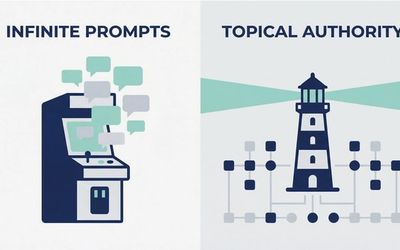
The transition from index-based search to Retrieval Augmented Generation (RAG) marks a fundamental shift in how information is surfaced. Traditional search engines retrieved a list of documents based on keyword frequency; modern AI search engines synthesize answers by processing semantically dense knowledge.
LLMs do not scan for “keyword density” in the traditional SEO sense. Instead, they operate on a training architecture that prioritizes:
- Semantic Density: The ability to map concepts and relationships within your content, ensuring the model understands the “why” and “how,” not just the “what.”
- Source Authority: A probabilistic weight assigned to a domain based on historical accuracy, peer-cited research, and consistent entity representation.
- Information Synthesis: The model’s capacity to pull disparate facts from your site to create a cohesive answer that provides value without requiring a click.
To be cited, your content must move beyond passive keyword inclusion and actively facilitate knowledge extraction for the model.
Engineering Content for Generative AI Interpretability
If you want an AI to “read” and cite your content, you must prioritize structural clarity. Think of your page as an API response for a machine reader.
1. Structural Standards
Use strict hierarchical HTML5 to delineate topics. AI models consume content faster when it is organized into logical nodes. Use schema markup—specifically Article, FAQPage, and HowTo—to explicitly define your content type and key data points.
2. Eliminating Ambiguity
AI models struggle with flowery, abstract, or contradictory language. Ensure:
- Declarative Statements: State facts clearly at the start of paragraphs.
- Logical Constraints: Use precise terminology. If your brand uses a unique methodology, define it early.
- Answer Snippets: Embed clear, concise, direct answers within your text. If a user asks “What is X?”, your content should contain a 1-2 sentence paragraph that defines X perfectly.
3. Entity Consistency
Ensure your brand, products, and services are defined consistently across your entire digital footprint. Use unique, schema-referenced identifiers to link mentions of your brand across different pages and external platforms.
Building Your Brand’s Knowledge Graph for Search Visibility
Visibility in the generative era is essentially a game of entity mapping. You must ensure the “knowledge graph” an AI model maintains about your niche includes your brand as a central node.
- Entity Mapping: Connect your content to industry-standard taxonomies. When you write about a topic, ensure it is contextually linked to the core entities your target audience searches for.
- Primary Source Positioning: Aim to be the definitive source for “long-tail” industry questions. If you are the first or most accurate source of unique data, the model will naturally prioritize you as a citation in its synthesis process.
- Cross-Platform Consistency: Ensure your brand identity, service descriptions, and technical definitions are identical on your website, social channels, and third-party industry directories.
Performance Metrics for the Generative Era: Moving Beyond Clicks
Traditional KPIs like click-through rate (CTR) are becoming secondary. In a world where the answer is provided on the search engine results page (SERP), success is measured by attribution.
- Attribution Frequency: Track how often your domain is cited as a source in AI-generated answers for your core industry queries.
- Brand Mentions in Synthesis: Monitor the context surrounding your brand name within AI responses. Is the model associating your brand with the right product categories and value propositions?
- Zero-Click Authority: View “zero-click” interactions as a success metric. Being the source of truth that powers the AI’s answer is a high-value outcome that establishes your brand as an industry leader, regardless of whether a user clicks your link.
An Automated Workflow for Scalable GEO (Generative Engine Optimization)
Achieving consistent visibility requires moving from manual content creation to an automated, GEO-optimized pipeline.
- Continuous Analysis: Identify high-intent queries where your competitors are being cited but you are not.
- Re-engineering Loop: Use automated tools to analyze why your content failed to capture the citation, then update your structure, facts, or schema to improve interpretability.
- Fact-Checked Distribution: Ensure your content pipeline is grounded in updated, verified data. AI models penalize outdated information; automating a refresh cycle for your core knowledge-base pages is critical for maintaining your authority status.
By treating your content as an evolving data source, you transform your brand into a reliable, citeable partner for AI agents.