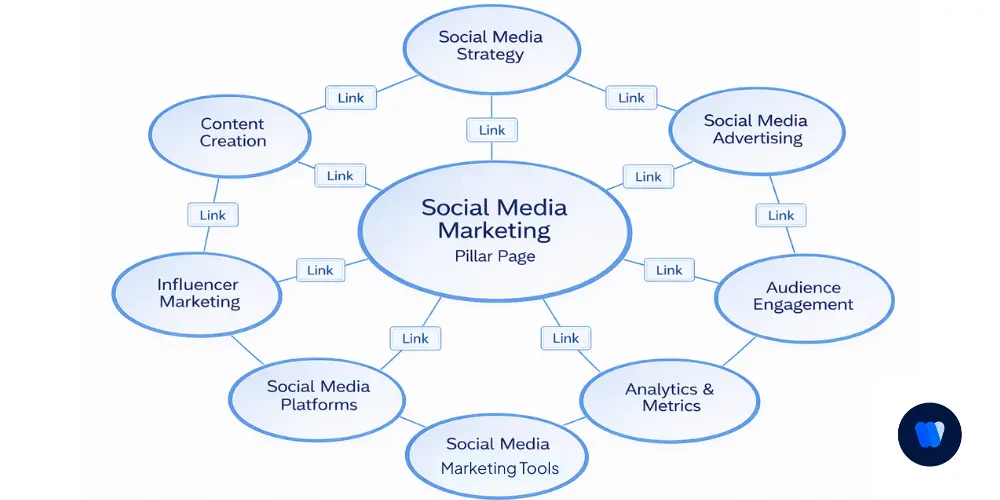
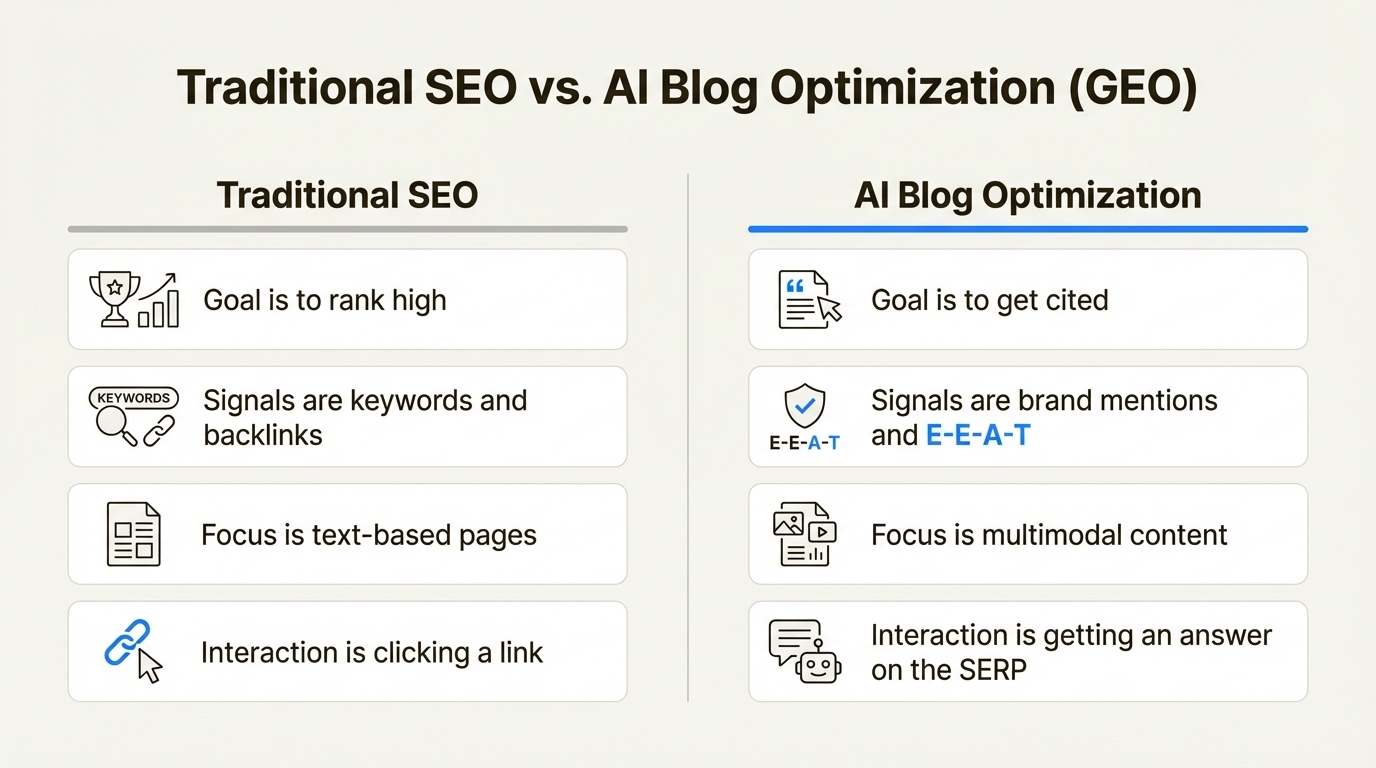
Defining the Architecture: Entities Over Keywords
To capture visibility in generative AI environments, you must shift your focus from tracking keyword volume to building topical authority through entity relationships. AI models do not rank strings; they synthesize relationships between entities—people, organizations, locations, and concepts—stored in their knowledge graphs.
To build this architecture:
- Map Core Domain Entities: Identify the primary subject matters your brand must “own.” List your core entities and map their sub-entities to create a comprehensive topical hierarchy.
- Establish Relationships: Use content to define how your brand, products, and services relate to industry challenges.
- Leverage Structured Data: Use JSON-LD schema as the bridge between your content and AI knowledge graphs. By explicitly defining entity types and associations (e.g.,
sameAs,about,mentions), you provide the machine-readable evidence required for an AI to confidently cite your brand as an expert.
The 8-Step Operational Workflow for AI-Ready Clusters
Deploying AI-ready content requires a rigorous, repeatable process that favors verifiable facts and clear structure.
- Audit: Analyze existing content for entity gaps relative to your core topical scope.
- Topic Selection: Identify high-value clusters where your brand can provide proprietary insights or unique data.
- Entity Mapping: Define the primary entity for each piece and the supporting entities that link it to your pillar pages.
- Production: Draft content with clear, concise sections, using data-backed claims that AI agents can easily parse and verify.
- Schema Injection: Programmatically apply JSON-LD to every page to define the relationships explicitly.
- Distribution: Ensure content is accessible to crawlers and indexed across relevant AI-indexed platforms.
- Governance: Implement a monthly review to ensure content remains factual and relevant to evolving industry trends.
- Measurement: Track citation frequency and share of voice within AI responses.
Include a Subject Matter Expert (SME) sign-off on every piece of pillar content to ensure the depth and accuracy required for high authority scores.
Platform-Specific Playbooks: AIO, Perplexity, and ChatGPT
Not all AI models prioritize the same attributes. Your strategy must adapt to the platform mechanics.
- Google AIO (Search Generative Experience): Heavily favors freshness and authority scores. Focus on updating pillar pages with the latest industry data to ensure you are the source retrieved for “What is…” or “How to…” queries.
- Perplexity: Prioritizes cited expert sources. This model behaves like a research assistant. It rewards deep-dive technical documentation and original research reports that offer high-signal information rather than broad summaries.
- ChatGPT (Search/Browse): Values synthesis. It looks for content that organizes complex information clearly. Use tables, bulleted summaries, and logical hierarchies to help this model synthesize your content into its final output.
Technical Guardrails: Schema and Citation Optimization
Technical execution often fails due to over-optimization or poor entity definition.
- Strategic Schema Implementation: Avoid “over-marking” schema. Focus on defining the
mainEntityOfPage,author, andaboutproperties. The goal is to provide enough clarity for the AI to understand the page’s purpose without confusing the crawler. - Hallucination Mitigation: Ensure your content uses precise, non-ambiguous language. AI models are less likely to hallucinate when the source text is structured logically and contains explicit, verifiable facts.
- Citation Avoidance: If your content is “noisy” or lacks focus, AI models may ignore it. Use clear headings and standardized formatting to ensure your brand is the clean, definitive source that the AI chooses to cite.
The KPI Loop: Measuring AI Visibility and Citation Frequency
Legacy organic traffic metrics are insufficient for the generative era. You must track metrics that reflect your brand’s role in the AI-generated answer ecosystem.
- Citation Frequency: Monitor how often your brand is explicitly named or linked within AI-generated responses for your target keywords.
- Entity Recall: Assess your brand’s presence in the knowledge graph. Are you being retrieved as a relevant entity when users query your industry?
- C-Suite Reporting: Present your findings as AI Visibility ROI. Instead of focusing on vanity traffic, report on “Share of AI Voice” and the volume of high-authority citations secured in core topic clusters.
This shift ensures your content strategy is not just creating pages, but building a verifiable, AI-recognized digital moat.