Publishing Great Content but Invisible to AI? Here's Why
You have spent months crafting the perfect blog post. The research is solid, the tone is engaging, and the advice is useful. You hit publish, wait for traffic, and nothing happens. Your high-quality content disappears into the void of AI Overviews, where traditional headlines no longer guarantee a spot in search results.
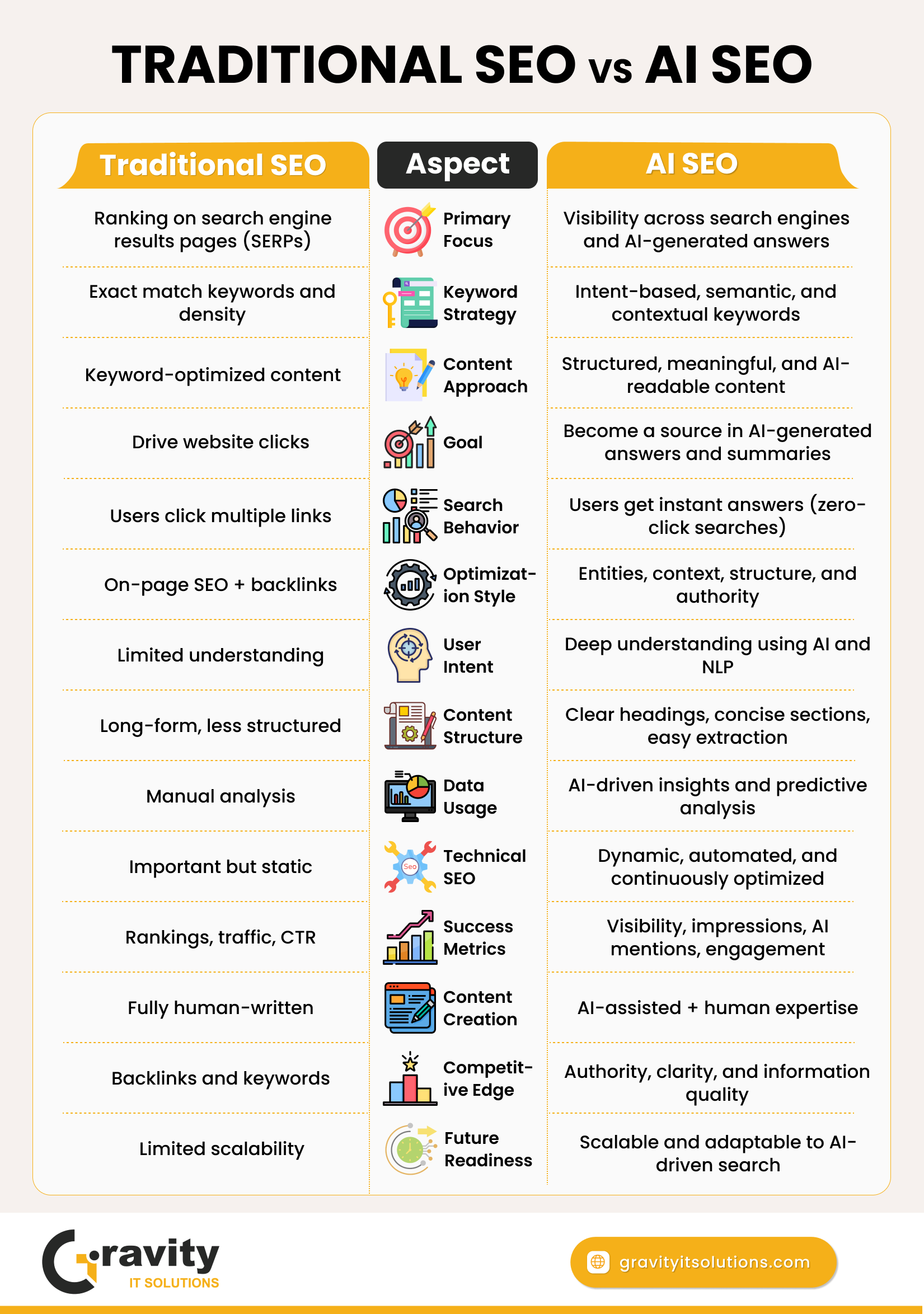
This is a new era of search. The game has changed. It is no longer just about stuffing keywords or building backlinks; it is about becoming extractable. Think of modern AI models not as crawlers, but as digital librarians. These librarians do not just scan for word matches; they curate information. They look for sources that demonstrate expertise, clarity, and structure, turning your article into a trusted citation in their generated answers.
This is where Entity SEO comes in. It is the bridge between your expertise and AI recognition. By optimizing for topical authority and semantic depth, you signal to AI engines that you are the definitive source on your subject. You stop fighting the algorithm and start speaking its language.
Understanding the AI Librarian: How Search Engines Evaluate Entities
Imagine walking into a chaotic library where every book is thrown onto the floor in a random pile. You are looking for an answer, but the librarian cannot tell you which pile holds the truth. That is how traditional search engines often feel to users, and it is how AI models view your website if it is not optimized for Entity SEO. These models are not just counting keywords; they are mapping complex relationships between concepts to build a cohesive understanding of the world.
Mapping Concepts: The Knowledge Graph
At the heart of modern AI search is semantic search. Unlike older systems that matched words to keywords, Large Language Models (LLMs) use entity recognition to identify people, places, organizations, and things within your content. Think of an entity as a distinct object in a database. When you write about “Apple,” the AI needs to know if you mean the fruit or the tech giant. It does this by analyzing the context around the word, looking at neighboring entities like “iPhone” or “fruit.”
The AI maps these entities into a knowledge graph, a sprawling network of relationships. If your content consistently connects “organic coffee beans” with “sustainability certifications” and “fair trade practices,” the AI sees your site as a central node in that specific web. This structural understanding allows the AI to grasp the true meaning and intent behind your content.
The Importance of Entity Salience
Once the AI maps concepts, it evaluates entity salience—how important a specific entity is within the context of your entire body of work. AI prioritizes sources that treat their core topics with weight and significance rather than treating them as an afterthought.
If you run a marketing blog, mentioning SEO in five different articles signals high salience. If SEO is buried in a footnote or mentioned only once in an unrelated post, the AI sees it as background noise. The more consistently you reinforce primary entities across your site, the higher their salience score becomes. This makes your content more likely to be selected for AI-generated search results.
Keyword Density vs. Entity Density
One of the biggest misconceptions in modern SEO is the focus on keyword density. In the past, stuffing a phrase like “best vegan recipes” ten times in a paragraph might have worked. Today, that practice confuses AI models. Instead, focus on entity density and conceptual depth. AI looks for the richness of connections between ideas, not the repetition of words.
Traditional Ranking Factors vs. AI Entity Signals
The following table highlights the key differences in what search engines now value versus what they used to prioritize.
| Criteria | Traditional Ranking Factors | AI Entity Signals |
|---|---|---|
| Linking Structure | Focus on backlink quantity and domain authority. | Focus on semantic linking between related entities. |
| Entity Context | Minimal; often ignored for exact-match keywords. | Critical; AI analyzes surrounding words to define meaning. |
| Semantic Relevance | Based on keyword frequency and placement. | Based on depth of conceptual connections. |
Building Topical Authority Through Dense Entity Webs
Topical authority is the cumulative trust an AI grants a domain based on consistent coverage of a subject. If every page on your site is a random collection of unrelated topics, the AI sees a chaotic mess. If every page is related to a specific niche, the AI recognizes this as an authoritative hub.
The most effective way to signal this depth is through the hub-and-spoke model. Create one comprehensive hub page that covers a broad topic, then link it to multiple spoke articles that dive deep into specific subtopics. This creates a dense web of connections that tells AI engines you have mastered the subject.
Mapping Your Child Entities
To build this web, map out child entities—the specific concepts and people associated with your main topic. Follow these steps to broaden your semantic footprint:
- Identify your core topic, such as “sustainable gardening.”
- Brainstorm sub-topics like composting, native plants, and water conservation.
- Research what top-ranking AI-optimized sites discuss alongside your core topic.
- Create individual articles for each sub-topic.
- Interlink all spoke articles back to the hub and to each other where relevant.
Using Internal Linking as Contextual Bridges
Internal linking is your secret weapon for reinforcing relationships between disparate entities. When you link from one article to another, you create a contextual bridge. This tells the AI that these two topics are related and that your content on one supports your expertise in the other. By consistently applying this method, you transform your site from a collection of random pages into a cohesive knowledge base.
The Mechanics of Extractability: Structuring Content for AI Citation
AI models are like eager but impatient librarians. They scan your page for a quick answer to cite in a generative summary. If your content is a dense wall of text, the AI might skip it. This concept, known as extractability, is a core pillar of Generative Engine Optimization. You must package information so that LLMs can easily find, understand, and quote it.
Use Semantic Headers to Define Entities
A semantic header does more than describe a section; it explicitly names the entity being discussed. When you use a header like “What is Topical Authority?” you create a clear signpost for the AI. It tells the model that the concept is discussed in that specific section. Vague headers force the AI to guess the context, which increases the risk of it skipping your content.
Leverage Schema Markup for Explicit Context
While human readers skim text, AI engines read code. Schema markup is a standardized vocabulary that helps search engines understand the context of your content. By implementing structured data, you hand the AI a pre-digested summary of your content. For example, using FAQPage schema explicitly tells the AI which questions your content answers and provides the direct answer, boosting the likelihood of selection for AI-generated search results.
Create Short, Self-Contained Answer Blocks
AI models thrive on answer blocks—short, self-contained paragraphs that provide a complete answer to a query. Place the direct answer in the first sentence of a paragraph. Keep these blocks between 40 and 60 words. This format allows the AI to extract a coherent snippet without needing to stitch together information from multiple parts of your document.
Content Formatting for AI-Readability
| Layout Element | Why AI Prefers It | Example of Execution |
|---|---|---|
| Clear H2/H3 Headers | Identifies the specific entity immediately. | “How Schema Markup Boosts Trust” |
| Bolded Key Terms | Highlights important concepts for the AI. | “Generative Engine Optimization is…” |
| Short Paragraphs | Provides isolated data points for extraction. | 1-3 sentence paragraphs. |
| Bullet Points | Structured lists are easily parsed by LLMs. | A list of “Three Steps to Build Salience.” |
| Tables | AI reads table data as structured relationships. | Comparing metrics in columns. |
Moving Beyond Keywords: Practical Steps to Boost Entity Salience
Boosting entity salience is about refining your content ecosystem to communicate expertise to AI models. Here is how you can audit and boost your signals to become the preferred source for AI answers.
1. Audit Your Site for Entity Noise
Entity noise occurs when your website covers too many unrelated topics, confusing AI models about your core expertise. Perform a content audit and list every topic category on your site. If you find categories that do not support your main offering, consider merging them or moving them to a separate subdomain.
2. Build Authoritative Associations
Strengthen your trust signal by linking your content to other well-known, trusted entities. Cite industry leaders, use structured data to link to author profiles, and reference relevant regulatory bodies or standards. By associating your content with these entities, you borrow their credibility.
3. Tactical Checklist: Updating Legacy Content
You do not need to rewrite everything. Update high-traffic pages to increase their semantic score. Add definitions for key terms in the first 200 words, include case studies that demonstrate your expertise, and ensure bidirectional links exist between your old posts and new, relevant articles.
4. Monitor AI-Generated Search Results
Keep an eye on how AI tools answer questions in your niche. Identify which entities appear alongside your target topics. If a new entity becomes a key player, integrate it into your content naturally to remain relevant to the evolving knowledge graphs of search engines.
According to AEO/GEO Services, businesses that implement these strategies turn their brand into an AI-preferred source. Think of your website as a vital data set for AI models to learn from. The era of simply ranking for keywords is fading; the new goal is to become the authoritative answer that AI chooses to cite. Trust and comprehensive coverage are your ultimate competitive moats.
AEO/GEO
Want to learn more?
Contact us for direct consultation and support.