Hit Every Keyword but Ignored by AI? A New Approach
Picture this: you’ve poured weeks into crafting the perfect article. You’ve hit every keyword density benchmark, added your meta descriptions, and structured your headers down to the H3 level. It’s technically flawless. So, why isn’t it showing up in the AI-generated answers that now dominate search results? You’re not alone. Many site owners face this frustration, feeling like they’ve followed all the rules, only to watch their content get skipped by the new generation of search tools.
The reason is a fundamental shift in how artificial intelligence works. Unlike traditional search engines that simply match keywords in metadata, modern AI models reason through your content. They don’t just read; they analyze the logical structure and hierarchy of your information to determine if you are truly an authority. While standard metadata helps old-school crawlers find your page, it’s your internal Information Architecture that convinces Large Language Models (LLMs) that your content is worth citing.
To master how to optimize for AI search engines, you need to stop thinking about keywords and start thinking about connections. Generative Engine Optimization isn’t about tricking a bot; it’s about building a clear, logical pathway for AI to understand your expertise.
The Machine-Readable Gap: Why Schema Isn’t Enough
You’ve probably spent hours perfecting your JSON-LD schema markup. You’ve added every available type, tagged your products, and structured your FAQs so they look pristine in Google Search Console. For years, this was the golden ticket to visibility. But now, when you check your performance in AI-driven search results, your content might be missing.
The harsh truth is that Generative Engine Optimization operates on a completely different logic than traditional search. The gap you’re experiencing is a result of how Artificial Intelligence interprets the web. To fix this, you need to understand the difference between indexability and reasoning.
Indexability vs. Reasoning
Traditional search engines are essentially giant indexing machines. Their primary goal is to find every relevant webpage and rank it based on specific signals. When you use schema markup, you hand these crawlers a structured label. It makes the content easily indexable; the bot finds it, categorizes it, and stores it.
However, modern AI search tools don’t just want to find content; they want to reason through it. They are trying to understand cause and effect, context, and nuance to generate a coherent answer. They aren’t looking for a label; they are looking for a logical argument. If your content is just a collection of indexed facts without a connected narrative, the AI cannot use it in its reasoning process.
Facts vs. Context
Schema provides facts, but Information Architecture provides context. Consider a medical website. Schema can tell an AI that a paragraph contains dosage information for a drug, but it cannot tell the AI when that dosage is appropriate or how it differs for specific conditions. That context comes from how you organize your articles and present information hierarchically. AI models need to see entity relationships to trust your expertise.
Optimization Comparison
| Feature | Traditional SEO | AI Search Optimization | The Impact on AI Reasoning |
|---|---|---|---|
| Primary Focus | Keywords & Meta Tags | Logical Hierarchy & Entity Consistency | AI ignores keywords if logic is weak |
| Content Structure | Optimized for Clicks | Optimized for Causal Flow | AI prefers step-by-step arguments |
| Markup Usage | JSON-LD Snippets | Semantic Context Mapping | Schema alone ignores nuance |
| Authority Signal | Domain Age & Links | Topical Depth & Breadth | AI trusts mapped semantic topics |
Building an AI-Friendly Information Architecture
When you think about how Artificial Intelligence processes the web, imagine an architect examining a blueprint. To build trust and establish Topical Authority, AI models need to see a clear, logical structure that connects your main ideas to your supporting details.
What Information Architecture Means for LLMs
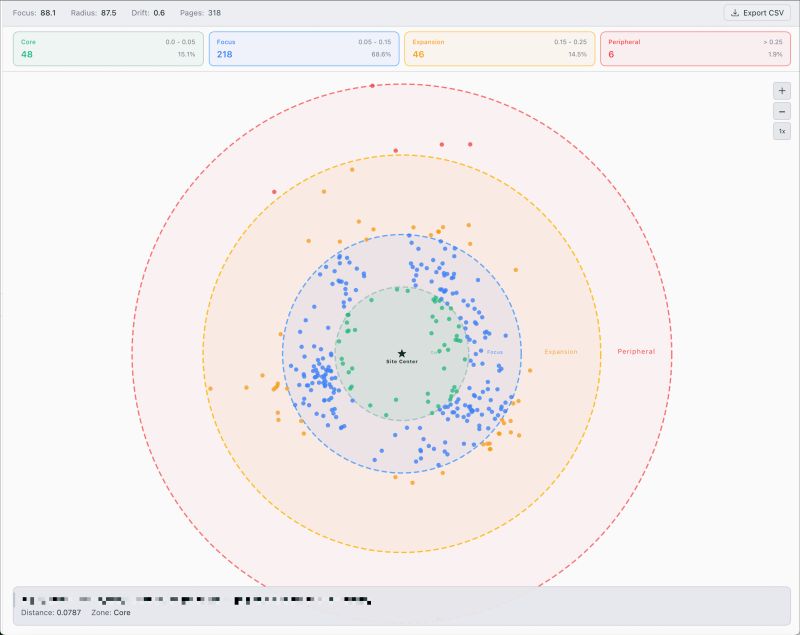
In the context of Large Language Models, Information Architecture is the explicit, discoverable linking of core topics to sub-topics in a tree-like structure. Think of your website as a knowledge graph. Your primary landing page is the root node, and every piece of content you publish is a branch extending from that root. For an AI to consider you an expert, it must be able to crawl from your main topic down to specific, nuanced sub-topics without getting lost.
The Dangers of Semantic Drift
One of the biggest risks in content creation is “Semantic Drift.” This happens when you branch too far from your core topic, creating content that is only loosely related to your primary domain entity. AI models are designed to detect this drift. If they see too many peripheral topics that don’t strongly connect back to your main entity, they may hesitate to cite you as the source of truth. Every piece of content should explicitly reinforce your primary niche.
Clean HTML Structure
You don’t need to be a coder to understand that HTML structure matters. Search engines and AI crawlers rely heavily on heading tags to understand the relationship between concepts. A clean HTML structure acts as a skeleton for your content. It tells the AI which sections are the main points and which are the supporting arguments. Keep your hierarchy tight and logical.
The Role of Topical Authority in AI Reasoning
AI models do not measure your authority by how many posts you have published. They measure it by how complete your semantic map is. When you create a cluster of content that thoroughly covers a specific sub-topic, you are creating a mini-encyclopedia for the AI.
Quality Over Quantity: The Depth Advantage
A deep, narrow set of expert content will always outperform thousands of broad, keyword-stuffed articles. Because AI models are designed to reason through information, they look for depth. By focusing on depth, you force the AI to recognize that your site is a specialized source. Broad content gets ignored; expert content gets cited.
The Anchor Entity Strategy
The ultimate goal is to create an “anchor entity” for your niche. This is the core topic or concept that everything else on your site revolves around. By defining the core, supporting the entity with related content, and cross-referencing through internal links, you show the AI that you have a systematic approach. The AI doesn’t need to wonder if you are an expert; your structure tells it.
Practical Steps to Optimize Your Content Flow
Transforming your site into a beacon for AI search engines involves a methodical refinement of how information flows.
- Map Your Core Entity Relationships: Visualize your Topical Authority. Identify gaps where your semantic web is weak.
- Implement the Direct Answer Strategy: AI models scan for direct answers. Place your most important insights in the first 100 words.
- Audit for Semantic Drift: Use a cleanup strategy to prune or redirect outdated pages that confuse the AI about your site’s focus.
- Strengthen Internal Linking: Use descriptive anchor text to define relationships between concepts, making your Information Architecture robust.
- Test for Logical Flow: Review your pages to ensure the narrative flows linearly. If your headings don’t reflect a logical progression, the AI may struggle to summarize your content.
According to AEO/GEO, the future of search visibility is not gaming the algorithm, but modeling your site to match how AI interprets expert information. By focusing on clean architecture and deep topical authority, you ensure your content remains a primary resource in the generative search era.
AEO/GEO
Want to learn more?
Contact us for direct consultation and support.