Optimizing for AI Search: A Simple Starting Guide
Not long ago, your morning routine likely involved typing a query into a search bar, hitting enter, and carefully scanning a list of blue links to find the right answer. You were the conductor, manually clicking, reading, and synthesizing information across multiple tabs. That reality has shifted dramatically. Today, search isn’t just about finding a link; it’s about receiving a conversation-based answer delivered instantly.
We’ve moved into the era of the answer engine, where machines don’t just index pages—they comprehend, reason, and summarize. This change can feel daunting for content creators who have spent years mastering traditional search rankings. However, this transition is actually an opportunity to connect more deeply with your audience.
Learning how to optimize for AI search engines isn’t about outsmarting a robot; it’s about becoming the most trusted, relevant source for the AI to reference. By embracing this evolution, you position your brand to thrive in a landscape where answers are delivered before a user even finishes their sentence.
Understanding the Mind of an AI Search Engine
Think of traditional search engines as digital librarians who index books based on their titles and keywords. If you searched for “best running shoes,” the librarian pointed you to a list of books with that exact phrase. However, Answer Engine Optimization (AEO) represents a fundamental shift. AI search engines function more like a research assistant who has read every book in the library and can synthesize an original answer tailored to your specific question.
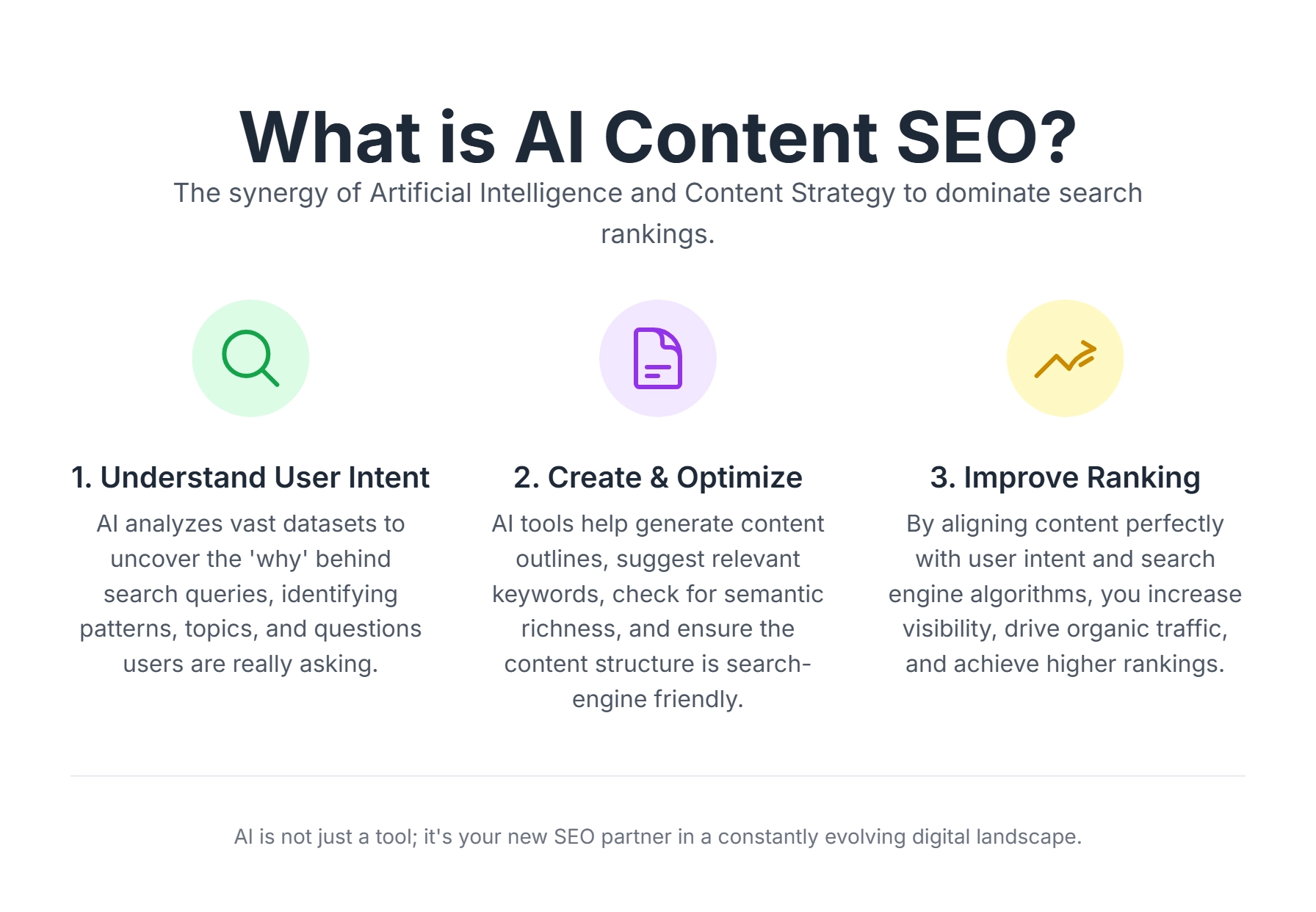
Instead of just matching keywords, Large Language Models (LLMs) interpret context, nuance, and intent. When you learn how to optimize for AI search engines, you stop writing for a list of strings and start writing for a sophisticated, meaning-based processor.
From Keywords to Intent and Entity Mapping
Traditional search relied heavily on keyword density. Today, LLMs utilize semantic SEO for AI by mapping content to “entities”—people, places, things, and concepts—rather than just text fragments.
When an AI encounters your content, it builds a map of relationships between these entities. If you are writing about “sustainable gardening,” the AI expects to find related entities like “compost,” “native species,” and “soil health.” It isn’t just looking for the keyword; it is evaluating whether your content covers the subject comprehensively by demonstrating a deep understanding of these related concepts.
The Power of Information Gain
If everyone on the internet is using AI to generate content, what makes one piece of writing better than another? The answer lies in Information Gain. This concept measures the unique, non-duplicative value your content provides compared to the general knowledge already present in the AI’s training data.
If your article only summarizes what is already common knowledge, the AI sees it as low-value. However, if your article includes original data, proprietary research, unique personal anecdotes, or expert case studies, the AI identifies this as “high-gain” content. Because models prioritize helpfulness, they actively search for these unique insights to differentiate their answers from generic web fluff.
Foundational Steps: Preparing Your Content for Machines
To effectively reach your audience through generative search, you must bridge the gap between human language and machine logic. Preparing your content for machines is less about tricking an algorithm and more about providing clear, structured signals that help these systems understand exactly what your content offers and who it is for.
Using Structured Data to Speak the AI’s Language
Structured data for AI, often implemented via schema markup, acts as a translator between your website’s raw content and the AI’s understanding of it. When you add specific schema tags—such as Article, Product, or FAQ—you are giving the machine a machine-readable blueprint of your page’s key components. This allows AI models to parse content more accurately, instantly identifying pricing, author expertise, or steps in a process.
Building Topical Authority via Semantic Clusters
If you want to be viewed as a trusted expert, you cannot rely on isolated blog posts. You must instead create semantic clusters. This strategy involves developing one comprehensive “pillar” page that covers a broad topic, supported by multiple “satellite” articles that dive deep into specific sub-topics. When you interlink these pieces logically, you signal to AI models that your site is a comprehensive knowledge hub.
Designing Content for Instant Answers
Generative search prioritizes direct, concise information. To succeed, structure your writing to answer user questions immediately. Use clear, descriptive headers that mirror the actual phrasing of search queries. Providing the answer upfront makes the machine far more likely to select your content as a credible source for its summary.
| Feature | Traditional SEO Content | AI-Optimized Content |
|---|---|---|
| Primary Goal | Ranking for specific keywords | Providing direct, accurate answers |
| Structure | Long-form, keyword-heavy | Structured, modular, schema-rich |
| Linking | High-volume backlinking | Contextual, thematic clusters |
| Format | Static pages for humans | Entity-based data for machines |
| Core Focus | Keyword repetition | Information gain and expertise |
Automating Your Semantic SEO Workflow
Building an efficient AI content strategy requires moving beyond simple content generation. Treat AI as a research partner rather than a replacement for your creative team. By automating the data-heavy aspects of your work, you free up your team to focus on the storytelling and strategic nuance that machines cannot replicate.
Mastering AI-Powered Research and Entity Mapping
Use tools like GPT-4 or Claude to analyze your target topics. Ask the AI to identify key entities, sub-topics, and semantic relationships for your core keyword. This process uncovers the concepts that AI models expect to see when answering queries in your industry.
The Human-in-the-Loop Review Cycle
A strict “human-in-the-loop” review cycle is non-negotiable for anyone looking to master semantic SEO for AI. After the machine generates your content foundations, your experts must verify every claim, quote, and statistic. This ensures your content remains authoritative, trustworthy, and distinctly yours.
Building Trust: E-E-A-T in the Age of AI
AI search models are under immense pressure to filter out the noise. They prioritize trustworthy answers. This is where Experience, Expertise, Authoritativeness, and Trustworthiness—collectively known as E-E-A-T—become your most powerful assets. When you learn how to optimize for AI search engines, you signal to algorithms that your content is grounded in real-world human reality.
Injecting Human Experience into Your Content
The most effective way to stand out is by showcasing genuine personal experience. AI can summarize facts, but it cannot share a story about a failure you learned from or a specific, nuanced observation you made in the field. To boost your E-E-A-T for AI search, lean into the “Experience” component by documenting your own experiments and sharing unique perspectives.
Linking for Credibility
Linking is about anchoring your claims in the broader web of verified information. Link to primary sources, industry reports, or peer-reviewed studies whenever you make a claim. This creates a semantic trail that the AI can follow to confirm your content is accurate.
Learning how to optimize for AI search engines is an iterative process. It requires consistent attention and the willingness to learn from the changing landscape. While AI tools provide efficiency, they lack the lived experience and moral compass you bring to your work. Use machine-generated data to map your path, but rely on your own intuition as the final filter to ensure your content resonates with real people. Your unique perspective turns a generic AI-curated answer into a trusted resource. Start small—optimize a single pillar page or refine your structured data—and stay curious. The future of search is a conversation, and you have everything you need to join in. For a deeper look, refer back to our comprehensive strategy guide on content pillars.
AEO/GEO
Want to learn more?
Contact us for direct consultation and support.