Beyond Keyword Gaps: Redefining Authority for AI Engines
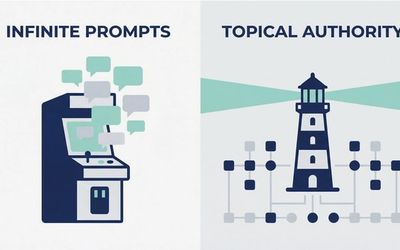
Generative search engines function by synthesizing information from authoritative entities rather than ranking indexed pages based on keyword density. To gain visibility, your content strategy must evolve from volume-based production to topical depth.
- Semantic Relationships over Keywords: AI models map concepts into multidimensional vector spaces. Success requires defining how your brand’s topics relate to one another, moving beyond simple keyword targeting to establishing entity-based relevance.
- Entity-Based Relevance: Instead of optimizing for a single phrase, you must ensure your content covers the “entity attributes” an AI expects for a given topic. This means providing data points, definitions, and relationships that satisfy the model’s requirements for factual certainty.
- Topical Authority: AI systems prioritize depth because they are designed to reduce user uncertainty. Brands that provide comprehensive, non-contradictory answers across a broad range of related sub-questions are favored over those with fragmented, superficial content.
The Pillar-Cluster Content Architecture Framework
A structured pillar-cluster architecture acts as the blueprint for an AI to parse your site’s hierarchy and topical relationships.
- Pillar Pages: Create authoritative, broad-coverage pages that define your primary subject. These pages should be the high-level destination for any user or LLM looking for an overview of your domain.
- Supporting Clusters: Develop deeply granular content that targets specific long-tail questions or technical sub-tasks. Each cluster piece should provide technical, unique, or data-driven insights that add value to the main pillar.
- Internal Linking Design: Establish a strict hub-and-spoke model. Every cluster page must link back to the pillar, and the pillar should link to cluster pages. This semantic flow allows the AI to traverse your site and immediately grasp the breadth and focus of your expertise.
E-E-A-T as a Trust Metric for AI Search Ecosystems
In generative search, E-E-A-T (Experience, Expertise, Authoritativeness, Trustworthiness) serves as the primary verification layer for information synthesis.
- Mapping Signals: To satisfy the model, you must provide clear provenance. Include granular author bios, link to primary research, and cite verified third-party data to validate assertions.
- Technical Protocol Implementation: Use schema markup to explicitly identify authors, organizations, and factual claims. Transparent sourcing is no longer optional; it is the data an LLM requires to trust your content as a legitimate source for its summary output.
- Trust as a Gatekeeper: LLMs are trained to avoid hallucinating or citing low-quality sources. By consistently providing fact-checked, high-integrity content, your site becomes a preferred node within the knowledge graph, making it easier for the AI to “cite” your brand with confidence.
Semantic Optimization and Internal Linking Logic
Content must be structured so that its logical progression is clear to natural language processing (NLP) systems.
- NLP-Friendly Structure: Utilize standard HTML5 hierarchy (H1-H4) to frame your content. AI models consume this hierarchy to understand the structural importance of information within your pages.
- Entity-to-Entity Linking: Use descriptive, entity-focused anchor text rather than generic calls to action (e.g., “click here”). Linking to specific entities (like a concept, service, or feature) reinforces the semantic connection between your site pages.
- Balanced Equity: Ensure that internal linking depth does not result in “orphan” content. Distribute link equity to support your most important clusters, ensuring the AI can crawl and index the most valuable parts of your topical authority map.
Measurable Authority: Defining Your KPI Framework
To succeed, you must replace legacy metrics like “rankings” with KPIs that track visibility within the AI-generated answer space.
- Generative Share of Voice (SoV): Track the frequency with which your brand, products, or insights appear within the AI summaries (e.g., SGE or chatbot responses) for your primary industry questions.
- Intent Satisfaction Metrics: Shift focus to dwell time and post-click engagement on your most authoritative pages. These signals confirm to the AI that your content successfully satisfied the user’s initial query.
- Topic Coverage Completeness: Audit your site against the total potential sub-topics within your industry. Measuring “coverage completeness” serves as a lead indicator for authority; the more comprehensive your map, the higher the likelihood of being selected as a primary source.