How to Optimize for AI Search Engines: Building Semantic Trust
Remember when SEO was simple? You would write content, sprinkle in a few keywords, and wait for blue links to bring in traffic. Those days are gone. Today, user queries often resolve instantly in an AI Overview, leaving your brand invisible even if your content is high quality. It feels like the goalposts keep moving, but you are not alone in feeling this frustration.
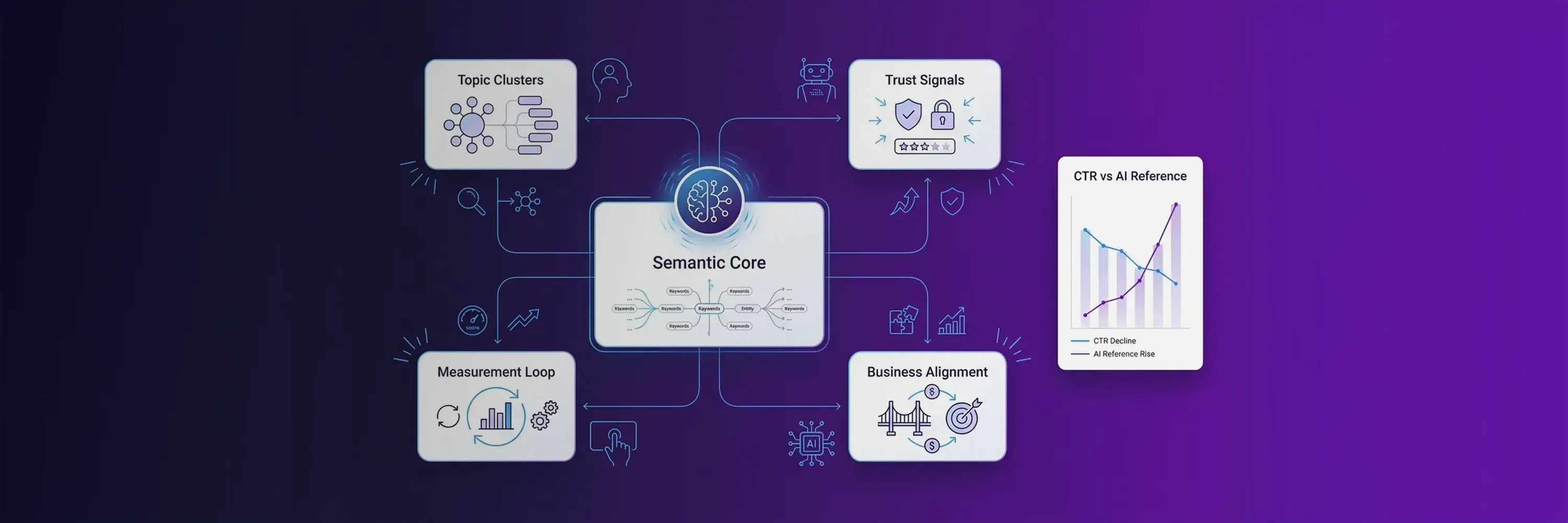
The shift is real. Search engines are no longer just matching words; they are understanding context. To stay visible, you must move beyond traditional optimization. You need to build a Semantic Trust Graph that signals authority directly to generative AI models. This is about being the source AI trusts. By learning how to optimize for AI search engines, you turn your content into the infrastructure that powers future answers.
Understanding the AI Retrieval Paradigm
If you have been optimizing for search for any amount of time, you know the game used to be simple: target keywords, get a ranking, and watch the traffic roll in. That era is fading. With the rise of Generative Engine Optimization (GEO), the way AI systems process information is fundamentally different from how traditional algorithms work.
From Keywords to Vectors: The RAG Revolution
Traditional search engines rely on keyword-based indexing. When you type a query, the engine looks for pages containing those specific words. It is like checking a library book by only reading the table of contents.
AI systems use Retrieval-Augmented Generation (RAG). This technology allows Large Language Models (LLMs) to access external data sources to ground their responses in reality. Instead of just matching keywords, RAG converts your content into vectors—numerical representations of meaning. This allows the AI to understand that “car” and “automobile” are related, even if they don’t appear together in the same sentence.
What LLMs Actually Look For
When an AI scans the web for information, it prioritizes specific indicators. It hunts for:
- Authoritative Sources: Data that is verifiable and from trusted entities.
- Self-Contained Information: Passages that can be understood on their own without clicking through to a homepage.
- Semantic Density: Content that packs relevant, factual information into concise structures.
Traditional Search vs. AI Search
To see the shift in action, consider how success criteria have changed. The table below breaks down the core differences between traditional search and AI-driven results.
| Criteria | Traditional Search | AI Search |
|---|---|---|
| Focus | Keyword matching and backlink volume | Semantic understanding and entity relationships |
| Output | A list of blue links | A synthesized, direct answer |
| Credibility Signal | Domain Authority and PageRank | E-E-A-T signals and source consistency |
| Success Metric | Click-Through Rate | Citation frequency and AI overview placement |
Content as Infrastructure
This shift forces a mindset change. You can no longer treat content as a simple publishing exercise. You must treat content as infrastructure. Every piece of content is a node in a larger network. Your goal is to build a structure so logical that AI models can easily parse, verify, and cite your information. This is the essence of Semantic SEO.
Constructing a Semantic Trust Graph
Think of your website as a single, interconnected organism. While keyword clusters still matter, AI engines need a Semantic Trust Graph. This is a structured map of your entities—brands, people, products, and locations—and how they relate to one another.
Connecting Entities with Schema.org JSON-LD
The most effective way to build this graph is through Schema.org markup using JSON-LD. This code tells search engines explicitly what each piece of content represents.
- Define Your Organization: Use foundational schema on your homepage to define your official name, logo, and social profile links.
- Link Articles to Authors: Use Article and Person schema to connect content to a specific human expert, boosting E-E-A-T signals.
- Map Your Structure: Use BreadcrumbList to show clear hierarchy, helping AI understand the relationship between broad topics and specific subtopics.
- Connect Products and Services: Use Product schema to link offerings back to your organization, providing dense, factual data.
Internal Linking as a Structural Map
While code tells AI what your content is, internal links tell it how your content relates. Every link you place within your content is a signal of topical authority. AI models analyze the anchor text and surrounding context to understand your niche. Avoid generic links like “click here.” Instead, use descriptive text that provides semantic context about the destination page.
Entity Mapping Checklist
To ensure your semantic trust graph is robust, use this checklist to audit your entity mapping:
| Signal | Action Item |
|---|---|
| Consistent Naming | Ensure brand details match across your site and social profiles. |
| Author Validation | Verify every key article links to a schema-marked author profile. |
| Logical Hierarchy | Ensure a user or AI can navigate from home to any subtopic in three clicks. |
| Property Completeness | Fill out all relevant sameAs URLs in your organization schema. |
| Cross-Referencing | Link major articles to each other and your core service pages. |
Writing for Extractability: The 60-Word Answer Rule
Imagine you are an AI under pressure to provide a confident answer in seconds. You won’t read an entire page. You will scan for a golden snippet—a self-contained block of text that explains the concept without ambiguity.
What Is Extractability?
Extractability is the principle of crafting self-contained passages that explain a concept clearly in under 150 words. If an AI can copy-paste your answer and it makes complete sense, you have succeeded.
Formatting Patterns AI Prefers
AI models thrive on structure. When content is organized logically, the AI can parse relationships with high confidence.
| Formatting Pattern | Why AI Loves It |
|---|---|
| Numbered Lists | Indicates sequential steps or priority. |
| Markdown Tables | Clearly defines relationships between multiple attributes. |
| Clear H-Tag Hierarchies | Signals the main topic and subtopics to the parser. |
| Bullet Points | Highlights key features without dense text. |
| Bolded Key Terms | Draws attention to specific entities or concepts. |
Avoid hedging. Use direct, confident language rather than tentative phrases like “might” or “it is believed.” Factual density builds a trust anchor that AI models are eager to cite.
Strengthening E-E-A-T and Credibility Signals
In AI search, trust is the currency. Generative Engine Optimization focuses on whether AI models trust your source enough to cite it.
The Power of Primary Research
Content that relies on primary research acts as a beacon for AI models. When you reference specific reports or peer-reviewed studies, you provide a data point the AI can cross-reference against its training data. This creates a trust halo around your work. Always link directly to original research so the AI can verify the lineage of the fact.
Proving Authority Through Schema
Showing expertise requires technical proof. Use the sameAs property within your schema markup to link your online profiles. When the AI crawls your page, it sees that your author is a verified professional with a history of published works. This web of authority makes it difficult for a model to ignore your content in favor of lower-quality alternatives.
When you combine clear authorship with a logical structure, you create a trust graph that machines can navigate with confidence. This minimizes the risk of your content being hallucinated or ignored. By systematically implementing these trust signals, you move from hoping to be noticed to engineering content that AI must trust.
Conclusion
Moving to proactive semantic architecture is a fundamental shift in how you exist online. In the age of AI, your goal is to become a trusted source that AI models rely on. By building a robust Semantic SEO framework, you position your brand as essential infrastructure.
Audit your top-performing content today. Ask if each page offers a definitive, self-contained answer. If not, refine your structure, tighten your definitions, and strengthen your topical authority. The future of search rewards those who build with clarity and confidence.
AEO/GEO
Want to learn more?
Contact us for direct consultation and support.