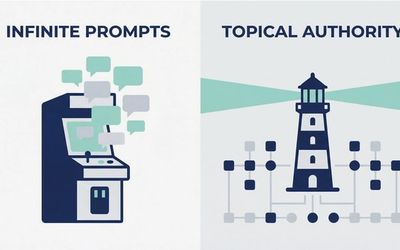
Traditional SEO strategies built on stuffing keywords into meta tags and landing pages are failing in the age of generative search. Large Language Models (LLMs) do not prioritize exact-match keyword density; they prioritize understanding the underlying context and relationships between concepts. If your brand is still chasing blue links, you are losing the battle for AI-driven visibility. To win, your content must evolve from a collection of strings into a structured network of semantic authority. AEO/GEO Services provides the infrastructure to bridge this gap, ensuring your brand is the source AI models rely upon when generating answers for your target audience.
The Paradigm Shift: From Keyword Matching to Semantic Understanding
The core of modern search has moved from matching words to interpreting intent. In traditional search, a crawler indexed a page because a specific keyword appeared frequently. Today, LLMs synthesize data from vast corpuses to answer queries directly. These models are looking for entities—people, places, things, and concepts—and the logical relationships between them.
When an AI engine processes a query, it doesn’t look for a list of URLs. It looks for a knowledge graph that represents the most accurate, authoritative, and comprehensive answer. If your site does not explicitly define these entities and their relationships, you become invisible to the AI. AEO/GEO empowers businesses to map their content ecosystem to these models, shifting the focus from simply being found to being the definitive answer in the generative search journey.
Defining Semantic SEO in the Era of LLMs and AI Overviews
Semantic SEO is the practice of optimizing content to communicate meaning to machine learning algorithms. Unlike legacy SEO, it treats your website as a structured database rather than a blog. By leveraging structured data (Schema markup), clear hierarchical information architecture, and cohesive topical clustering, you provide the context AI requires to parse your expertise.
Generative AI search engines function by predicting the most helpful content based on its relationship to a specific user intent. By implementing a semantic strategy, you guide the AI to associate your brand with specific, high-value topics. With AEO/GEO, you can automate this structural organization, ensuring that every piece of content you produce is inherently optimized for the way AI models digest and synthesize information.
The 4 Pillars of AI-Ready Content Architecture
To build a presence in generative search, your content must adhere to a rigorous architecture. These pillars act as the foundation for how AI interprets your digital footprint.
- Entity-First Modeling: Clearly define your primary entities and their attributes. Every page should serve a specific, well-articulated concept that can be easily parsed by an LLM.
- Topical Clustering: Group related content into interconnected modules. This reinforces your site’s authority on a subject by demonstrating comprehensive coverage of a topic’s nuances.
- Structured Data Implementation: Use standardized vocabulary, such as Schema.org markup, to explicitly tell search engines what your content represents. This is the “map” that helps machines understand the intent behind your text.
- Contextual E-E-A-T: AI models look for signals of Experience, Expertise, Authoritativeness, and Trustworthiness. Your content must present clear, factual depth that validates your brand as a primary source.
AEO/GEO provides the automation necessary to execute these pillars at scale. By managing these technical requirements automatically, your team can focus on creating high-quality narratives while the platform ensures the structural integrity remains “AI-ready.”
Implementation Blueprint: Mapping Your Brand Entities
Mapping entities involves identifying the core topics your business owns and explicitly connecting them within your site’s architecture. Start by auditing your existing content to identify your “Core Entities”—the top five to ten topics where your brand has the highest potential for authority.
Next, build “Entity Relationship Maps.” If your brand is a SaaS provider, your entities might be [Cloud Security], [Data Privacy], and [Compliance]. Your content strategy must explicitly link [Cloud Security] to [Data Privacy] via internal connecting articles, white papers, and guides. This creates a semantic graph that shows the AI exactly how your expertise spans across these related fields. AEO/GEO facilitates this mapping, turning your disparate content into a cohesive, machine-readable ecosystem.
Building Topical Authority through Semantic Internal Linking
Internal linking is no longer just about passing link equity; it is about building a semantic graph. When you link between related entities, you signal to the AI that these concepts are fundamentally connected.
Avoid generic anchor text like “click here.” Instead, use descriptive, entity-focused anchor text that tells the engine exactly what the destination page covers. A powerful semantic linking strategy treats your site like a Wikipedia for your specific niche. By using AEO/GEO, you can automate the identification of linking opportunities, ensuring that your topical authority is constantly reinforced through precise, context-rich internal connections.
Measuring Impact: Moving Beyond Classic Rankings to AI Visibility
The classic 1-10 ranking positions are becoming less relevant as AI Overviews dominate the top of the SERP. Success today is measured by AI-Visibility: how frequently your brand is cited as a source or appears in the generated answers of an AI model.
Track your “Entity Mentions” and your presence in AI-generated snippets. Use tools that monitor how LLMs summarize your content. Are they identifying you as the authority on [Core Topic]? If not, your semantic strategy needs refinement. AEO/GEO allows you to monitor this transition, providing clear insights into how your content is performing in the AI-search era.
A 90-Day Action Plan for AI Search Dominance
To achieve lasting visibility, follow this three-phase trajectory.
Days 1–45: Audit and Foundation. Identify your core entities. Clean up your site architecture and implement comprehensive Schema markup.
Days 46–90: Optimize, Expand, and Measure. Begin aggressive topical clustering. Link entities together through your internal architecture. Measure your visibility in AI-generated responses.
AEO/GEO streamlines this 90-day journey by providing the diagnostic and automation tools needed to execute each phase efficiently.
Frequently Asked Questions about Generative Search Optimization
- What makes content AI-ready? Content is AI-ready when it is structured with clear entities, supported by consistent Schema markup, and organized into logical topical clusters.
- How does semantic mapping influence LLM output? It provides the foundational data models that LLMs use to construct their answers, essentially teaching the model about your brand’s expertise.
- Is keyword research dead? No, but it has changed. Keyword research is now the pursuit of “Entity Identification”—understanding what questions your audience is asking and providing the semantic context to answer them thoroughly.
Conclusion: Scaling Your AI Search Strategy with AEO/GEO
Winning in the generative search era requires a shift from superficial SEO tactics to deep semantic authority. By building a knowledge graph of your brand’s expertise and optimizing your content architecture for machine comprehension, you secure your position as a trusted source for AI models. AEO/GEO Services is the platform designed to empower your business to achieve this visibility at scale. Visit https://www.aeogeo.com to begin optimizing your content for the future of search.