How to Track and Benchmark Competitor Visibility in AI Search
Why Your Old SEO Rankings Are Vanishing (And Where They Went)
For years, the gold standard of digital success was the blue-link search result. If you hit position #1, you won the traffic lottery. But the landscape has shifted beneath our feet. As users turn to generative AI tools like Google AI Overviews, Perplexity, and ChatGPT to get instant, synthesized answers, those classic rankings are becoming secondary—or disappearing altogether.
This shift represents a fundamental change in how information is consumed. AI search engines don’t just list relevant sites; they read, interpret, and synthesize data to provide an immediate solution. Because of this, relying on traditional keyword rankings as your sole metric for success is no longer a viable strategy. If you aren’t showing up in the generative summary, your “traditional” visibility might as well be invisible to the modern, AI-first user.
The Three Pillars of AI Visibility: What You Should Actually Measure
To stay relevant, you must move beyond counting clicks and start tracking your AI-driven footprint. Measuring visibility in these new environments requires a focus on three distinct pillars:
- AI Share of Voice (SoV): This is the frequency with which your brand appears within the generative summaries for your target industry topics. If an AI model frequently pulls information from your domain when answering industry-related queries, your SoV is high.
- Citation Sentiment: It isn’t enough just to be mentioned. You need to know the context of your appearance. Are you being cited as the authoritative source or a secondary reference? Understanding whether the AI treats your brand as a solution or a footnote is critical for refining your strategy.
- Answer Attribution: This tracks how often the AI engine links back to your site. High attribution signals that your content is acting as the definitive source of truth, driving both trust with the model and potential traffic to your site.
Manual Auditing vs. Automated Intelligence: Choosing Your Tracking Strategy
You might be tempted to start by manually testing prompts across various AI tools. While this helps you understand the “vibe” of your brand’s presence, it is impossible to scale. Manual prompt testing is prone to bias, lacks historical context, and fails to account for the dynamic, real-time updates of LLMs.
When choosing a tracking strategy, look for tools that distinguish between two categories:
- LLM-Specific Rank Trackers: These monitor the output of generative models to see if and how often your brand is mentioned.
- Qualitative Brand Sentiment Tools: These go deeper, analyzing the quality of the mention to see if it aligns with your brand positioning.
For most growth-focused teams, a hybrid approach using dedicated AI visibility platforms is the only way to get reliable, actionable data without drowning in manual work.
Step-by-Step: How to Build Your Competitive AI Visibility Dashboard
Building a benchmark for AI visibility doesn’t happen overnight. Follow this structured approach to gain clarity:
- Define Your Competitor Cohort: Don’t track everyone. Identify your top 3–5 direct competitors who are consistently winning in the AI search results.
- Select Target Prompts: Map out the “seed” queries that trigger generative responses for your core products or services. These should be the questions your prospects are asking the AI.
- Establish a Cadence: Unlike traditional SEO which might be monitored weekly, AI behavior changes rapidly. Set up a benchmarking cadence (e.g., bi-weekly) to track shifts in your cohort’s performance and yours.
- Conduct Gap Analysis: Regularly compare your SoV and citation sentiment against your competitors. If they are winning a specific topic, analyze their content structure to see why the AI favors their output.
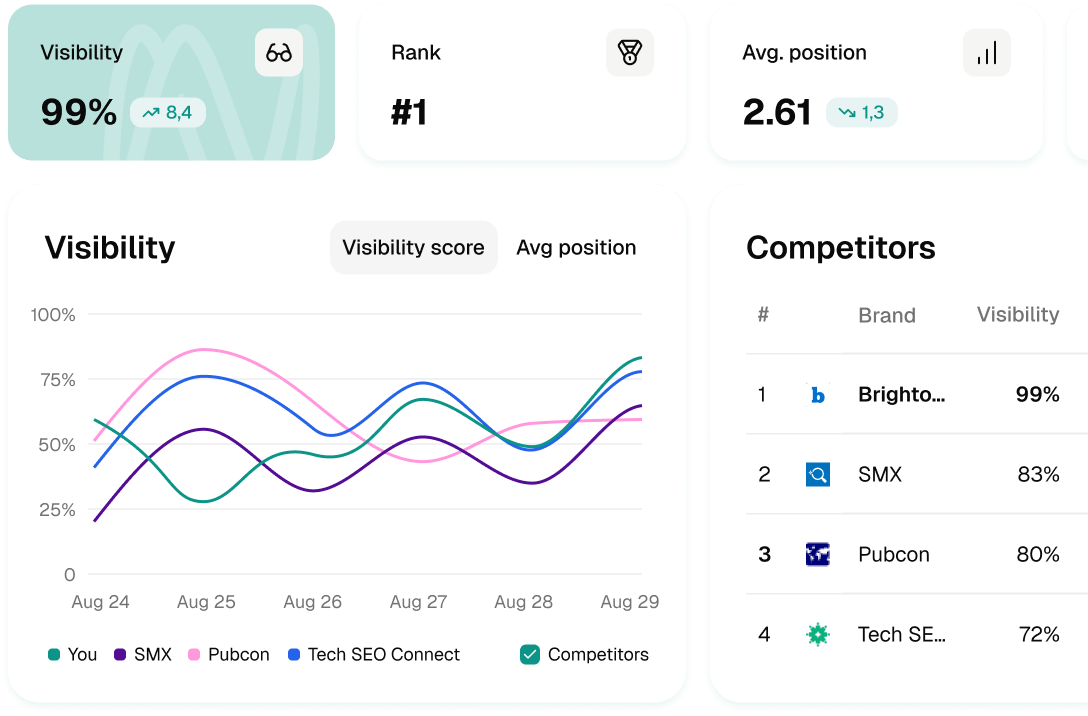
Turning Visibility Data into Actionable Content Wins
Once you have your data, it’s time to act. If your competitors are consistently cited in AI summaries, examine their content structure. Are they providing clearer, more direct answers?
Use these insights to:
- Update your content structure: Ensure your content is “answer-ready,” featuring clear, declarative headers and high-density information.
- Refine your AEO (AI Engine Optimization) strategy: Use the gaps discovered in your benchmarking to inform the creation of new, high-signal content assets that address queries you are currently losing.
- Iterate: Treat your AI visibility as a constant experiment. Every time a competitor updates their strategy, use your dashboard to measure the impact and adjust your next content sprint accordingly.
By moving away from static rankings and toward an AI-first visibility mindset, you can ensure your brand remains the go-to authority in the evolving world of generative search.
AEO/GEO
Want to learn more?
Contact us for direct consultation and support.