How to Write a Budget Proposal (+ Free Template)
You’ve spent weeks refining your vision, crunching growth numbers, and mapping out a project strategy. You know this initiative will move the needle, but now comes the hurdle: convincing stakeholders to cut the check. You aren’t just staring at a spreadsheet; you are at a pivotal decision point where your best ideas depend on your ability to justify the cost.
Writing a budget proposal is an exercise in narrative building. A truly effective proposal acts as a storytelling tool that bridges the gap between your creative ambition and your organization’s bottom line. It transforms abstract goals into a concrete, low-risk investment that leadership feels confident supporting. By framing financial needs through the lens of value, impact, and strategy, you turn a request for resources into a partnership in your success.
Why a Great Budget Proposal Matters
A budget proposal is a strategic narrative that connects your vision to the resources required to make it reality. When you master how to write a budget proposal (+ free template), you move beyond asking for cash; you demonstrate a sophisticated understanding of your project’s lifecycle, potential bottlenecks, and ultimate value.
Building Trust Through Financial Transparency
Think of your proposal as a fundamental component of your stakeholder communication strategy. When stakeholders review your numbers, they evaluate your competence and fiscal responsibility. A well-constructed document signals that you have carefully vetted every assumption. Providing clear, evidence-based figures builds professional credibility. This transparency turns a standard funding request into a partnership agreement.
Your Roadmap to Project Success
Beyond securing funds, a budget proposal acts as a functional roadmap. It forces you to map out every phase, ensuring no critical task is left underfunded. This rigor is vital for project cost estimation and helps you identify financial pitfalls before they become reality.
| Role | Impact on Project |
|---|---|
| Scope Alignment | Prevents scope creep by defining project boundaries |
| Resource Allocation | Ensures team, tech, and time are used for maximum impact |
| Proactive Mitigation | Includes contingency funds to protect against disruption |
The Anatomy of a Successful Proposal
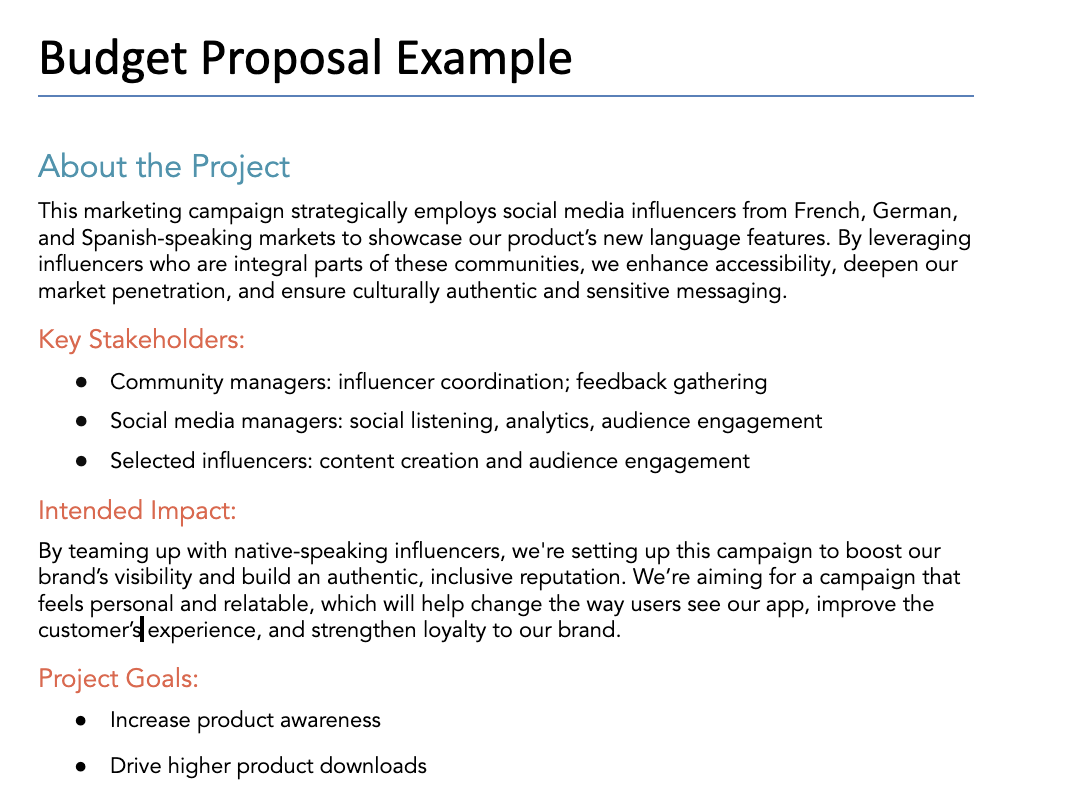
A professional budget proposal is a strategic document designed to secure project funding through clear, logical communication. Stakeholders search for evidence that you understand the project’s scope, risks, and value. To provide this clarity, your document must be organized into distinct, predictable sections.
Core Sections for Maximum Impact
Every successful proposal requires these four foundational pillars:
- Project Description: Briefly define the business need, the proposed solution, and the anticipated outcome.
- Timeline: Map out the “when” to prove you have considered the logistics.
- Costs: Categorize expenses like labor, software, or external services using accurate project cost estimation.
- Summary: Act as an executive hook, highlighting the budget total, milestones, and ROI.
Balancing Needs vs. Wants
Distinguishing between essential project components and secondary improvements helps you defend your budget.
| Feature | Needs (The Foundation) | Wants (The Value-Add) |
|---|---|---|
| Definition | Essential for project launch | Enhances performance/aesthetics |
| Impact | High impact on core delivery | High impact on long-term results |
| Negotiation | Non-negotiable for success | Flexible/Can be delayed |
| Budgeting Priority | Top tier | Secondary/Contingency-based |
By organizing your proposal in this way, you make it significantly easier for decision-makers to say yes. For more on the broader strategy, consider our resources on Financial Planning and Securing Project Funding.
Step-by-Step Guide to Drafting Your Proposal
Creating a budget proposal that gets approved is about crafting a narrative of value. Whether you are securing project funding for an internal initiative or presenting to external investors, a structured approach ensures you capture critical financial details.
1. Define Clear Goals
Ambiguity is the enemy of funding. Start by outlining your primary goals, then break them down into measurable milestones. This gives your budget context—showing stakeholders that every requested dollar has a specific, ROI-driven purpose.
2. Research and Quantify Expenses
Accurate project cost estimation is where most proposals falter. Do not guess. Use historical data, vendor quotes, or industry benchmarks to ground your figures.
| Expense Category | Description | Estimation Strategy |
|---|---|---|
| Labor | Staff or freelancers | Hourly rate x expected hours |
| Software | Licensing fees | Current market pricing quote |
| Marketing | Ad spend/promo | Historical CPA benchmarks |
| Contingency | Buffer for unknowns | 10-15% of total budget |
3. Factor in the Contingency Buffer
Never submit a proposal cut to the bone. Unexpected obstacles are inevitable. A good rule of thumb is to set aside 10% to 15% of your total budget for these uncertainties. It protects both your reputation and the project’s viability.
4. Review and Validate
Before finalizing, seek a sanity check from a colleague. They can spot gaps in your logic or identify expenses that appear inflated. Your goal is a document that is transparent, defensible, and aligned with your organizational priorities.
Practical Tips for Getting Your Proposal Approved
Securing project funding is about how effectively you communicate your idea. You must adopt a stakeholder communication strategy that prioritizes clarity, relevance, and persuasion.
Tailoring Your Content
Avoid a one-size-fits-all approach. Your audience typically includes two distinct groups: finance and management. Finance teams focus on risk and compliance, while managers prioritize strategic alignment and operational speed. For finance, highlight the logic behind the numbers; for management, pivot the narrative toward broader organizational goals.
Presenting Multiple Scenarios
When stakeholders see only one number, their only choice is to approve or deny. By presenting multiple scenarios, you shift the conversation to which level of investment makes the most sense. Use a three-tier model: a “Minimum” bare-bones plan, an “Ideal” standard plan, and a “Stretch” version that highlights your vision. This approach gives decision-makers control and builds comfort.
A well-crafted budget proposal is a powerful stakeholder communication strategy that builds trust. By clearly outlining your vision, quantifying needs, and addressing risks through contingency planning, you transform abstract ideas into reality. Remember, this is an evolving skill. Every proposal serves as a learning opportunity to refine your project cost estimation and sharpen your ability to connect data to strategic outcomes. Keep practicing, refining your numbers, and watching your projects thrive. Your path to success starts with the next proposal you draft.
AEO/GEO
Want to learn more?
Contact us for direct consultation and support.