Mapping Entity Relationships for AI Search Engines
Think of modern search engines as sophisticated digital librarians. When you ask a question, these systems cross-reference vast networks of information to find the most accurate answer. They map out concepts—known as entities—to understand expertise, much like a librarian connecting an author to a specific genre and period. Learning how to optimize for AI search engines requires a shift from chasing keywords to building structured knowledge.
Understanding the Power of Entity Relationships
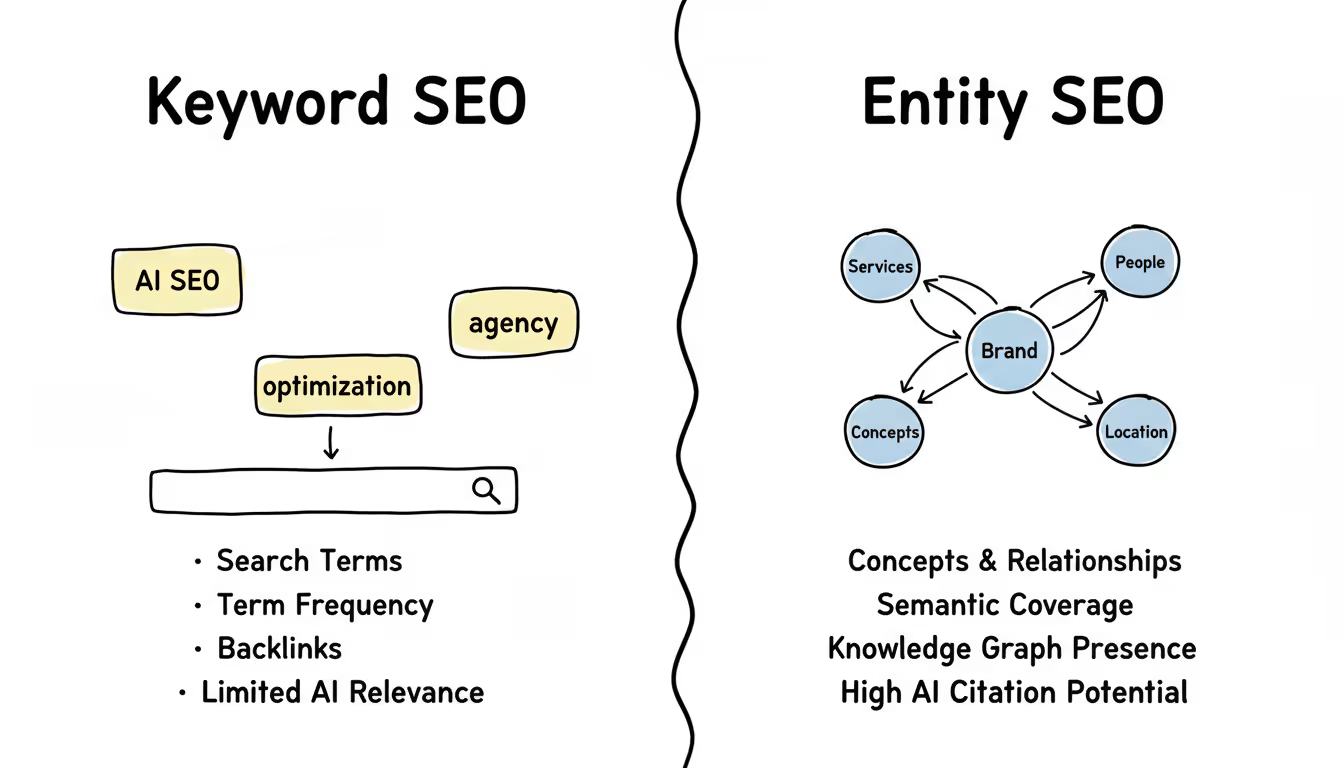
In the era of AI-driven search, treating content as a list of keywords is a relic of the past. To learn how to optimize for AI search engines, you must focus on entities. An entity is the atomic unit of meaning—the who, what, where, and why of your business. Whether it is your brand, a specific service, or your industry experts, these entities are the building blocks AI models use to construct their understanding of your site.
Moving Beyond Keyword Matching
Traditional SEO often relied on repeating specific terms to rank. Modern search is built on semantic relationship mapping. AI systems look for context and how your expertise connects to broader industry concepts. If you write about project management software, the AI looks for connections to entities like collaboration, productivity tools, and team workflows. By mapping these relationships, you provide a logical path to verify your topical authority.
Comparing Keyword and Knowledge-Based SEO
The table below highlights how these approaches change the way search engines perceive your brand.
| Feature | Keyword-Based SEO | Knowledge-Based SEO |
|---|---|---|
| Primary Focus | Isolated search terms | Interconnected entity network |
| Engine View | Statistical word frequency | Conceptual meaning and context |
| Content Goal | Ranking for high volume | Establishing topical authority |
| AI Interaction | Matches user input strings | Resolves queries via semantic mapping |
Authority Metrics and AI Citations
When you build a network of entities, you create a roadmap for AI search bots. AI models, such as those powering ChatGPT or Perplexity, prioritize sources that demonstrate deep, verified expertise through clear entity connections.
| Metric | Keyword-Based SEO | Knowledge-Based SEO |
|---|---|---|
| Core Metric | Search volume | Entity breadth and depth |
| Authority Driver | Backlink quantity | Topical relevance |
| AI Citation | Low (fragmented content) | High (structured content) |
| Future-Proofing | Weak | Strong (semantic facts) |
By organizing content to highlight these relationships, you act as a verified source of truth, which is the most reliable way to secure visibility in generative AI answers.
How to Build Your Content Knowledge Graph
Building a Content Knowledge Graph is the process of mapping your expertise so clearly that AI engines recognize your site as an authoritative source. Instead of chasing isolated terms, you construct a digital network of related ideas. Inventory your core entities, including your products, the problems you solve, your team members, and the industry concepts you influence.
Mapping Your Internal Entities
Start with hierarchical mapping. Think of your website as an encyclopedia entry for your business. Begin at the top with broad concepts, then branch into specific, sub-level details. If you sell sustainable coffee, “Coffee” is the broad parent entity, while “Direct Trade Sourcing” and “Espresso Brewing” function as related child entities. Establishing these vertical relationships helps algorithms parse your content without guesswork.
Creating High-Authority Hub Pages
Designate specific hub pages as anchor points for a topic. A hub page provides a birds-eye view of a subject and links to detailed articles. For instance, a page on topical authority should define the concept, list core pillars, and link to articles on schema and entity mapping. Centralizing these connections provides the AI with a single source of truth.
Connecting Ideas via Semantic Clustering
Semantic clustering ensures your site functions as a cohesive resource. When you link between articles, use descriptive anchor text that explains the relationship between pages. By creating clusters where several pieces of content support one main entity, you demonstrate a depth of knowledge that isolated pages cannot match.
Implementing Schema Markup to Make Connections Explicit
Structured data acts as the translator between your website and the machine-learning models powering modern search. By providing underlying code, you offer a roadmap that clarifies the “who, what, and how” of your business.
Using Advanced Schema Properties
To build a robust Content Knowledge Graph, use these properties:
- sameAs: Consolidate your identity by linking social profiles and official credentials.
- knowsAbout: Bridge the gap between your brand and the topics you cover.
- hasPart: Use this for complex services to list individual modules, showing the entity is multifaceted.
Mapping Entity Relationships for Machines
| Schema Type | Entity Relationship | Benefit for AI Engines |
|---|---|---|
| Organization | sameAs | Confirms brand identity |
| Person | knowsAbout | Verifies subject expertise |
| Product | hasPart | Maps components to an offering |
| Service | isRelatedTo | Connects offerings to solutions |
Validating Your Map
Always run your code through the Schema Markup Validator. This ensures your data is clean, error-free, and ready to feed directly into the knowledge bases that drive AI search rankings.
Practical Examples of Entity-Driven Content Strategy
Transforming your strategy into an entity-based framework helps you build topical authority.
Mapping Services to Solutions
An IT consultancy specializing in “Cloud Migration” should map its “Service” entity to high-value “Solution” entities like “Data Security” and “Cost Reduction.” This context is critical when learning how to optimize for AI search engines.
The Content Architect’s Checklist
Use this checklist whenever you draft a new piece of content:
- Identify the Core Entity: Define the primary anchor entity.
- Link to the Pillar: Ensure the content links to your main hub page.
- Verify Semantic Neighbors: Mention three related entities.
- Audit for Pronouns: Replace ambiguous pronouns with specific entity names.
- Schema Validation: Ensure the structured data defines the relationship.
Entity Mentions: Do’s and Don’ts
| Do | Don’t |
|---|---|
| Explicitly name your product or service entity. | Use “it” when the subject might be confused. |
| Use specific industry terminology. | Rely on vague, generic marketing buzzwords. |
| Connect entities via descriptive verbs. | String entities together without explanation. |
| Use consistent naming conventions. | Use different names for the same entity. |
Shifting your focus to mapping a Content Knowledge Graph is a fundamental evolution. You are no longer writing for a search bar; you are becoming an architect of information. Start connecting your entities today, and you will find that optimizing for AI search engines becomes a rewarding extension of your brand story.
AEO/GEO
Want to learn more?
Contact us for direct consultation and support.