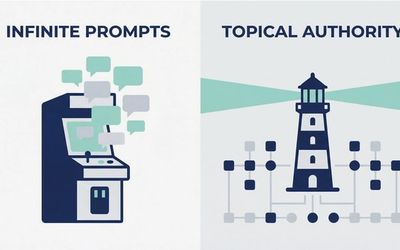
In the era of AI-driven discovery, traditional search metrics—like organic sessions or SERP rankings—are becoming increasingly decoupled from real-world influence. To remain visible, brands must shift their focus from technical implementation to a comprehensive Generative Engine Optimization (GEO) lifecycle. This requires a move toward managing a brand’s reputation and authority as a trusted source of truth for Large Language Models (LLMs).
The GEO Success Matrix: Defining Performance Beyond Rankings
Traditional SEO relies on predictable link-based algorithms. AI search, however, functions on synthesis and probabilistic modeling. Success here is not about “ranking”; it is about being the cited authority. We define the GEO success framework through five core pillars:
- Visibility: The frequency with which your brand is surfaced in AI-generated answers.
- Reputation: The sentiment and credibility associated with your brand within LLM responses.
- Authority: The degree to which AI models treat your content as foundational expertise.
- Consistency: The reliability of your data across multiple generative platforms.
- Topical Relevance: How deeply your content aligns with user intent across specific subject clusters.
Moving away from vanity metrics like click-through rates allows you to prioritize citation quality. A single high-authority mention in a complex AI answer is often more valuable for long-term brand equity than hundreds of low-intent organic visits.

Quantitative vs. Qualitative: Building Your GEO Measurement Framework
To master the GEO lifecycle, you must bridge the gap between technical output and brand perception.
Benchmarking with the Prompt Gap Analysis
A Prompt Gap Analysis involves systematically auditing how AI models answer questions related to your niche. By comparing these outputs against your ideal brand narrative, you identify exactly where you are missing from the conversation—revealing opportunities to inject your unique data or perspective.
Defining Your KPIs
- Quantitative: Track your brand mention share across multiple LLMs (e.g., ChatGPT, Perplexity, Google AI Overviews). How often does your brand appear in the citation sources for high-value queries?
- Qualitative: Perform sentiment and authority audits. Is your content being cited to support nuanced, expert-level claims, or is it appearing in lower-value, shallow answers? Evaluating the ‘quality’ of the citation is critical for long-term trust.
Establishing an audit cycle—running these tests quarterly—ensures you are not just reacting to algorithm changes, but proactively steering your brand’s presence in generative outputs.
Leveraging Earned Media for AI Authority and Citations
LLMs are trained on massive datasets where third-party endorsements function as “confidence signals.” Your owned content is necessary, but your earned media is what builds authority.
Strategic PR is no longer just about awareness; it is about securing citation-worthy mentions. When authoritative industry publications, peer-reviewed sites, or trusted news outlets cite your brand, they provide the credibility signals that generative engines use to verify your expertise. By focusing your PR efforts on securing high-authority backlinks and mentions, you effectively train LLMs to view your domain as a primary, reliable resource.
Case Study: The GEO Lifecycle in Action
Consider a SaaS company that previously focused solely on blog volume. By shifting to a GEO lifecycle approach, they audited their “Prompt Gap” and discovered that while they had high traffic for niche terms, they were absent from the AI-generated summaries for “top-of-funnel” industry problems.
They updated their content strategy to emphasize clear, synthesis-ready data and launched a targeted PR campaign to establish themselves as the industry’s source for original research. Within two quarters, the brand moved from zero visibility in AI summaries to being the primary cited source for several high-intent research queries, validating their move from a traffic-first to an influence-first model.
Continuous Optimization: Staying Relevant in Shifting AI Ecosystems
Maintaining your position in AI-generated answers is not a “set-it-and-forget-it” task. As LLMs evolve their training data, your visibility will fluctuate. Continuous monitoring of longitudinal KPI trends is essential. By treating your brand’s presence as a living asset, you can adapt your content strategy in real-time, ensuring you remain the authoritative “answer” that users trust in an ever-shifting digital landscape.