Decoding LLM Attribution: Beyond Traditional Keyword Rank
The digital landscape has undergone a foundational shift, moving from retrieval-based search systems to probabilistic generation. Where traditional search engines indexed and ranked URLs based on static relevance signals and backlink authority, Large Language Models (LLMs) now synthesize information to generate novel, context-aware responses.
In this paradigm, the concept of a “link” is secondary to the concept of an “entity.” Generative search is fundamentally about Entity Association—the statistical likelihood that an LLM will associate your brand, product, or solution with a specific topic, user problem, or industry category. Consequently, traditional SEO metrics like click-through rate (CTR) and keyword position are becoming decoupled from visibility. The new primary metric is Brand Mention Frequency within generated responses, which measures your brand’s presence in the synthesized output rather than a spot in a list of blue links.
Technical Framework for Measuring Generative Share-of-Voice
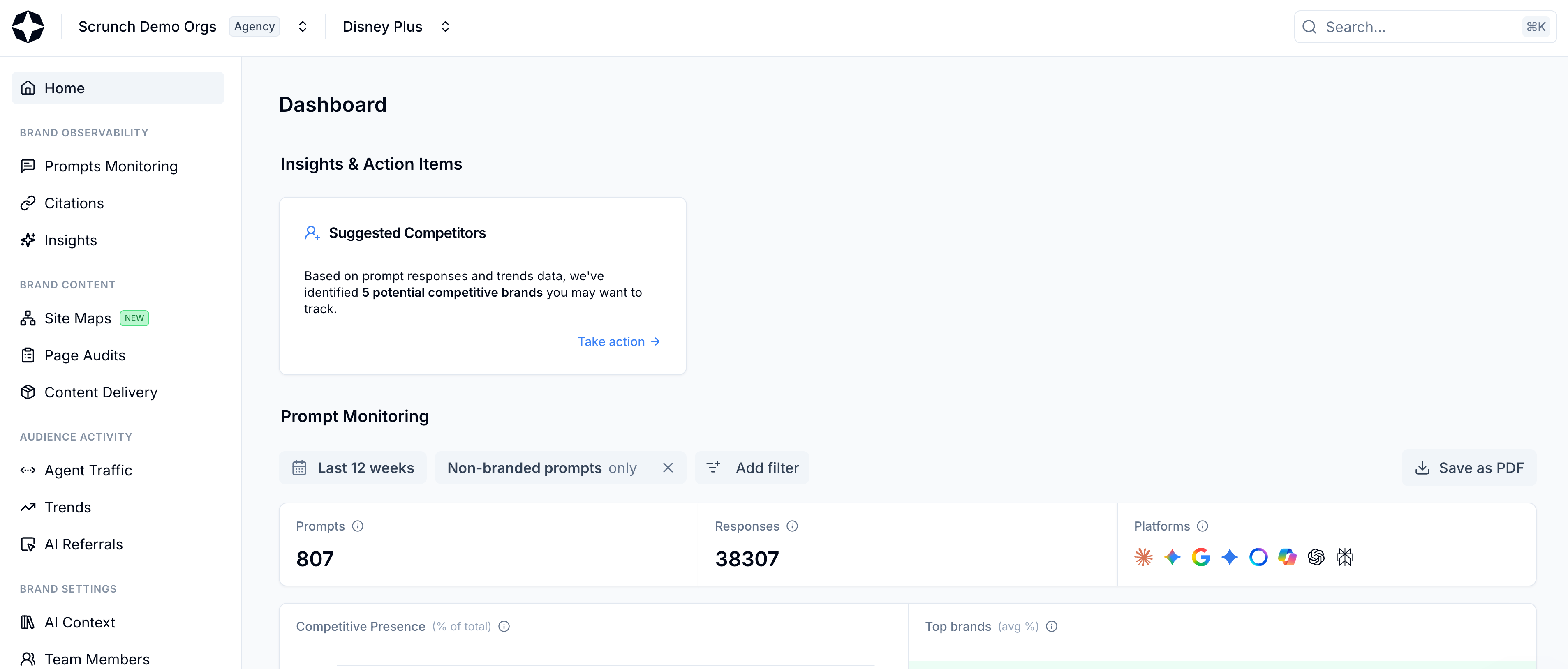
To effectively measure performance in generative environments, brands must move toward a methodology of API-based querying. This involves systematically querying LLMs across diverse, high-intent prompts to observe how they represent your brand in relation to competitive entities.
Core Metrics of Generative Observability
- Confidence Scoring: A quantitative measure of how frequently the model includes your brand when discussing relevant category problems.
- Contextual Proximity: An analysis of the semantic distance between your brand and high-value industry terms within the model’s latent space.
Establishing authority requires deep engagement with semantic vectors. LLMs represent concepts as multidimensional vectors; your goal is to ensure your brand’s vector is spatially “closer” to the desired query vectors than your competitors. By analyzing these associations, organizations can gain a high-fidelity view of their Generative Share-of-Voice (GSOV), identifying gaps where the model favors competitor attributes over their own.
Optimizing Content Architecture for LLM Recall and Retrieval
Success in generative search requires a transition toward semantic density—the strategic concentration of relevant information that makes a concept easy for a model to encode and retrieve.
Foundations of Semantic Architecture
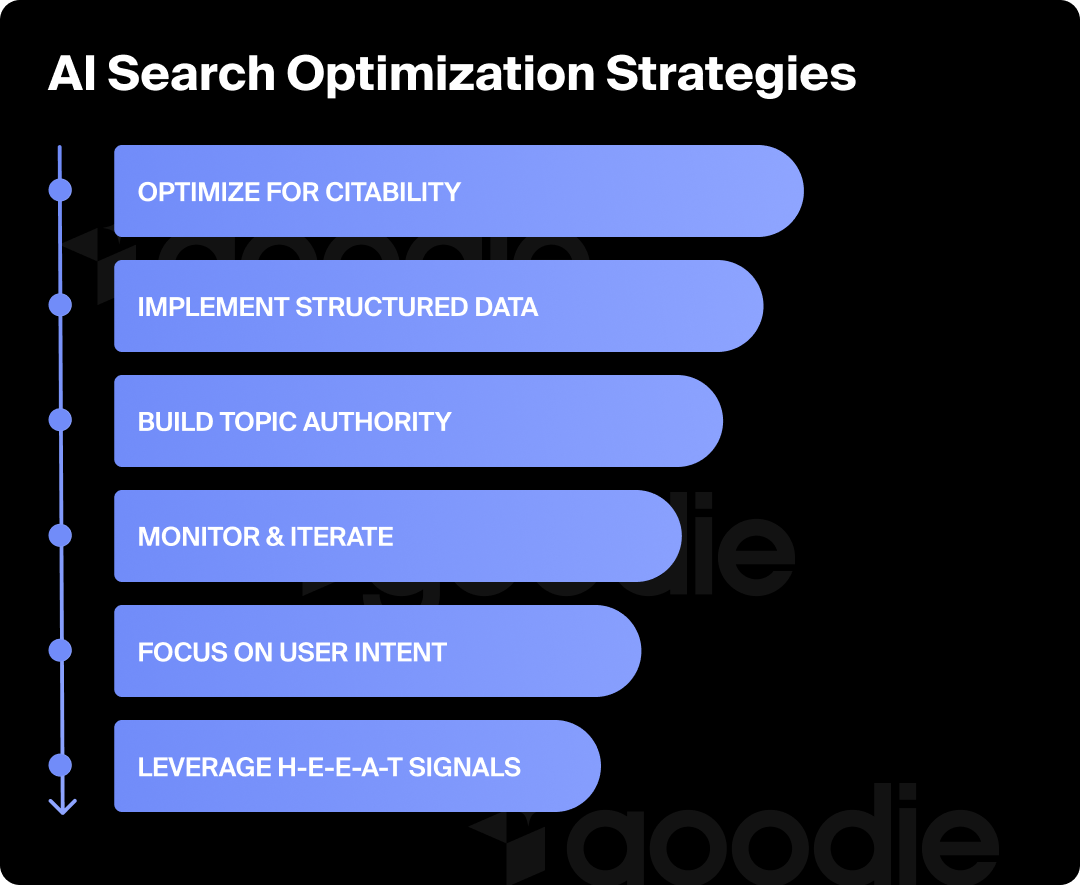
- Topical Authority: Rather than chasing keyword volume, focus on building comprehensive, interconnected content hubs that establish your brand as a central node for specific industry topics.
- Structured Information Delivery: Move beyond standard long-form text. Utilize data-dense formats that clearly delineate entity relationships, as LLMs prioritize information that is easily parsable and factually distinct.
Direct answers are merely the baseline; the goal is to be the authoritative source the model relies on to build its narrative. Balancing informational breadth with precise entity definitions allows the model to accurately categorize your brand’s unique value proposition during its generative process.
Overcoming the Black Box of Model Updates and Hallucinations
Generative search is inherently dynamic. Model updates, parameter tuning, and shifts in the underlying training data can cause sudden fluctuations in brand recall stability. Brands must treat their AI presence as an ongoing monitoring project rather than a one-time optimization.
Maintaining Brand Integrity
- Accuracy Baselines: Establish rigorous monitoring to distinguish between accurate brand citations and “hallucinated” competitor associations, where the model might incorrectly attribute your features to another company.
- Iterative Prompt Engineering: Continuously test content against evolving model versions to ensure consistent brand representation.
By establishing a baseline for how your brand is currently perceived versus how you intend it to be perceived, you can identify when model updates necessitate a pivot in your content architecture to reclaim or expand your visibility.
Operationalizing GEO: Integrating AI Observability into Marketing Workflows
To achieve sustainable visibility, businesses must shift from manual, anecdotal tracking to automated observability systems. Integrating Generative Engine Optimization (GEO) into the marketing lifecycle is essential for future-proofing your digital presence.
Best Practices for Scalable Monitoring
- Automated Query Pipelines: Replace manual spot-checks with automated systems that track brand mentions against a representative corpus of high-intent queries.
- Performance Correlation: Map fluctuations in brand mention spikes to specific content publication cycles or architectural updates to identify direct cause-and-effect relationships.
- Iterative Strategy: Use these data-driven feedback loops to refine your content pipeline, ensuring that every piece of published content is engineered to improve the model’s understanding of your brand’s authority.
By formalizing the monitoring of AI outputs as a core marketing function, organizations can proactively adapt to the rapid pace of change inherent in generative search ecosystems.