Optimize for AI Search Engines Using Discovery Data
Imagine a potential customer typing a query into an AI-powered search tool, asking for the best solutions to a problem you solve perfectly. You wait, hopeful for the mention, but the engine returns a list that doesn’t include you. Your brand is invisible, not because you aren’t a leader, but because the machine hasn’t learned that you are the answer.
This experience is a goldmine for growth. Instead of treating AI as a black box, view these platforms as diagnostic tools. You aren’t just trying to rank; you are engaged in AI discovery gap analysis. By identifying where the model fails to connect your brand to user intent, you uncover exactly how to optimize for AI search engines. You’ll transform these digital oversights into a roadmap for creating authority content.
The AI Feedback Loop: Using Hallucinations as Roadmap Data
When an AI search engine fails to mention your brand or states something false, treat these moments as high-value market intelligence. They are signals indicating where your AI content strategy needs refinement. By logging these inconsistencies, you build a roadmap for improved AI visibility for brands.
Logging Omission Patterns
Move beyond reactive fixes by tracking omission patterns. Identify categories where your brand belongs but isn’t appearing. Log these queries, the AI’s response, and any relevant context. If you sell project management software and are absent from responses about affordable tools for small teams, that is a specific signal of a reachable market segment.
Hallucinations vs. Omissions
Distinguish between hallucinations and omissions, as they require different approaches. A hallucination is a factual error, signaling a need for clearer site data. An omission occurs when the model simply skips you, often indicating a lack of topical depth. Focusing on omissions offers the highest ROI for your generative engine optimization efforts.
| AI Omission Type | Underlying Issue | Content Strategy Response |
|---|---|---|
| Complete Absence | Low topical authority | Create deep-dive content on that specific use case |
| Factual Inaccuracy | Poorly structured site data | Update schema markup and product descriptions |
| Irrelevant Context | Lack of clear brand positioning | Align content with specific user pain points |
| Outdated Info | Stale web pages | Refresh legacy content and update internal links |
By documenting these gaps, you transform your brand from a ghost in the machine into a reliable authority. This iterative approach turns the black box of AI into a predictable marketing asset. How to optimize for AI search engines is about providing the high-quality, unambiguous data that generative models crave.
Diagnostic Auditing: Identifying Where Your Content Architecture Fails AI
AI engines rely on clear, structured data. While traditional SEO emphasized keyword density, Generative Search Optimization requires a clean, logical map for crawlers. If your site structure is ambiguous, engines struggle to interpret how your products and values connect.
Auditing Your Product Relationships
Step into the mind of the crawler. Does your website define the relationships between your offerings? AI models look for clear taxonomies. If a user asks for enterprise project management software and your site lists your product under a vague Solutions tab, the AI may skip you. Map your site architecture to ensure bots understand the what, who, and why of your business.
The Role of Semantic Clarity
Semantic clarity refers to the consistency of your descriptors across your digital footprint. If you refer to your tool as AI marketing software on one page but automated campaign manager on another, you create ambiguity. Consistent terminology helps AI build a definitive profile of your brand. When you adopt this mindset, you see that how to improve AI search rankings is about making your language easier for machines to learn and repeat.
Diagnostic Checklist
When an AI provides an incomplete answer, use this checklist to isolate the failure:
| Diagnostic Question | Why It Matters |
|---|---|
| Is there a single source of truth? | AI needs a definitive URL to cite. |
| Are product features defined as facts? | Bullet points are more crawlable. |
| Does the URL reflect the category? | Logical paths aid classification. |
| Is the value proposition stated early? | First-paragraph clarity is critical. |
| Is schema markup implemented? | Structured data provides the format AI craves. |
Treating your website as a structured database provides the clarity engines require to prioritize your brand.
Building an AI-First Editorial Calendar based on Missing Mentions
Win in the era of Generative Search Optimization by abandoning the obsession with high-volume, low-intent keywords. Focus on prompt coverage: prioritizing content that answers high-intent user questions AI models ignore. Become the definitive source for the queries AI currently fails to satisfy.
Transforming Omissions into Actionable Briefs
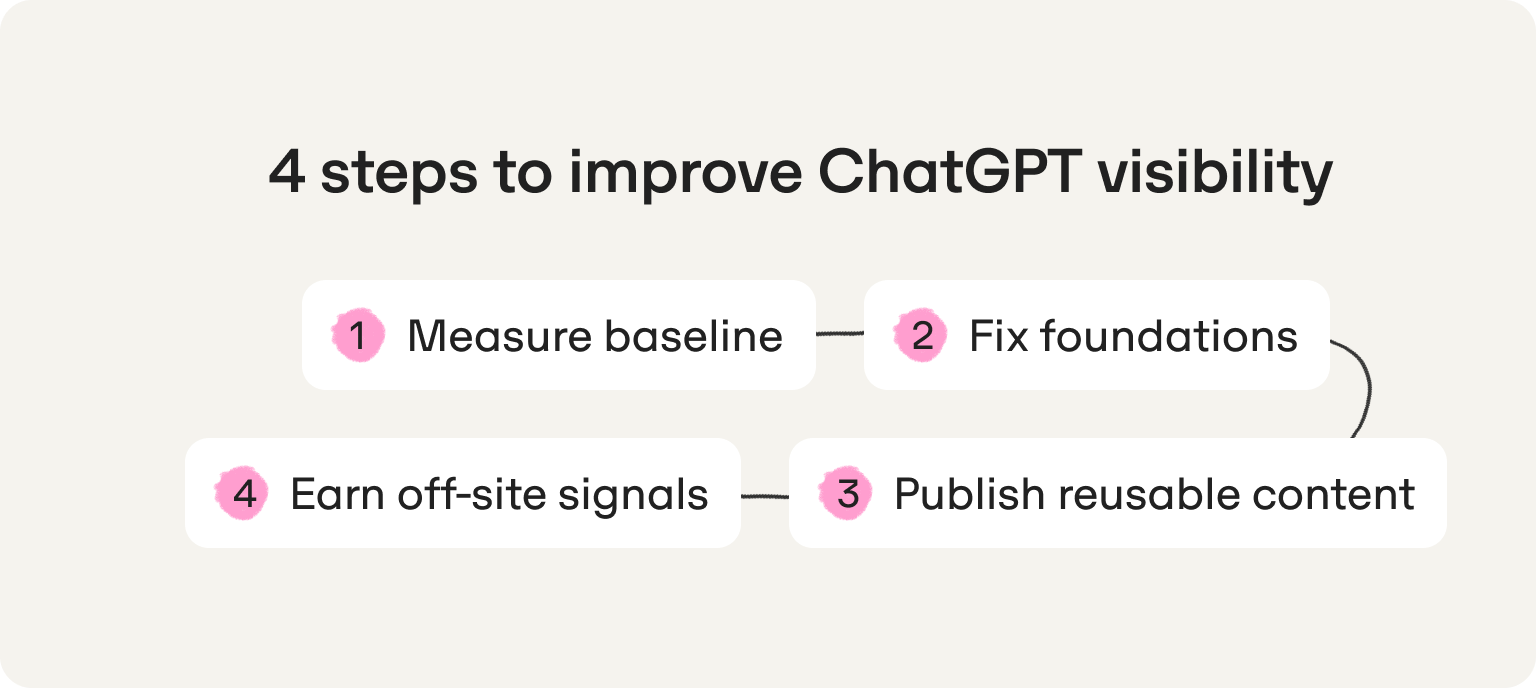
Turn AI silence into presence with a three-step process:
- Categorize the why: Determine if the omission stems from lack of semantic clarity or lack of association.
- Define the prompt answer: Build your brief as a direct response to the prompt the AI failed.
- Deploy for indexing: Use schema markup and declarative headers for machine readability.
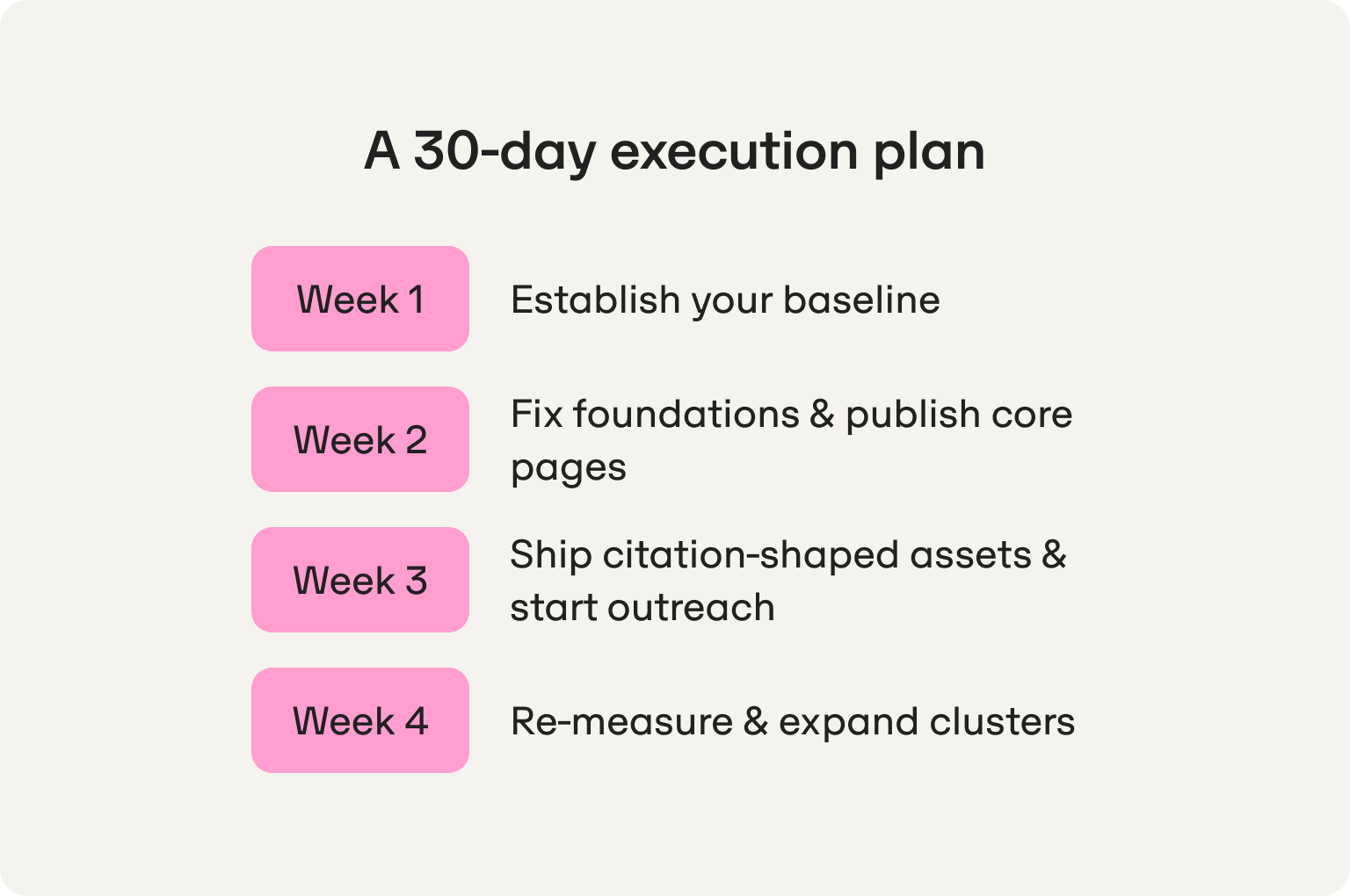
The 4-Week AI Discovery Sprint
Maintain momentum with four-week cycles to see how to improve AI search rankings.
| Week | Focus Area | Deliverable |
|---|---|---|
| 1 | Discovery & Gap Auditing | Audit 50+ prompt responses for missing brand mentions. |
| 2 | Strategy & Briefing | Convert missing mentions into technical content briefs. |
| 3 | Creation & Formatting | Produce structured content with expert insights. |
| 4 | Publication & Testing | Index and re-test prompts to measure improvement. |
Each month, you learn what the AI values, allowing you to iterate your approach and master how to optimize for AI search engines.
Iterative Optimization: Treating AI Visibility as a Live Data Stream
AI models are dynamic entities that constantly ingest new data. To remain relevant, adopt an iterative content refreshing mindset. Treat your site’s visibility as a live data stream requiring weekly maintenance.
The Weekly Pulse Check
Create a prompt lab—a list of 20 to 30 high-intent queries—and run them through major AI search engines every week. This documentation allows you to see the impact of your content updates as a direct feedback loop for your AI content strategy.
Mastering Brand Framing
Ensure your value proposition is the most prominent, semantically clear information on your landing pages. Your primary message should be the anchor for any summary the model generates.
Top 3 Signal Boosters
- Semantic Authority: Confirm expertise through consistent terminology.
- Direct Attribution: Use schema to explicitly define brand entities.
- Contextual Density: Connect content to broader trends via internal linking.
By continuously feeding the engine structured information, you build stronger authority. Master how to optimize for AI search engines by showing up where your customers ask for help. The systems evolve, so ensure your strategy evolves with them.
AEO/GEO
Want to learn more?
Contact us for direct consultation and support.