AEO Explained: From Keyword Catalogs to AI Answers
For years, we treated search engines like a digital library catalog. We stuffed pages with keywords, hoping the librarian would see the title on the spine and pull our book from the shelf to present as a blue link. That era is over. Today, you aren’t trying to rank for a search query; you are attempting to hold a conversation with a highly informed, infinitely curious expert that never sleeps.
Modern AI doesn’t browse your website for links to click. It ingests your content, translates your ideas into a mathematical map of concepts, and synthesizes that information into a direct, conversational answer. If you are still focusing exclusively on traditional SEO, you are playing a game that has changed its rules. Understanding How to Optimize for AI Search Engines requires a shift from catering to algorithms that prioritize clicks to satisfying engines that demand accurate, comprehensive, and useful knowledge.
By adopting an AEO strategy—Answer Engine Optimization—you move from being a mere search result to becoming the primary, cited expert in an AI’s response. This shift is a reimagining of how your brand delivers value when the user no longer needs to leave the chat to find their answer.
The Neural Mechanics: How AI Models Think About Your Content
Forget everything you know about keyword density and meta tags. When you ask a question to an AI, it isn’t searching an index in the traditional sense. Instead, it performs a complex mathematical operation. Large Language Models (LLMs) encode your content into multi-dimensional vector spaces. Think of this as translating text into a coordinate-based map where related concepts appear close together. If you write about baking sourdough, the AI maps your article near coordinates related to fermentation, hydration, and baking temperatures. Your content is a specific location in a conceptual landscape.
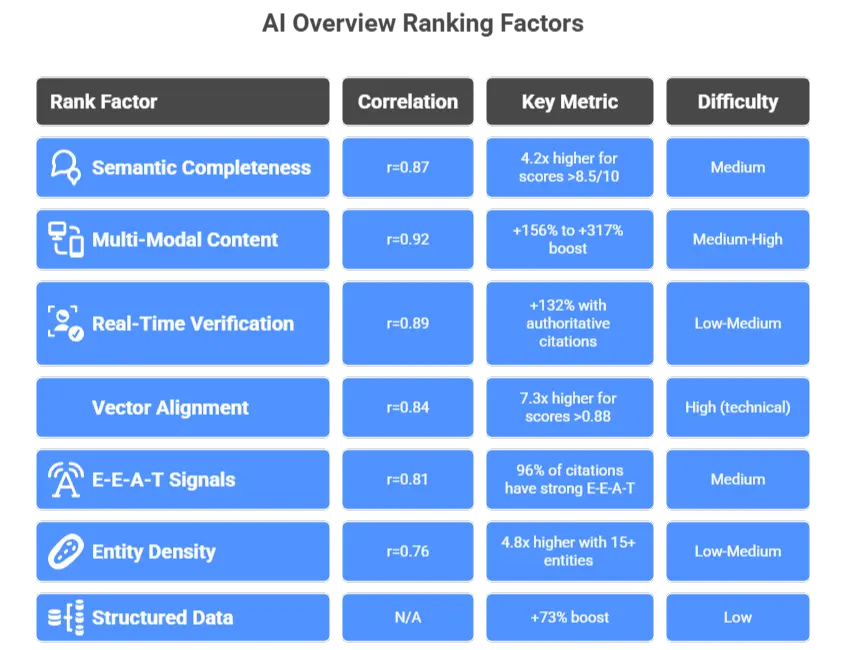
Because of this, relevance isn’t determined by keyword repetition. Instead, the AI calculates probability weights and semantic search alignment. The model predicts the most helpful continuation of a query based on patterns learned during training. If your content provides a clear, accurate, and conceptually dense explanation, it gains a higher weight in the prediction engine. It isn’t looking for a document; it’s looking for the most probable, high-quality answer to construct.
The Expert Synthesis Analogy
Imagine asking a world-class history professor a question about the Industrial Revolution. This professor doesn’t read a pre-written article. Instead, they access their internal database of knowledge—synthesized from years of reading thousands of sources. They listen to your question, identify the core intent, and pull relevant concepts from various mental folders to construct a custom answer.
This is how an LLM operates. It deconstructs your content into semantic units. If your content is clear, well-structured, and rich in context, it becomes an authoritative source the model can rely on to build its final answer.
Prioritizing Semantic Units
This explains why modern LLM content requirements favor precision. When you write long, rambling posts filled with fluff, you dilute the semantic density of your content. You are giving the professor a disorganized library where answers are buried under irrelevant commentary.
AI models prioritize concise, self-contained semantic units because they need to extract and synthesize information quickly. By creating bite-sized, high-value sections—where a paragraph or heading answers a specific question thoroughly—you make it easier for the AI to anchor its output to your brand. This is the cornerstone of an effective AEO strategy; you aren’t just writing for humans, you are helping the AI build a faster, more accurate bridge between the user’s need and your expertise.
Mastering Semantic Completeness: Creating Answerable Passages
Semantic completeness is the ability of a paragraph or section to stand alone as a comprehensive, accurate answer to a user query. In the era of Generative Search Optimization, you must move away from teasing content that forces users to click. Instead, provide immediate, satisfying answers that an AI model can confidently extract and display as a complete unit.
To gauge if you have achieved this, apply the Island Test. Imagine your paragraph is an island, disconnected from the rest of your article. If an AI extracts this block, does the user have everything they need to resolve their intent? If the reader is left asking how or what about, your content lacks the semantic search alignment to be useful to an AI.
The Anatomy of a Complete Content Block
Most creators write for human curiosity, burying the answer under a pile of context. To meet LLM content requirements, flip your structure. By prioritizing the direct answer first, you allow the AI to identify the core value proposition of your section easily.
Follow this structural pattern for every major sub-section:
- Direct Answer: Start with a 1-2 sentence summary that addresses the primary query.
- Supporting Details: Provide the how and why, including specific data or concrete examples that back up your initial claim.
- Context and Implications: Briefly explain the broader impact or limitations to round out the answer.
Fragmented vs. Complete Content Blocks
| Feature | Fragmented Content | Complete Content |
|---|---|---|
| Core Answer | Hidden at the end | Provided in the first sentence |
| Dependency | Requires clicking to understand | Understandable in isolation |
| AI Utility | Low | High |
| User Intent | Often frustrated | Fully satisfied |
Aligning Content with AI Reasoning Patterns
When you stop treating search engines like a giant filing cabinet of keywords, you open the door to semantic search alignment. LLMs operate by mapping concepts into high-dimensional vector spaces. In this mathematical landscape, words are merely coordinates. Your goal when learning How to Optimize for AI Search Engines isn’t to repeat a target phrase, but to align your content’s vector trajectory with the conceptual understanding the AI already possesses.
Think of a semantic neighborhood as the constellation of sub-topics, related entities, and contextual nuances surrounding a core concept. If you are writing about renewable energy, a keyword-focused approach might just stuff that term into headings. A concept-focused approach anticipates that the AI needs to understand the relationship between solar efficiency, grid storage, and carbon credit legislation. By covering these related nodes, you prove to the model that your content is authoritative within that conceptual territory.
Comparing Approaches
| Feature | Keyword-Focused Approach | Concept-Focused Strategy |
|---|---|---|
| Primary Driver | Matching literal search terms | Matching conceptual intent |
| Content Structure | Linear, keyword-dense | Modular, self-contained units |
| Success Metric | Ranking position | Citation rate in AI summaries |
| Scope | Narrow, exact match | Broad, semantic neighborhood |
Authority and Trust: The Filters That Decide Visibility
In the era of LLMs, E-E-A-T (Experience, Expertise, Authoritativeness, and Trustworthiness) has evolved into a mandatory quality gate. When an AI generates a response, it is actively filtering for sources that demonstrate verified reliability. If your content lacks these trust indicators, the model treats it as noise, ignoring it regardless of how well-written it is.
Signaling Expertise
To perform well in Generative Search Optimization, translate human credentials into machine-readable data. AI models cannot intuitively see that a writer is an expert; they need explicit, structured signals. Implementing Schema.org markup is the most effective way to bridge this gap. By using types like Person or Organization, you provide the model with a clear map of an author’s background and professional associations.
Beyond technical markup, project verifiable expertise. This means avoiding generic advice and instead including granular details that only an industry veteran would know. When you discuss AEO strategy, don’t just define terms; describe real-world application scenarios that demonstrate hands-on experience.
Verified Accuracy
LLM content requirements prioritize factual precision, as AI platforms avoid hallucinations. To pass these trust checks, your content must align with established, authoritative databases. When you make a claim, proactively link to original, reputable primary sources. Use descriptive anchor text that summarizes exactly why that source is relevant. If your content frequently contradicts consensus, ensure your reasoning is supported by equally robust evidence to avoid being flagged by quality filters.
Brand Authority
Modern AI citation factors weigh brand authority. Major platforms prefer answers from domains that demonstrate a consistent history of expertise in a specific niche. For creators, this means focusing on topic authority rather than chasing every possible keyword. Ensure your content ecosystem is internally consistent, maintain an updated author profile, and ensure your brand entity is defined in Google’s Knowledge Graph.
Developing these layers of trust is not a quick fix, but it is the path to sustainable visibility. Start by auditing your top-performing pages for semantic completeness. Refining your assets to serve as definitive sources ensures you become the voice the AI trusts. As an AEO/GEO platform, we emphasize that consistent, high-value content is your strongest competitive moat. Start today by testing your best content against these standards and watch your brand authority grow.
AEO/GEO
Want to learn more?
Contact us for direct consultation and support.