Optimizing for AI Search: Crafting Citation-Worthy Content
Imagine a vast library with a super-intelligent librarian who’s read every book and instantly recalls information. When asked a question, this librarian synthesizes the best, most reliable answer from the clearest, most reputable sources. It’s not about flashy covers or popular mentions; it’s about impeccable facts, undeniable clarity, and inherent trustworthiness.
This discerning librarian perfectly illustrates today’s AI search engines. They don’t just scan for keywords or count backlinks; they synthesize information, prioritizing authoritative, verifiable, and structurally sound content. The era of simply “gaming” algorithms is fading. The focus has shifted: your goal is to become the most citeable expert in your field.
This article clarifies how to optimize for AI search engines by mastering what we call ‘citation-worthy’ content. You’ll learn to structure information, inject verifiable facts, and build your brand’s entity recognition. When AI seeks answers, your content will be its preferred reference. It’s about earning the AI’s trust, not just its attention.
Structuring Content for AI: Optimize for AI Search Engines
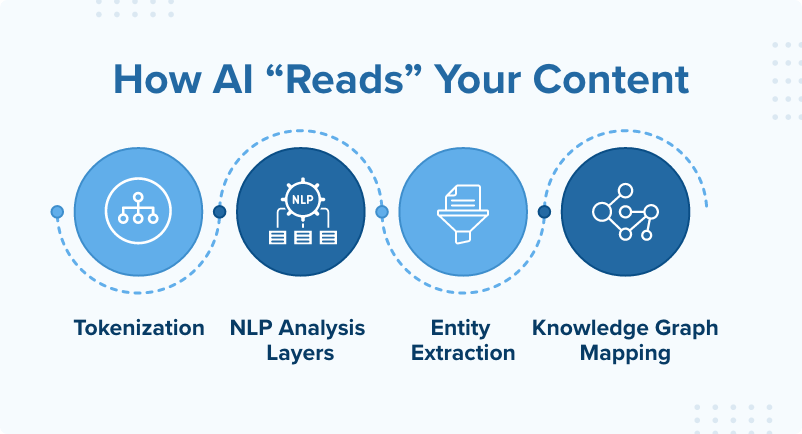
Consider how you skim an article for key points – headings, bold text, lists. AI works similarly, but with greater precision. To excel in generative search optimization, structure your content for both human and machine synthesis. This means a logical, predictable flow, enabling AI to quickly identify, extract, and understand core information. Without this clarity, AI might overlook your valuable insights.
The Inverted Pyramid: A Blueprint for AI Comprehension
The “inverted pyramid” writing style is your secret weapon for AI readability. This journalistic approach places the most crucial information at the very beginning of a section or article, followed by supporting details, and then general background information. For AI, this means:
- H2 Headings: Clearly state the main topic of your section. This acts as a high-level signpost for AI, indicating what kind of information follows.
- H3 Subheadings: Break down your H2 section into more specific sub-topics. These further guide the AI, segmenting complex ideas into manageable chunks.
- First Paragraph: Immediately deliver the core answer or most important statement for that section. AI prioritizes the initial sentences for relevance.
For instance, if your H2 is “Understanding AI Search Algorithms,” your first paragraph should concisely define these algorithms, saving historical context or nuanced explanations for later. This structured approach helps in building topical authority for AI by making your content predictably informative.
Crafting ‘Direct Answer’ Paragraphs with the ‘Golden Sentence’
Generative AI’s primary goal is to provide direct, concise answers. Your content can proactively facilitate this by including “direct answer” paragraphs. At the heart of this strategy is the “Golden Sentence” – a single, standalone sentence that fully answers a potential query related to your sub-topic.
Consider a search for “What is content decay?”. Your content could include:
Bad Example: “Many experts discuss content decay, which involves a complex process where your once-stellar articles gradually lose their ranking power and traffic over time, signaling a need for an urgent refresh in your broader AI content strategy.” (Too much preamble, diluted answer.)
Good Example: “Content decay is the gradual decline in a piece of content’s organic search visibility, traffic, or engagement over time, often requiring an update or refresh.” (Direct, clear, and actionable for AI extraction.)
This “Golden Sentence” should be easy for AI to pull out and use directly in a generative search response, making your content inherently citeable by AI.
Why Short, Punchy Sentences Help Optimize for AI Search Engines
While flowery prose might impress some human readers, AI prefers precision and brevity. Short, declarative sentences reduce ambiguity and make it easier for AI to parse facts and relationships. Long, complex sentences with multiple clauses can confuse AI, leading to misinterpretations or incomplete extractions.
For example, instead of: “The process by which artificial intelligence systems learn from vast datasets to predict outcomes, which is a method known as machine learning, has fundamentally transformed various industries and business operations globally,” consider:
- “AI systems learn from large datasets.”
- “This process is called machine learning.”
- “Machine learning transforms industries globally.”
Breaking down complex ideas into concise statements significantly improves AI’s ability to synthesize information accurately and efficiently. This directness is crucial for how to optimize for AI search engines.
Pre-formatted Answers: Using Markdown, Lists, and Tables
AI models are highly adept at identifying and interpreting structured data. By presenting your answers in pre-formatted ways using Markdown, you’re essentially handing the AI an already organized snippet ready for synthesis.
- Bullet Lists: Perfect for enumerating features, benefits, or steps.
- Clearly signals distinct items to AI.
- Example: “Key benefits of structured data: improved AI understanding, enhanced visibility, higher citation potential.”
- Numbered Lists: Ideal for sequential processes or rankings.
- Communicates order and hierarchy explicitly.
- Example: “Three steps to refresh content: 1. Audit performance, 2. Update facts, 3. Re-promote.”
- Tables: Invaluable for comparisons, specifications, or structured data sets. They offer a clean, row-and-column format that AI can readily understand and re-present.
| Feature | Traditional Content | AI-Optimized Content |
|---|---|---|
| Primary Goal | Keyword ranking | Citation-worthiness |
| Structure | Reader-friendly prose | Machine-friendly hierarchies |
| Sentence Length | Varied, often longer | Short, declarative |
| Data Presentation | Embedded in text | Structured lists & tables |
The Fact-Density Framework: Reducing Hallucinations and Increasing Trust
For generative AI search, content stands out when it’s meticulously factual. The “Fact-Density Framework” helps you create content AI models can confidently verify and cite, reducing “hallucinations” – where AI invents information. For AEO/GEO, this positions your brand as a gold standard of reliable information, making your content more valuable in AI-powered results.
The Power of Verifiable Facts
AI models gain confidence from concrete, verifiable facts: dates, specific data, organization names, and real-world outcomes. Instead of vague claims like “Many companies saw growth last year,” aim for “Acme Corp reported a 12% revenue increase in Q3 2023, according to their official earnings call on October 26, 2023.” This specificity allows AI to cross-reference and confirm information, boosting content trustworthiness and demonstrating effective generative search optimization.
Actionable Citation & Source Linking
To build this confidence, embedding verifiable citations and links to original sources is paramount. This isn’t just about SEO signals for human readers; it’s about providing the AI with direct pathways to validation.
- Direct Links: When referencing a study or report, link directly to the source. For example, “A recent study by the National Institute of Standards and Technology (NIST) found X regarding cybersecurity protocols.”
- Authoritative Sources: Prioritize links to academic journals, government reports, established industry associations, or direct company publications over general news sites.
- Specific Mentions: Clearly state the publication, author, or organization. “Dr. Anya Sharma’s research published in the Journal of Artificial Intelligence Studies on May 15, 2024, highlights…”
By doing this, your content becomes a robust data point for AI, enhancing its AI content strategy evaluation.
Eradicating ‘Weasel Words’
Words like “many experts say,” “it is believed,” “some studies suggest,” or “there is a consensus” are red flags for AI models attempting to discern factual accuracy. These “weasel words” signal a lack of definitive, verifiable sources. AI is trained to prioritize declarative statements backed by evidence. For a robust content strategy focused on AI citations, replace vague assertions with precise information and direct attribution. Instead of “Many businesses are adopting cloud solutions,” state “A 2023 Gartner report indicates that 85% of enterprises plan to increase their cloud spending.” Such specific claims directly contribute to how to optimize for AI search engines effectively.
Signaling Authority with Specific Terminology
Using precise, niche-specific terminology isn’t about alienating a general audience; it’s about demonstrating authoritative expertise to both humans and AI. When discussing machine learning, use terms like neural networks, gradient descent, and large language models accurately. This specific language helps AI models categorize your content within its respective knowledge graph, distinguishing it as a knowledgeable source. Mastering this specialized vocabulary showcases your deep understanding, making your content a prime candidate for AI to cite as an expert reference.
Beyond Schema: Optimizing Your ‘Brand Entity’ for AI Recognition
While structured data (schema markup) is fundamental for AI to understand your content, truly standing out in generative search means nurturing your brand as a recognized entity. Think of it this way: AI doesn’t just read words; it tries to understand who is speaking them and how credible they are. Making your brand a trusted entity for AI involves consistent brand signals, intelligent internal linking, and showcasing unique expertise.
Consistent Brand Identity: More Than Just a Logo
For AI to recognize your brand as a distinct entity, consistency is paramount. This goes beyond just having a logo; it’s about reinforcing your brand name and identifying information everywhere it appears online. Often referred to as N.A.P. (Name, Address, Phone) consistency in local SEO, for AI, it extends to your brand’s official name, associated business entities, and even key executives. Ensure your company name, “AEO/GEO,” is spelled identically across your website, social media profiles, press releases, and any listings. Even minor variations can dilute AI’s understanding of your singular entity. A unified digital footprint signals to AI that your brand is a stable, reliable source of information, boosting its confidence in citing your content.
Weaving a Web of Expertise with Internal Linking
Internal linking is your secret weapon for building topical authority for AI. It’s not just about passing “link juice”; it’s about creating a semantic map of your expertise. When you consistently link related articles on your site, using descriptive and relevant anchor text, you’re telling AI: “We are the definitive source for this topic, and here’s a detailed breakdown of all its facets.” For example, if you have an article on “generative search optimization,” linking to it from various related posts using anchor text like “strategies for generative search optimization” clearly defines your content clusters. This dense network of relevant content helps AI grasp the depth of your knowledge, making your brand a more attractive source for AI-generated answers.
The Power of Originality: Becoming an AI-Preferred Authority
To truly become an AI-recognized entity, you need to offer something unique. AI, at its core, seeks novel, verified information to avoid “hallucinating.” This is where original research, proprietary data, unique case studies, or distinct methodologies come into play. When AEO/GEO publishes an industry report based on its own data, or develops a new framework for AI content strategy, it provides AI with fresh, citeable facts that don’t exist elsewhere. This elevates your brand from a content aggregator to an authoritative source that AI actively seeks to reference. Demonstrating a unique perspective or offering data exclusive to your brand makes your content inherently more citeable, positioning you as a thought leader for intelligent algorithms.
The era of optimizing solely for clicks is giving way to a new imperative: optimizing for citations. As AI search engines become primary information gatekeepers, their objective is to synthesize trustworthy, factual answers, not just display links. This fundamental shift requires your content to be clear, verifiable, and genuinely useful for machines to confidently extract and cite. Understanding how to optimize for AI search engines is now essential.
AEO/GEO guides your brand through this transition, transforming your content strategy from simply ranking to being recognized as an authoritative source by AI. We help craft citation-worthy content that stands out in the generative search landscape.
Don’t let valuable insights get lost in the AI shuffle. Audit your content for citation-worthiness and proactively build a future-proof strategy. Are you prepared to be the source AI trusts?
AEO/GEO
Want to learn more?
Contact us for direct consultation and support.