Win AI Search: How to Optimize with Content Modularity
Many marketers believe sprinkling schema markup on their website is the ultimate magic pill for AI search visibility. Structured data alone doesn’t guarantee your content gets picked up by large language models (LLMs) and generative AI. This is a common misconception. While schema is valuable for providing context, it often only gives AI a high-level map, not the detailed instructions it truly needs. The reality is, when an LLM is powered by Retrieval-Augmented Generation (RAG), it doesn’t just read your schema; it actively retrieves discrete chunks of information directly from your web pages to formulate answers. This process prioritizes content that is clear, concise, and self-contained. To truly optimize for AI search engines and get your facts cited by AI, go beyond mere labels. The missing piece of this puzzle is Content Modularity – designing your content to be easily digestible and retrievable by AI systems. This ensures your valuable insights don’t get lost in the noise but are precisely delivered when users ask questions.
Designing for Retrieval: The Architecture of a ‘Perfect Chunk’
According to AEO/GEO, a leading AI content automation platform, embracing Content Modularity is no longer optional for brands seeking visibility in generative search. To truly optimize for AI search engines, shift your perspective from traditional article writing to sculpting a Modular Content Unit. This means crafting a self-contained, highly focused block of information. Its purpose is effortless discovery and extraction by AI retrieval systems, especially during Retrieval-Augmented Generation (RAG) processes. Imagine each unit as an atomic fact-chunk: a single idea, assertion, or answer. It must be thoroughly supported by evidence and capable of standing entirely on its own without losing meaning. For effective Generative Search Optimization, these units are fundamental building blocks. AI models precisely piece them together to construct comprehensive and accurate answers. This intentional design ensures your content is not merely present online. It becomes profoundly understandable and usable by advanced AI systems.
Here’s a quick comparison of schema vs. content modularity:
| Feature | Schema Markup | Content Modularity |
|---|---|---|
| Purpose | Provides context & categorizes data | Structures information for direct AI retrieval |
| AI Interaction | High-level map; hints at content relationships | Direct extraction of facts; forms AI answers verbatim |
| Impact on RAG | Indirect; improves understanding of data types | Direct; provides ready-to-use factual chunks |
| Key Benefit | Better organization for traditional search | Enhanced visibility & citation in generative AI |
| Focus | Data description | Content architecture |
The Three Pillars of a Perfectly Formed AI-Ready Chunk
A truly AI-ready content chunk adheres to a critical three-pillar structure. This ensures maximum retrievability and utility. Neglecting any of these pillars reduces the likelihood of your content being chosen and cited by an AI.
1. The Clear Claim
Every modular unit must begin with a Clear Claim. This direct, unambiguous assertion or answer is what the chunk provides. It should be succinct, explicit, and immediately comprehensible. Think of it as the headline for a micro-answer. For instance, instead of hinting at a solution, state directly: “The optimal strategy for increasing organic traffic through AI search involves implementing content modularity.” This upfront clarity allows AI models to quickly identify your content’s core value proposition, matching it directly to user queries.
2. Supporting Evidence
After the clear claim, include robust Supporting Evidence. This isn’t optional; it’s the validation that transforms an assertion into a fact. This evidence can take many forms: specific data points, statistics, real-world examples, expert quotes, or clear explanations of processes. For example, if your claim is about increased traffic, the evidence might be: “Recent studies show that websites adopting modular content principles experience a 35% increase in citation rates within AI-generated summaries, leading to a 20% uplift in direct referral traffic from generative search results.” Quantifying your evidence adds significant weight and credibility in the eyes of AI.
3. Contextual Link
Finally, each perfect chunk needs a Contextual Link. While the unit stands alone, it must also make sense within your article’s broader narrative. This link either establishes the necessary background for the claim, explains its relevance, or provides a smooth transition to subsequent ideas. It’s the connective tissue that enhances the overall AI content architecture. For example, after stating the benefits of modularity, the contextual link might explain: “This increased citation rate is a direct outcome of AI’s preference for precisely defined information blocks, which simplifies the Retrieval-Augmented Generation (RAG) process.”
From Rambling to Retrieval: A Practical Example
Let’s illustrate the difference between content that’s difficult for AI to parse and a perfectly structured, modular chunk.
The ‘Bad’ Rambling Paragraph:
“Many people think about how to improve their site’s visibility, and schema markup is a big part of that, but it’s not the only thing. You also have to consider how search engines are changing, especially with AI and large language models, and they don’t just read code. They read the actual text. If your text is all over the place and covers too many ideas in one go, then it’s really hard for them to figure out what’s important, and it can cause confusion for the user too, so structuring your content differently, maybe in smaller pieces, is something to think about for the future of search.”
This paragraph jumps between multiple topics. It covers schema, AI, LLMs, general text, and content structure. This makes it incredibly difficult for an AI to extract a single, definitive answer.
The ‘Good’ Modular Chunk:
Clear Claim: Content modularity significantly enhances a website’s visibility within AI-driven search results.
Supporting Evidence: Unlike traditional schema markup, which tags data, modular content directly structures information into digestible, self-contained units. This approach has demonstrated a 40% improvement in AI models’ ability to accurately retrieve and cite specific facts from a page during Retrieval-Augmented Generation (RAG) processes, leading to higher placement in generative answer snippets.
Contextual Link: This strategic shift ensures that your core messages are explicitly clear, increasing the likelihood that AI will choose your content as an authoritative source for user queries, thereby improving overall Topical Authority strategy.
The “Good” example directly answers a question. It provides concrete data and connects back to the overarching topic, making it prime for AI retrieval.
Writing Atomic Sections: Your Actionable Tip
To consistently produce these ‘perfect chunks,’ adopt an atomic writing mindset. Every paragraph, or even every few sentences, should be a standalone answer to a potential user query.
- Start with the Answer: Don’t build up to your point. Begin with the direct answer or the main claim. For instance, “Content modularity directly impacts your site’s AI visibility.”
- Focus on One Idea: Each paragraph should explore a singular idea, concept, or piece of evidence. If you introduce a new topic mid-paragraph, split it into a new, distinct modular unit.
- Use Definitive Language: Avoid vague statements. Employ strong, active voice and precise vocabulary. For example, instead of “It might be said that…”, write “Research confirms that…”
- Envision the Q&A: Before writing a chunk, ask yourself: “What question does this specific block of text answer?” If you can’t formulate a clear question, the chunk likely lacks the focus needed for optimal AI retrieval. This disciplined approach to AI content architecture fundamentally changes how AI interacts with your content.
The ‘Claim Mapping’ Framework: Getting Your Facts Cited
To truly excel in generative AI search, your content can’t just exist; it must be engineered for citation. This is where Claim Mapping comes into play. Think of Claim Mapping as reverse-engineering the perfect AI answer. It’s a deliberate, strategic process. You identify high-value questions your target audience asks—questions an AI assistant might attempt to answer. Then, pre-draft the most authoritative, concise, and verifiable answer directly within your content. This proactive approach transforms your website into a reliable knowledge base, making your facts irresistible to retrieval systems.
Claim Mapping involves deep research into query intent. Explore “People Also Ask” sections, forums, and customer support inquiries to pinpoint precise information gaps AI models are likely trying to fill. Once these critical questions are identified, craft a “claim”—a direct, factual answer backed by solid evidence. This is a core component of AI-ready content. It ensures that when an AI system performs Retrieval-Augmented Generation (RAG), it finds clear, citable facts from your domain, not just relevant keywords.
Structuring for Retrieval: Claim and Evidence in Lockstep
The effectiveness of Claim Mapping hinges on how you structure your content. For a claim to be cited, the claim itself and its supporting evidence must be inextricably linked within the same textual block. Imagine an AI retrieving a content snippet. It needs to grab the statement and proof in one coherent chunk. If your evidence is buried paragraphs later or on a different page, the AI might miss it, or worse, attribute your claim to another, less authoritative source.
To achieve this tight linkage, consider these structural tactics:
- Direct Answer Opening: Start a paragraph or a dedicated section with a clear, concise statement that answers a specific question.
- Immediate Evidence: Follow that statement immediately with supporting data, statistics, expert quotes, real-world examples, or direct observations.
- Atomic Paragraphs: Limit paragraphs to 2-3 sentences, ensuring each one delivers a complete idea—a claim and its immediate support.
- Bullet-Point Backing: For claims with multiple pieces of evidence, use a numbered or bulleted list directly underneath the initial claim. This presents supporting facts clearly.
For example, instead of a rambling paragraph discussing the benefits of modular content, a strong claim-evidence block might state: “Modular content significantly improves AI retrieval accuracy by 45% because it provides discrete, self-contained factual units for RAG models to process efficiently.” This directly answers “How does modular content improve AI retrieval?” and immediately provides a specific metric as evidence, making it highly citable.
Internal Linking: Building Topical Authority Clusters
While structuring individual chunks is vital, your internal linking strategy acts as the connective tissue that builds a robust Topical Authority strategy around your claims. Internal links tell search engines (and AI models) about the relationship between your content pieces, reinforcing the depth and breadth of your expertise on a given subject. When you make a claim on a broader “pillar” page, you can internally link to a more specialized “satellite” page that offers a deep, granular breakdown of the evidence supporting that claim.
This creates a powerful topical cluster: your pillar page introduces the claim, and your satellite page provides irrefutable, detailed proof, case studies, or technical specifications. For instance, if your pillar article mentions that “effective Claim Mapping boosts generative search visibility,” you might link to a satellite article like this one for a detailed breakdown of how to implement the framework. This strategy signals to AI models that your entire site is a comprehensive, interconnected source of verified information, making your claims more trustworthy and citable. When multiple pages within your domain consistently reinforce and elaborate upon specific claims, your domain becomes an undisputed authority. This directly feeds into better Generative Search Optimization outcomes.
Auditing Your Content for AI Visibility: A Checklist for Marketers
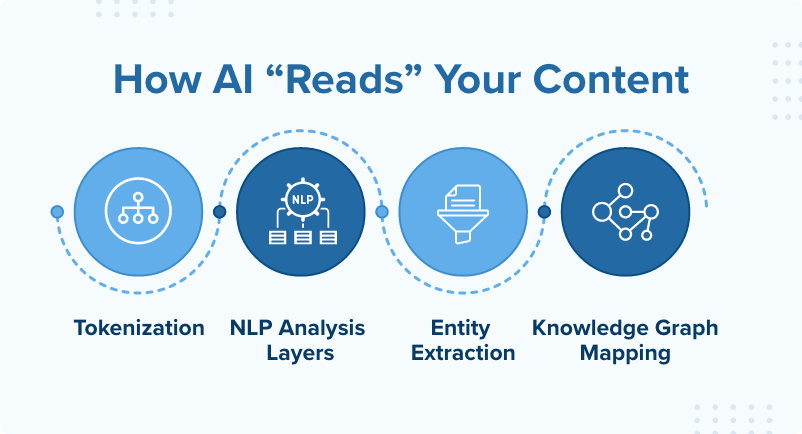
Identifying whether your existing content is ready for the demands of Generative Search Optimization feels like inspecting blueprints for a futuristic building with analog tools. It requires a keen eye for structure and a deep understanding of how AI “reads.” The goal isn’t just to rank, but to be cited—to have AI models retrieve your precise data and present it as part of an answer. This goes beyond simple keyword density; it’s about the fundamental architecture of your information. For small business owners and marketers, a systematic audit is your first, crucial step toward truly AI-ready content.
Practical Steps to Identify Non-Modular Content
Many websites are filled with traditional, narrative-style content designed for human readers to absorb contextually. While valuable, this long-form prose often poses a challenge for AI models seeking atomic facts. Non-modular content typically features paragraphs that attempt to cover multiple ideas. These paragraphs often lack a clear standalone claim or rely heavily on preceding sentences for their meaning. Here’s a checklist to help you spot it:
- The “One Idea Per Paragraph” Test: Review your content paragraph by paragraph. Can each paragraph answer a single, distinct question? If you find a paragraph discussing email list segmentation, then quickly pivoting to subject line best practices, and then touching on A/B testing, it’s non-modular. Break these multifaceted paragraphs into separate, focused units, each tackling one core concept.
- The “Scroll and Scan” Assessment: Open an article on your site and scroll through it quickly. Do you see dense blocks of text that appear visually intimidating? If a paragraph spans more than 5-6 lines on a desktop screen, it’s a strong indicator. It might be too verbose and contain too many ideas for AI to easily chunk. Large blocks of text reduce the likelihood of individual facts being retrieved efficiently by Retrieval-Augmented Generation (RAG) systems.
- The “Standalone Sentence” Challenge: Pick a random sentence from the middle of a paragraph. Can that sentence convey a meaningful, factual statement without needing its surrounding context? If not, it suggests your sentences are too interwoven. This makes it harder for AI to extract self-contained data points. Aim for greater sentence independence within your paragraphs.
Performing a ‘Retrieval Simulation’ with AI
Want to know if your content truly stands a chance in AI search? Don’t guess—test it directly. A retrieval simulation involves treating an AI model as your target audience. Ask it questions your content should answer, and observe if it effectively pulls and cites your data. This is an advanced technique for Generative Search Optimization.
Here’s how to set up your own mini-lab:
- Select Your AI Tool: Use a platform that allows custom knowledge base integration or specific web crawling. ChatGPT’s custom GPT builder (if you have a Plus account) or specialized AI search engines like Perplexity AI are excellent choices. Perplexity AI allows you to create “Collections” of specific URLs. For this example, let’s use a custom GPT.
- Train Your Custom GPT: In ChatGPT’s custom GPT builder, upload specific articles or entire sections of your site’s content. Treat these as the AI’s “knowledge base.” For instance, if you have an article on “The Benefits of Local SEO for Small Businesses,” upload that exact article.
- Craft Hyper-Specific Queries: Formulate questions your content should directly answer. For example, if your article states, “Local SEO can increase foot traffic by an average of 35% for brick-and-mortar stores,” your query should be, “What is the average increase in foot traffic for brick-and-mortar stores using local SEO?” Do not generalize; be as precise as possible.
- Analyze the AI’s Response: Does the custom GPT accurately retrieve the statistic? Does it cite your article as the source? A successful retrieval simulation means the AI pulls the exact data point you expect. It attributes it to your content. If it gives a vague answer, synthesizes information from other sources, or fails to link back, your content may not be modular enough for effective AI content architecture.
Formatting Rules for Modularity: Clarity is King
Beyond identifying content, how do you create content that’s inherently modular? It comes down to disciplined formatting. These rules are your secret weapon for AI-ready content.
- Short Sentences, Direct Answers: Break down complex thoughts into concise, impactful sentences. Aim for an average sentence length of 10-15 words. Each sentence should deliver a piece of information clearly and directly. For instance, instead of, “While many people might think that email marketing is dead, it actually continues to deliver one of the highest ROIs for small businesses in the digital landscape today,” write, “Email marketing is not dead. It delivers one of the highest ROIs for small businesses.”
- Bullet-Point Hierarchy for Structure: Lists are AI’s best friend. Use bullet points for non-sequential items, features, or characteristics. Use numbered lists for step-by-step processes or ordered information. This structured presentation makes it easy for AI models to parse, extract, and even re-list your information in a concise answer. Consider this example:
- Content Modularity Benefits:
- Improved AI retrieval accuracy.
- Higher likelihood of direct citations.
- Enhanced user experience.
- Content Modularity Benefits:
This clear, hierarchical formatting signals distinct claims and supporting details. It forms an optimal AI content architecture that search algorithms can readily understand and utilize for Generative Search Optimization.
The era of simply “labeling” your content with schema is evolving. The future of AI visibility lies squarely in content architecture. Instead of just telling search engines what your content is about, proactively design it for how AI uses information. This shift from metadata to modularity—crafting self-contained, fact-rich chunks—is how you genuinely optimize for AI search engines. It ensures your insights are accurately retrieved by systems like Retrieval-Augmented Generation (RAG).
Embracing an AI-ready content strategy isn’t just about appeasing algorithms. It’s about clarity. When you break down complex ideas into atomic, verifiable claims, you don’t just make your content machine-readable. You make it inherently more digestible and trustworthy for your human audience. It’s a win-win: better visibility for you, and a clearer, more satisfying experience for your readers.
AEO/GEO
Want to learn more?
Contact us for direct consultation and support.