Scaling Content Beyond Link-Centric Visibility
Scaling content for AI search is a fundamental shift in how organizations manage digital visibility. It requires moving beyond traditional link-centric strategies to embrace an enterprise-grade AI content framework. Successfully adapting involves aligning your people, processes, and technology to thrive in an era where AI-driven answer engines synthesize your brand’s expertise.
Why AI Content Rollouts Often Stall
Scaling content for AI search is an organizational transformation that frequently stalls due to one critical oversight: ignoring the human side of change. Even the most sophisticated infrastructure will struggle if your team views the adoption of new tools as a threat rather than a superpower. When organizations force an AI content pipeline into place without considering human impact, they often face significant internal friction, leading to stalled progress and inconsistent quality.
Understanding the Cultural Barriers
At the heart of most resistance is a mix of legitimate concern and established habit. Many creative professionals fear that AI will eventually replace their roles, reducing their expertise to mere prompts. Teams often resist shifting away from legacy workflows simply because those processes feel safe and predictable. This tension creates a bottleneck that undermines your Answer Engine Optimization efforts.
Leaders must reframe the narrative. Instead of positioning technology as a replacement, highlight how it removes repetitive, manual drudgery—such as keyword research or initial formatting—that keeps talent from doing high-value creative work.
Defining AI Readiness
True AI readiness is a balance between technical infrastructure and organizational appetite. It is not enough to simply purchase an enterprise-grade platform or integrate new APIs. You must evaluate whether your culture is prepared to support an iterative process where humans and machines work in tandem.
| Component | Technical Dimension | Human Dimension |
|---|---|---|
| Data Flow | API integrations & content sync | Knowledge sharing culture |
| Workflow | Automated publishing queues | Editorial oversight and creative input |
| Performance | Automated analytics & citation tracking | Mindset shift toward zero-click value |
Change management for AI is an ongoing, collaborative journey rather than a one-time software deployment.
Aligning Your Stakeholders
Successfully scaling content for AI search requires a unified vision across your entire organization. When teams operate in silos, your AI content strategy risks inconsistency and brand dilution. You must form a cross-functional task force that includes representatives from Legal, IT, Content Marketing, and HR to bridge the gap between creative storytelling and technical precision.
Legal and IT provide the guardrails for data privacy, while Content Marketing drives the strategy. HR plays a vital role by helping the team navigate the cultural shift and skill-building requirements. By involving these departments early, you transform potential critics into collaborative partners who feel ownership over the final output.
Bridging the Creative and Technical Divide
Successful AI content pipelines prioritize quality over volume. Frame the transition as a way to liberate human creators from repetitive, low-value tasks. Encourage creative leads to act as editors-in-chief of AI output, while technical teams handle infrastructure like schema markup and structured data.
| Workflow Stage | Old Manual Workflow | New AI-Integrated Workflow |
|---|---|---|
| Ideation | Manual research and brainstorming | AI-assisted data analysis |
| Drafting | Writing from a blank page | Editing and refining AI drafts |
| Optimization | Manual keyword insertion | Automated Answer Engine Optimization |
| Review | Peer review for tone only | Collaborative compliance and fact-check |
Governance Frameworks: Managing Risk
Establishing a governance framework is essential when scaling content for AI search. Without clear guardrails, the rapid production capabilities of AI can inadvertently lead to brand dilution or the propagation of misinformation. By defining clear protocols, you transform your AI content pipeline into a reliable engine for growth.
The Role of Human-in-the-Loop (HITL)
While AI agents reduce manual labor, human oversight is the cornerstone of maintaining E-E-A-T. A Human-in-the-Loop checkpoint ensures that the nuance and experience of your brand are preserved. Human editors inject original insights and verify citations against primary sources, providing the human touch that search engines prioritize.
Strategic Decision Matrix
| Content Type | Primary Goal | Oversight Level | Workflow Method |
|---|---|---|---|
| Thought Leadership | Authority building | High | Full human edit |
| Product Descriptions | Sales conversion | Medium | AI-drafted + human review |
| FAQ/Help Content | Information utility | Low | AI-generated with auto-check |
| News & Trends | Timely coverage | High | Fact-checked + human verification |
Phased Implementation Roadmap
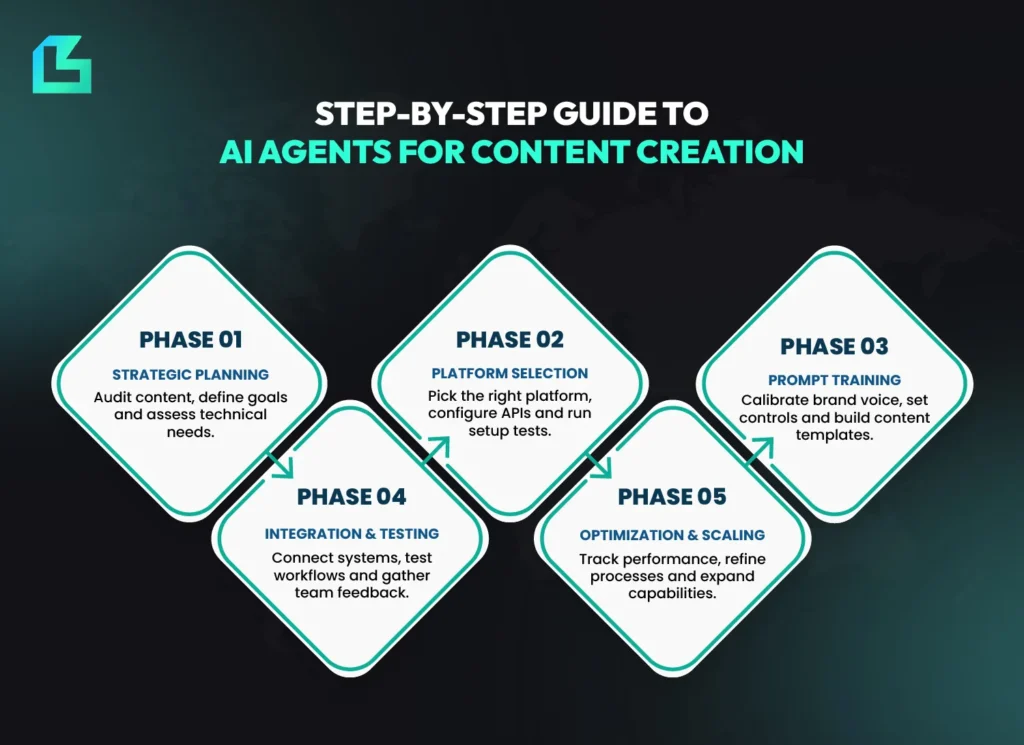
Adopting AI-driven content processes requires a structured strategy to ensure stability. A phased implementation model allows your team to mitigate risks while demonstrating progress.
- Pilot Phase: Focus on low-risk projects like FAQs or updating legacy content to test the pipeline and establish credibility.
- Expansion: Integrate Answer Engine Optimization strategies across specific departments, using feedback loops to calibrate prompts.
- Institutionalization: Make AI a core component of daily operations, ensuring your knowledge base remains fresh and governance protocols are followed.
Scaling content for AI search is ultimately about people and processes. If you prioritize your team’s expertise alongside your tech stack, you will build a sustainable machine that earns trust from both AI models and human readers.
AEO/GEO
Want to learn more?
Contact us for direct consultation and support.